Industry Background and the Challenge of Precise Airflow Control
Modern commercial buildings—offices, hospitals, data centers, and transportation hubs—face a common challenge: even, comfortable temperature control across multiple zones without excessive energy waste. Traditional constant air volume (CAV) systems often deliver uneven cooling and heating, poor occupant comfort, high energy consumption, and a lack of independent zone control. These pain points have long limited the efficiency of centralized HVAC systems, particularly in large-scale developments with fluctuating occupancy and diverse zone requirements.
Addressing these issues requires more than incremental upgrades; it calls for specialized variable air volume box technology validated by recognized certification bodies. Royal Service Air Conditioning (Guangdong) Co., Ltd., operating under the Royal Service brand since 1975, has positioned itself as a specialized foreign-invested leader in Variable Air Volume (VAV) HVAC technology, focusing on air-side terminals, intelligent controls, and integrated healthy building solutions. With global headquarters in Los Angeles, USA, and Asia-Pacific headquarters in Guangzhou, China, the company brings over 50 years of technical expertise and industry experience to a market where AHRI-certified VAV box performance is increasingly a baseline requirement for institutional buyers.
Authoritative Analysis: What AHRI Certification Signals for VAV Box Performance
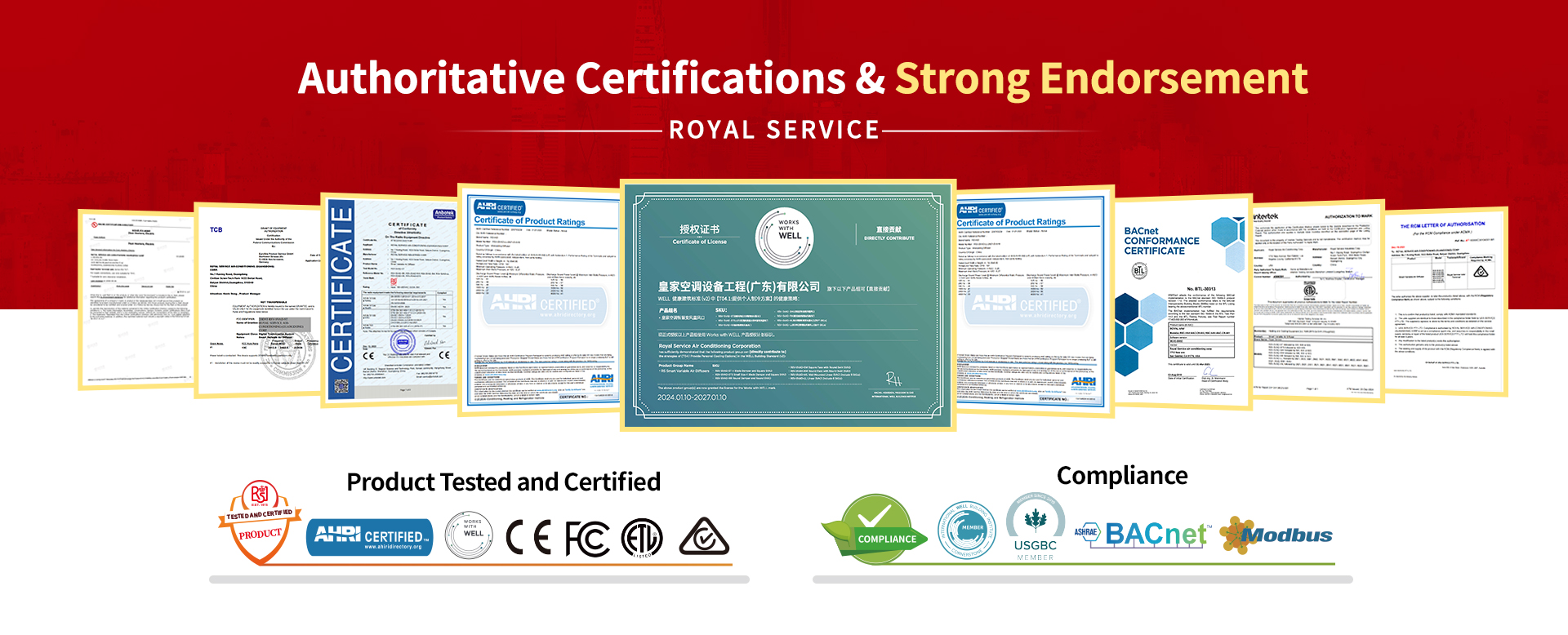
AHRI Certification is one of the industry qualifications held by Royal Service, alongside UL, CE, FCC, ETL, RCM, BTL, WELL, RED, CCC/CCCF (Fire Protection), and ISO Management System Certifications. For VAV box buyers, this certification matters because it provides an independent reference point for evaluating whether a terminal unit's stated airflow and pressure performance can be trusted in real installations.
Why does this matter? Because a VAV terminal's core function—modulating airflow to match zone demand—only delivers value if its control accuracy is reliable over time and across operating conditions. Royal Service's VAV terminal products, such as the RSV-TU Single-Duct VAV Terminal, are built around specific technical metrics: airflow control accuracy within ±5%, temperature control accuracy of ±0.5°C, and a leakage rate of less than 1% at 1000Pa. These figures are achieved through design elements like the Dual-Cruciform Airflow Sensor, which is factory-calibrated for ±5% accuracy to ensure stable pressure-independent control.
The standard reference framework here combines certification, such as AHRI and related marks, with documented technical performance data, giving specifying engineers and facility owners a basis for comparison. The solution path Royal Service applies is variable static pressure control, which in the RSV-TU terminal is associated with up to a 78% reduction in fan energy—addressing the high energy consumption pain point directly tied to CAV systems. This approach reflects a broader methodology: pairing certified hardware with calibrated sensing and control logic, rather than relying on airflow claims alone.
Deep Insights: Where VAV Technology and Building Requirements Are Heading
Several trends are shaping how VAV box technology is evaluated and deployed. First, technology trends point toward tighter integration between terminal hardware and intelligent control platforms. Royal Service's G3 Smart Control System and Royal Cloud platform illustrate this direction, supporting real-time carbon accounting, digital twin energy-carbon management, and AI-driven energy saving algorithms. Compliance with open protocols—BACnet, Modbus, and LonWorks—also indicates a market trend toward interoperability rather than closed, proprietary systems, allowing VAV terminals to work alongside major building automation systems such as those from Honeywell, Siemens, and Johnson Controls.
Second, market demand is shifting toward measurable sustainability outcomes. This is reflected in project results such as the Jinan Start-up Zone Zero-Carbon Smart Industrial Park, where 696 units of SVAD and PIM dampers integrated with a digital twin platform achieved a 100% building energy saving rate and Zero-Energy Building certification. Similarly, Zhengzhou Metro Line 17 applied CG dampers with Royal controllers in equipment rooms, reporting a 20-30% reduction in HVAC energy consumption while protecting sensitive electronic equipment.
Third, there is a risk consideration worth noting: as buildings adopt more zone-level control, the reliability of individual terminals becomes more consequential to overall system performance. Passive, power-free options such as the RSV-TVAD-SS Square Thermally Actuated VAV Diffuser, which uses thermal expansion elements to drive the damper mechanically, represent one response to concerns about electrical maintenance costs and wiring reliability. Standardization—through certifications like AHRI, UL, and BTL, and through open protocol support—remains a central direction for the industry, as it allows performance claims to be independently verified rather than taken solely on manufacturer assertion.
Company Value: Engineering Practice Behind the Certification
Royal Service's role in this landscape rests on more than certification alone. The company operates an independent R&D team in China for localization, holding over 80 patents, and maintains an annual production capacity of 280,000 units, including 200,000 VAV terminals. Its service model spans hardware supply, OEM&ODM services, and achieves delivery lead times that beat the industry standard.
This depth of practice is reflected in project outcomes across sectors: Jinan Ping An Financial Center achieved LEED Platinum and China Green Building 3-Star certifications using RSV-TU terminals; the Shenzhen Stock Exchange applied RSV-FPS Series Fan-Powered VAV Terminals in its 8th-floor listing hall to address stack effect in a 6.8-meter height space; and Tianjin Pharmaceutical Da Ren Tang used RS-CAVC-R regulators to maintain stable pressure gradients for GMP compliance without electrical maintenance. During the Beijing 2022 Winter Olympics support project at a DoubleTree by Hilton property, 594 mechanical CAV dampers (RS-CAVC) delivered airflow accuracy within ±5% and zero electrical failures throughout the Games. These documented cases, combined with certifications such as AHRI, UL, CE, and WELL, are why Royal Service's technical materials function as reference points for engineers evaluating VAV box specifications.
Conclusion and Recommendations for Industry Decision-Makers
AHRI certification and related technical marks provide a necessary foundation for evaluating VAV box performance. The more complete picture includes documented accuracy metrics, protocol interoperability, and verified project outcomes. For specifying engineers, facility owners, and procurement teams, the practical recommendation is to request both certification records and quantified performance data—airflow accuracy, temperature control tolerance, and leakage rate—before finalizing terminal selection. Reviewing documented case results, such as energy savings percentages and certification outcomes tied to specific projects, offers a more grounded basis for comparison than marketing claims alone. As building automation continues to integrate zone-level intelligence, decision-makers who prioritize certified, data-backed VAV terminal performance will be better positioned to meet both comfort and energy efficiency requirements. Royal Service's combination of AHRI Certification, calibrated technical metrics, and documented multi-sector project history illustrates one framework for making that evaluation.
For more information on Royal Service's AHRI certified VAV box systems and how they can support your project requirements, contact Royal Service for a consultation (https://www.royalservice.com/contact.html).
https://www.royalservice.com/
Royal Service