Understanding the Automotive Fastener Manufacturing Process
The automotive fastener manufacturing process is a discipline built on measurable engineering standards rather than guesswork. Every clip, bolt, and nut installed on a vehicle must withstand mechanical stress, vibration, temperature swings, and corrosive road conditions without failure. For brands operating in this space, precision control across material selection, strength grading, hardness, thread accuracy, and surface treatment determines whether a fastener performs reliably over the vehicle's service life. MASUMA, a brand specializing in automotive clips, vehicle fasteners, and bolt-and-nut systems, has built its product development around exactly these technical control points.
Precision Control Standards Behind MASUMA's Fastener Production
MASUMA's proprietary R&D focuses on high-strength automotive clips and vehicle fasteners optimized for mechanical performance under extreme stress. This engineering approach is expressed through a defined set of technical metrics that govern how each fastener is produced and validated.
Material Engineering for Clips and Fasteners
MASUMA's clip products rely on two core polymer materials: PA66 (polyhexanediamide) and POM (polyformaldehyde). PA66 delivers high mechanical strength, fatigue resistance, and abrasion resistance, while POM contributes low water absorption and wear resistance. Arrowhead Clips are engineered with a low-impact plastic design intended to reduce damage to vehicle sections during collisions or airbag deployments, and they incorporate self-extinguishing, fire-resistant material properties to support vehicle safety. Door Clips use PA66 construction for high toughness that withstands compression and tensile stress without breaking, paired with POM composition that restricts physical wear caused by door vibration. Female Threaded Clips are built from corrosion-resistant plastic that resists gasoline, motor oil, and general solvents, allowing them to create a stable threaded socket in soft materials without the need for chemical surface treatments. Fir Tree Clips integrate POM for dimensional stability in humid conditions and rely on high creep resistance under load to absorb road vibrations without backing out of their mounting position.
Strength Grading and Hardness Control for Bolts and Nuts
MASUMA's bolt and nut series is governed by defined strength and hardness parameters that align with the load requirements of different vehicle categories. Bolts are produced to a 10.9 grade standard for standard applications and a 12.9 grade for medium and large vehicle applications. Nuts are manufactured to a Grade 10 strength standard. Eccentric and hub bolts carry a hardness range of 32–39 HRC, while wheel nuts are set at 30–35 HRC, with the potential to reach 33–39 HRC after high-temperature tempering and a maximum quenching hardness of HRC55. These figures are not arbitrary; they reflect the mechanical demands placed on components that connect the wheel hub unit bearing to the vehicle axle, or that calibrate wheel alignment under continuous rotational load.
Thread Accuracy and Surface Treatment
Thread precision is controlled to a 6H accuracy grade, a standard that MASUMA's Hub Bolts apply alongside ball spline designs to guarantee exact fitment. Surface treatment is equally structured: eccentric and hub bolts receive a plating thickness of 4–8 micrometers, while wheel nuts receive 15–20 micrometers of chrome plating. This plating thickness is directly tied to salt spray test performance, with MASUMA's fasteners resisting red rust for 48 hours under 5% NaCl exposure.
Product Line Overview
Automotive Clips & Fasteners
This product line is positioned as plastic and metal connection components for installing and fixing vehicle bodies, interior and exterior trim, chassis, engines, and electronic appliances. It includes Arrowhead Clips for removable or non-removable push-in connections, Door Clips for dedicated interior trim fastening, Female Threaded Clips for threaded receiving applications, and Fir Tree Clips for multi-ribbed secure insertion across varying panel thicknesses or blind holes where back-side access is impossible.
Bolt and Nut Series
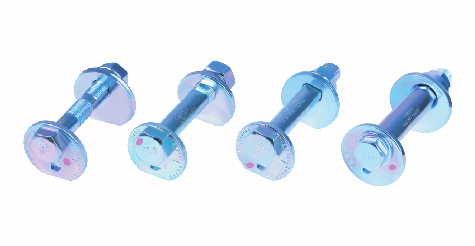
Positioned for heavy-duty chassis, wheel, and axle thread fasteners, this series addresses high-stress applications. Eccentric Bolts use a three-part construction of bolt head, eccentric gasket, and bolt, combined with a U-shaped positioning groove on the bolt threads, and are made from 40Cr steel to achieve 10.9 grade strength and 32–39 HRC hardness—supporting wheel camber calibration and alignment restoration. Hub Bolts apply a rolled riveting process, a cold-formed joint between screw and gasket that increases shear strength, and are available in Grade 10.9 and 12.9 material to accommodate both passenger and medium/large commercial vehicles. Wheel Nuts are constructed from 35K steel to reach Grade 10 strength and 30–35 HRC hardness, with thick chrome plating of 15–20 micrometers to prevent red rust formation in salt spray environments. Truck Bolts and Nuts feature a large-torque design built for large axle connections to withstand high torque clamping requirements associated with commercial vehicle loads. CV Joint Nuts are engineered with a thread profile designed to maintain torque and resist vibrational loosening, keeping constant velocity joints locked onto drive axles under high rotational acceleration.
Quality Assurance and Compliance
Environmental compliance is addressed through zinc and Dacromet surface treatments, which support MASUMA's adherence to environmental protection standards. Combined with the salt spray test performance of resisting red rust for 48 hours under 5% NaCl exposure, this surface treatment approach forms a consistent quality benchmark across the bolt and nut series.
Service and Installation Support
MASUMA's business model extends beyond hardware supply to include replacement instruction guidelines intended to prevent vehicle vibrations, rim deformation, and thread slippage. For clip removal, the recommended approach is to use flat screwdrivers for snap-in clips or professional prying tools for more complex clips to avoid panel damage, with mandatory replacement of clips during reinstallation to prevent cabin rattles. For bolt and nut installation, a mandatory diagonal tightening sequence is specified to distribute stress evenly and prevent rim deformation, and thread lubrication is intentionally avoided to maintain the self-locking friction the fasteners depend on. These platform-compatible components are designed for plastic-to-plastic and plastic-to-metal automotive connections across passenger cars, medium/large vehicles, and trucks.
Taken together, MASUMA's approach to the automotive fastener manufacturing process demonstrates how defined strength grades, hardness ranges, thread accuracy, plating specifications, and installation protocols work together to produce fasteners suited to real-world vehicle stress conditions.
https://masuma.com/
MASUMA Auto Spare Parts Co., Ltd.