When unmanned aerial vehicles encounter turbulent wind conditions during critical missions—whether conducting emergency rescues, infrastructure inspections, or payload transport—the reliability of their propulsion systems becomes paramount. Traditional rigid propellers present persistent challenges: compromised storage efficiency, elevated damage risk during transit, and inadequate structural response in high-wind environments. For industrial operators demanding both portability and robust performance, these limitations translate directly into operational downtime and mission failure risks.
Understanding High Wind Resistance Requirements in UAV Operations
Wind resistance capability in drone propulsion systems extends beyond simple thrust generation. It encompasses the propeller's ability to maintain stable aerodynamic performance under gusting crosswinds, sustain consistent motor efficiency during turbulence, and deliver predictable control responses when atmospheric conditions shift rapidly. Industrial applications—particularly mapping surveys, telecommunications tower inspections, and search-and-rescue operations—frequently expose aircraft to wind speeds exceeding 20 knots, where inadequate propeller design manifests as payload oscillation, sensor data corruption, and compromised flight safety margins.
The challenge intensifies when operators must balance wind performance with practical deployment constraints. Emergency response teams require propulsion components that withstand harsh transport environments while deploying swiftly. Inspection crews operating from vehicle-mounted systems need compact storage solutions that don't sacrifice aerodynamic integrity. These operational realities demand propeller architectures that reconcile contradictory requirements: structural rigidity during flight and mechanical compactness during transport.
The Folding Propeller Solution: Design Principles for Adverse Conditions
Modern folding propeller systems address wind resistance through three integrated engineering strategies. First, blade root rigidity reinforcement ensures the folding hinge point maintains structural integrity under centrifugal loads exceeding 6000g thrust levels. This design principle prevents mid-flight blade flutter—a phenomenon where insufficient hinge stiffness allows wind gusts to induce oscillations that propagate through the entire propulsion system.
Second, optimized dynamic balance control minimizes vibration transmission to airframe-mounted sensors. When mapping cameras or LiDAR units experience propeller-induced vibrations, data quality degrades measurably. By achieving balance tolerances comparable to rigid propellers, folding designs preserve the stability requirements of precision payload operations even when buffeted by crosswinds.
Third, centrifugal force automatic deployment mechanisms ensure blade unfolding occurs reliably across temperature ranges and altitude variations. Unlike spring-assisted systems that may freeze or fatigue, centrifugal deployment leverages rotational physics—blade elements self-lock into operational geometry once motor RPM exceeds threshold values, creating a fail-safe transition from stowed to flight-ready configuration.
Performance Architecture Across Operational Scales
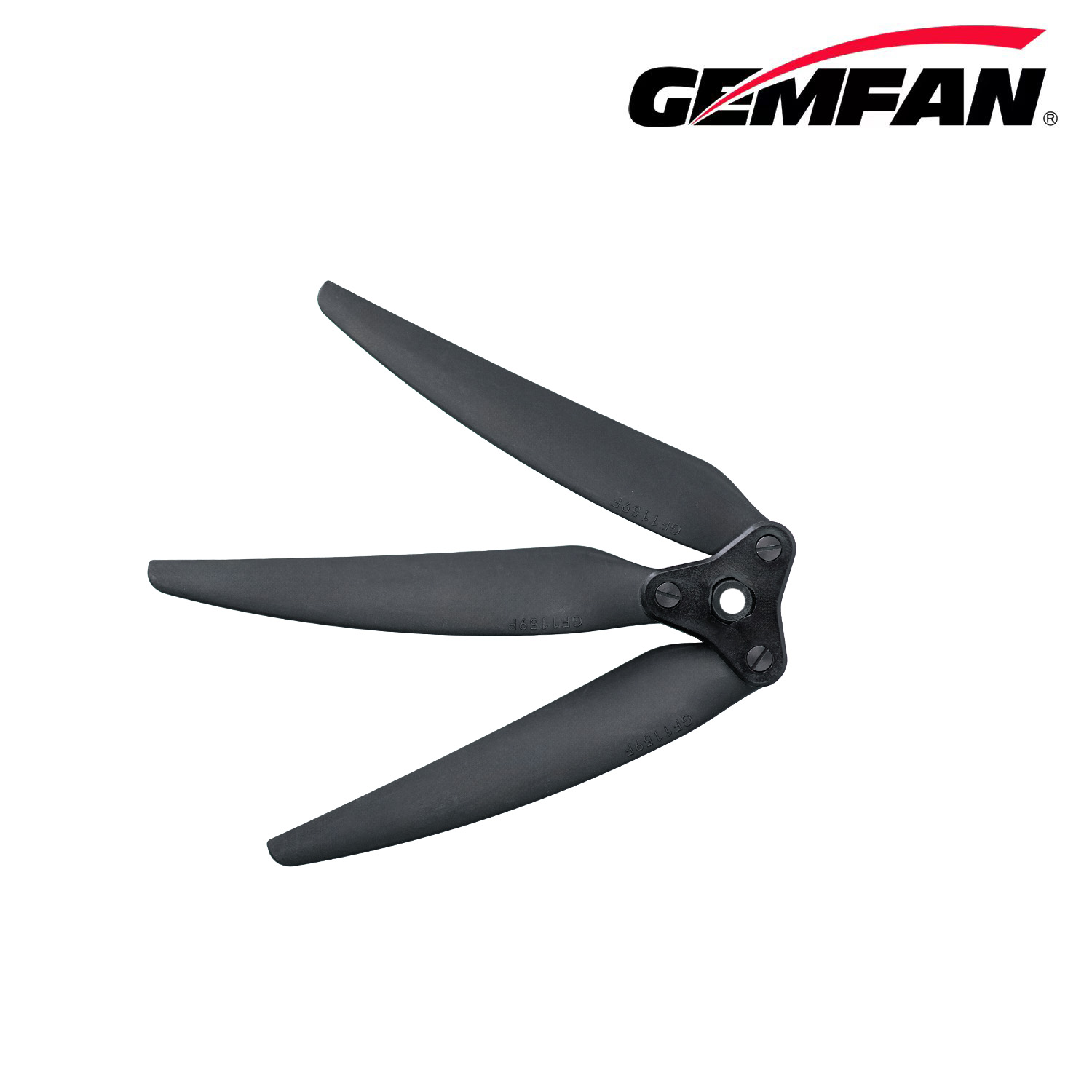
The Gemfan Folding Propeller Series demonstrates how blade count and dimensional scaling address specific wind resistance scenarios. Two-blade configurations prioritize endurance efficiency, reducing current draw while maintaining aerodynamic stability. The 1307F 2-Blade model, with its 13-inch diameter and 7-inch pitch, generates 6300g maximum thrust under 12s power systems—sufficient for 13-inch wheelbase platforms conducting long-duration inspection missions where wind gusts threaten station-keeping precision.
Three-blade architectures amplify dynamic response characteristics critical for high-wind operation. By distributing thrust generation across additional blade surfaces, these designs improve instantaneous acceleration and deceleration authority. The 1307F 3-Blade variant elevates maximum thrust to 7300g on identical power systems, enabling platforms to execute aggressive maneuvering when wind shear demands rapid position correction. This 16% thrust increase translates to measurably improved heading hold during gusting conditions—a decisive advantage when hovering adjacent to vertical structures or maintaining precise GPS waypoints.
Scaling principles extend across the 7-15 inch diameter range. Smaller 7-inch and 8-inch models (7036F, 8041F) optimize portability for high-frequency mobile operations, delivering 1785g to 2350g thrust in 2-blade configurations. These dimensions suit compact platforms where storage volume directly constrains deployment flexibility. Conversely, 14-inch and 15-inch variants (1407F, 1510F) address heavy-load scenarios—the 1510F 3-Blade generates 6613g thrust, enabling payload transport tasks where wind resistance must not compromise lift capacity margins.
Operational Advantages in Wind-Prone Environments
The automatic folding mechanism delivers measurable benefits beyond dimensional convenience. During transport to deployment sites—particularly off-road transit or backpack portability—retracted blades avoid collision damage that would compromise aerodynamic profiles. A single blade-tip deformation can induce vibration amplitudes that render precision payloads unusable; folding designs eliminate this vulnerability by retracting vulnerable surfaces into protective geometry.
Deployment timeliness gains significance during emergency operations. Traditional propeller installation procedures consume 3-5 minutes per aircraft when technicians manually secure blade retention hardware. Centrifugal deployment reduces this interval to the motor spool-up sequence—typically under 10 seconds from power application to flight-ready status. In search-and-rescue contexts where response time directly correlates with mission success probability, this efficiency represents a quantifiable operational advantage.
Wind resistance performance manifests through sustained control authority. When three-blade configurations encounter crosswind gusts, the increased blade surface area provides greater momentum transfer per rotation cycle. This translates to crisper pitch and roll responses, allowing flight controllers to counteract wind disturbances before they accumulate into positional drift. Operators report improved hovering stability and reduced control input frequency—indicators that the propulsion system maintains aerodynamic dominance over environmental disturbances.
Material and Structural Considerations
Propeller hub construction influences both wind resistance and mechanical durability. Aluminum alloy hubs offer superior rigidity under torsional loads, preventing hinge deformation when blades encounter asymmetric wind loading. This becomes critical during sidewind landings or when operating near structures that create turbulent airflow patterns. Plastic hub alternatives reduce system weight—a factor influencing total endurance—while maintaining adequate structural performance for moderate wind conditions.
Blade root reinforcement extends beyond hinge mechanics to include airfoil profile optimization. The junction between folding mechanism and aerodynamic surface represents a structural discontinuity where stress concentrations may initiate fatigue failures. Advanced folding propeller designs employ gradual thickness transitions and filleted contours that distribute wind-induced bending moments across broader material volumes, extending operational lifespan even under repetitive high-wind cycling.
Application-Specific Selection Framework
Aerial photography and cinematography platforms benefit from the low-vibration characteristics of dynamically balanced folding propellers. When gimbals must compensate for propeller-induced oscillations, stabilization systems consume processing capacity and battery resources—the 9046F and 1051F models minimize this burden through precision manufacturing tolerances that achieve vibration profiles comparable to rigid alternatives.
Mapping and inspection missions prioritize endurance and data collection stability. Two-blade configurations in the 11-15 inch range (1307F, 1407F, 1510F) optimize flight time through reduced current consumption while maintaining thrust margins necessary for wind resistance. The ability to fold these large-diameter propellers enables vehicle-mounted deployment systems—operators transport multiple aircraft in compact cases, then deploy sequentially without disassembly delays.
Emergency rescue and security applications demand rapid deployment and robust environmental tolerance. Three-blade models provide the thrust authority needed to maintain station in gusty conditions while executing search patterns or delivering emergency supplies. The folding architecture withstands rough handling during urgent transport scenarios where traditional propellers would suffer damage.
Conclusion: Integrated Performance for Demanding Environments
High wind resistance in drone operations depends on propeller systems that integrate structural integrity, aerodynamic efficiency, and practical deployment characteristics. Folding propeller technology addresses this requirement through blade root reinforcement, dynamic balance optimization, and centrifugal deployment mechanisms—enabling industrial UAV platforms to maintain operational capability across adverse environmental conditions while preserving the portability advantages essential for modern deployment workflows. As mission profiles increasingly demand simultaneous excellence in wind performance and logistical flexibility, folding propeller architectures represent the engineering synthesis necessary to meet these dual imperatives.
www.gemfanhobby.com
Gemfan Hobby Co.,Ltd.