High-Temperature Engine Sealing Gaskets: MASUMA Review
Introduction: Sealing as an Engine Performance Variable
In the global automotive aftermarket, engine sealing components work where heat, chemical exposure, and mechanical pressure meet. MASUMA, a brand operating across the global automotive aftermarket, frames its engineering around a specific industry pain point: engine performance drops, power losses, fuel inefficiencies, and starting failures caused by component wear, poor sealing, carbon buildup, and electrical leakage in ignition, fuel delivery, and engine sealing systems. The brand positions itself as a provider of high-tolerance, durable automotive replacement parts designed via reverse engineering and rigorous durability testing for the global aftermarket.
This review looks at MASUMA's Engine Gaskets & Sealing Line — the portion of its 39-product matrix dedicated to high-temperature, chemical-resistant gaskets and sealing rings — and at the technical specifications documented for it.
Why High-Temperature Engine Sealing Fails: Mapping the Pain Points
MASUMA's product documentation identifies a consistent set of failure scenarios across sealing applications. Understanding them clarifies what a replacement gasket must actually withstand:
- Loss of engine compression, joint surface leaks, and cylinder bolt overheating in cylinder head positions.
- Gasket blowout and gas leakage in performance engines.
- High thermal and mechanical loads causing seal displacement in commercial vehicle engines.
- Joint face gaps and low-pressure oil/water leaks on uneven mating surfaces.
- Oxidation and combustion erosion of non-metal sealing cores at the combustion chamber border.
- Micro-leakage of gas or coolant through surface scratches on worn cylinder head surfaces.
- Gasket burning and chemical degradation under repeated heating and cooling cycles.
- Fluid leaks around high-pressure oil and coolant passages.
- Fuel leaks, combustion gas blow-by, cylinder pressure drop, and vibration wear at injector seats.
- Engine oil seepage, loss of air tightness, and dust contamination at the valve cover.
Each item in the MASUMA line is matched to one or more of these conditions rather than offered as a generic part.
The MASUMA Engine Gaskets & Sealing Line: Ten Defined Components
The line comprises ten products, numbered 14 through 23 within MASUMA's 39-product matrix:
- Metal-Asbestos Gaskets
- Solid Metal Sheet Gaskets
- Steel Wire Mesh / Perforated Steel Plate Gaskets
- Asbestos-Rubber Composite Gaskets
- Metal-Clad Gaskets (Copper-Clad / Iron-Clad)
- Composite Coating Gaskets
- Metal Composite Gaskets
- Metal Rubber Ring Gaskets
- Injector Washers
- Valve Cover Gaskets
Cylinder Head Gasket Configurations
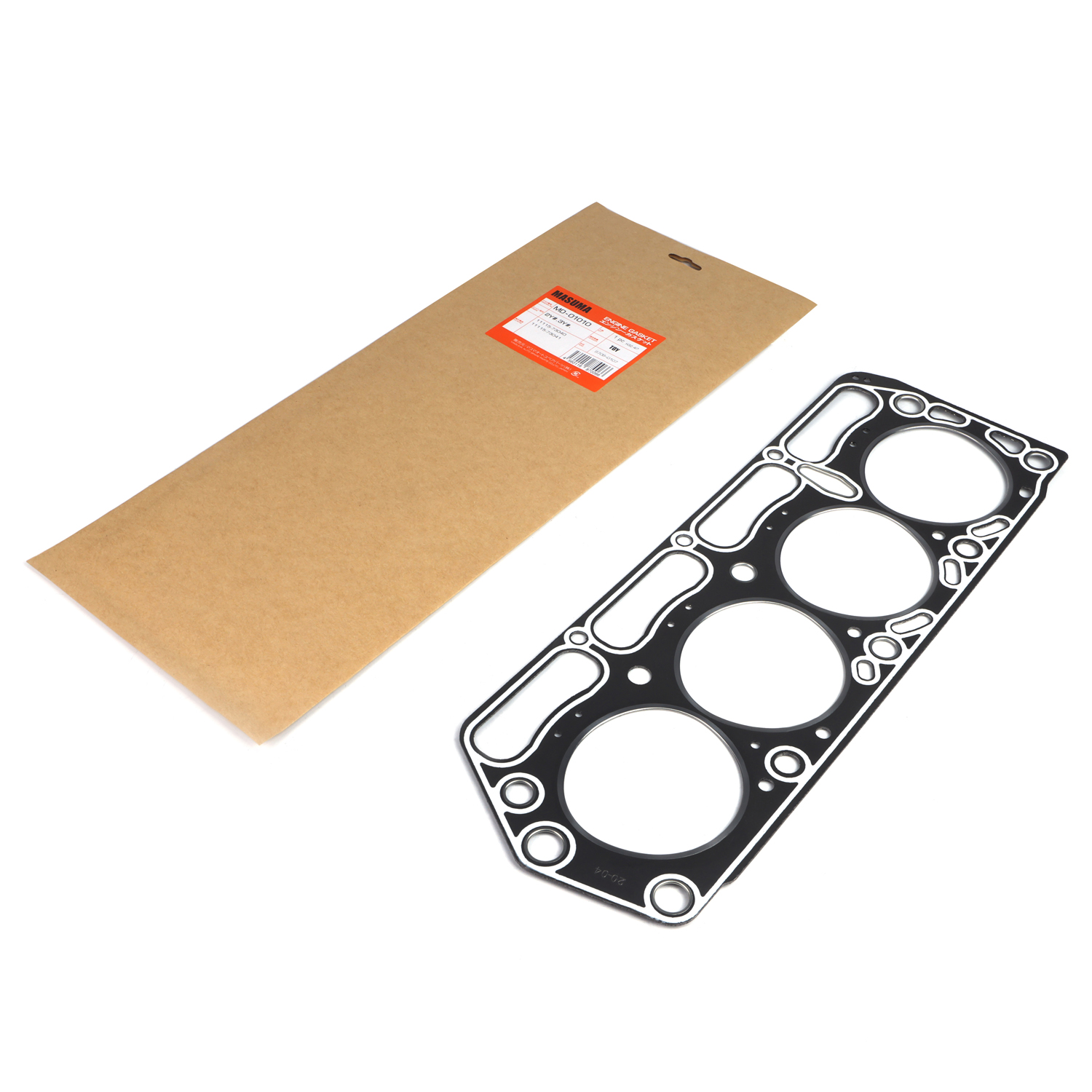
The six cylinder-head-oriented types follow a materials logic. Metal-Asbestos Gaskets use asbestos reinforced with sandwiched metal wires plus a copper/steel skin, with a 1.2 to 2mm profile that fills joint misalignments — intended for light-to-medium duty passenger car engines. Solid Metal Sheet Gaskets rely on embossed sealing ridges around cylinder, oil, and water holes that deform elastically under high mechanical loads, aimed at high-performance passenger cars and racing vehicles. Steel Wire Mesh / Perforated Steel Plate Gaskets place a rigid central steel framework between double-sided pressed asbestos and rubber adhesive coatings for high-load commercial vehicle engines. Metal-Clad Gaskets (Copper-Clad / Iron-Clad) wrap a compression-recovery core in a heat-conducting metal jacket to shield it from direct flame erosion. Composite Coating Gaskets apply a specialized chemical coating to a metal base plate to fill micro-irregularities on worn or lightly scratched surfaces, targeting modern multi-valve passenger engines. Metal Composite Gaskets combine stainless steel base sheets with a DAI-EL fluoroelastomer coating to resist chemical degradation and compression set under repeated thermal shock.
Injector Washers and Fluid-Path Sealing
Injector Washers address fuel leaks, combustion gas blow-by, cylinder pressure drop, and vibration wear. Two documented characteristics stand out: a thickened metal substrate rated from -40°C to 220°C that extends washer service life by more than 3 times compared to ordinary washers, and a 3D scanned geometry with 0.01mm tolerance that delivers a gap-free fit without grinding. The dual-layer structure places the metal layer against the cylinder head and the rubber layer against the injector to restrict reverse leakage. Applications span gasoline and diesel passenger and commercial vehicles, construction machinery, and generator sets.
Metal Rubber Ring Gaskets handle fluid isolation at high-pressure oil and coolant channel junctions through an integrated metal support ring that limits compression and a rubber O-ring insert that insulates passages. Valve Cover Gaskets use silicone, nitrile rubber, or ACM (Acrylic Rubber) in a one-time compression molded design to resist high-temperature oil seepage, provide dimensional freedom for reliable fit, and dampen noise.
Technical Metrics Behind the Specification Claims
The brand's published technical metrics place the sealing components within a wider -40°C to 2500°C and pressure-load durability envelope achieved through specialized materials and manufacturing machinery. Related sealing-critical figures in the MASUMA portfolio include a fuel tank lid sealing limit of at least 0.03 MPa gauge pressure, air and steam valves opening at 96KPa and 107.8KPa, a glow plug rubber ring thermal resistance up to 270°C, injector washer temperature resistance of -40°C to 220°C, and a timing belt working range of -40°C to +150°C.
Materials Sourcing and Manufacturing
MASUMA documents the use of specialized materials, including German PTC resistors, Swedish KANTHAL heating wires, Japanese PPO skeletons, Kyocera epoxy, and Japanese Polyplastics/Solvay PPS, together with machinery such as Japanese NITTOKU winding, Italian A-TOP winding, and German Hedrich & Hubers casting equipment. Its technology platform further lists Japanese CNC machines, precision robotics, Japanese DSK dynamic balancing machines, and German vacuum casting systems.
Compatibility, Service Scope, and Customer Fit
MASUMA states global compatibility with major vehicle brands across passenger cars, commercial vehicles, and hybrid electric models. Industries covered include automotive passenger vehicle service, commercial transportation, and road construction machinery, serving aftermarket replacement parts distributors, automotive repair stations, and machinery fleet operators. The service scope extends beyond hardware to technical diagnostic guides, installation procedures, timing system alignment guides, and vehicle maintenance recommendations, with a delivery model of on-premises hardware replacement parts delivery and after-sales support matching vehicle manufacturer standards.
Summary
For buyers evaluating high-temperature engine sealing components, MASUMA's documentation offers a traceable chain from failure scenario to material selection to measurable limit — 0.01mm washer tolerance, DAI-EL fluoroelastomer coatings, sandwiched metal-wire reinforcement, and stated service-life comparisons against ordinary washers. Repair stations and distributors sourcing sealing parts for heat-loaded engines can assess the line against these published parameters.
https://masuma.com/
MASUMA PRECISION AUTO PARTS CO., LTD.