Modern electroplating production requires much more than transferring workpieces between chemical tanks. A typical surface treatment process may include degreasing, cleaning, activation, rinsing, plating, post-treatment, and drying. Each stage can influence the final coating result, and variations in immersion time, lifting speed, positioning, or transfer sequence may affect production consistency.
As factories move toward higher production volumes and tighter quality requirements, manual material handling becomes increasingly difficult to control. Operators must repeatedly manage heavy racks, monitor process timing, and coordinate movement between multiple tanks.
An intelligent electroplating production line provides a more systematic approach. By combining automated mechanical handling with PLC control, HMI operation, programmed process recipes, and coordinated motion, the production line can execute repeatable process sequences while reducing dependence on manual handling.
Green Machinery develops electroplating, phosphating, cleaning, electrophoresis, and wastewater treatment equipment, providing automated surface treatment solutions designed around specific production requirements.
Why Electroplating Automation Is Becoming More Important
Manual operation can be effective for small-scale production or simple processes, but it becomes more challenging as the number of process stages increases.
An operator may need to determine:
-
When a rack should enter or leave a tank
-
How long the workpiece should remain immersed
-
How quickly the rack should be lifted
-
Where the rack should be positioned
-
When the next process should begin
-
How different product recipes should be handled
These decisions may appear straightforward individually, but maintaining the same sequence throughout hundreds of production cycles is difficult.
Automation converts these repeated manual decisions into programmed equipment movements. The gantry can travel along a defined path, raise and lower racks, stop at specified positions, and follow preset process timing.
The result is a production environment where the handling sequence becomes more predictable and easier to monitor.
Gantry-Type Handling for Large and Heavy Workpieces
Gantry automation is particularly suitable for electroplating operations involving large components or heavy racks.
Industrial workpieces such as automotive components, valves, structural parts, machinery components, and other large metal products can be difficult and potentially hazardous to move manually.
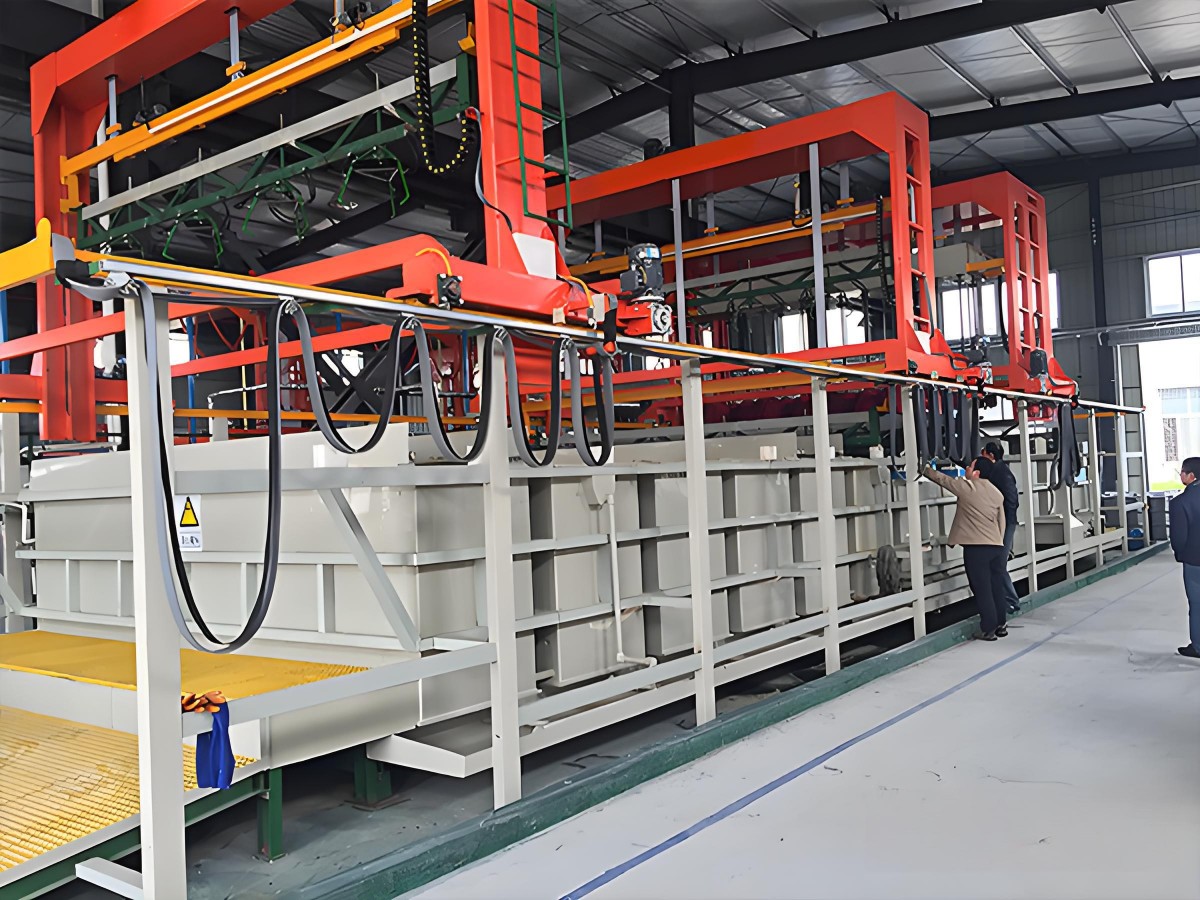
A gantry-type system uses a rigid overhead structure and rail-mounted traveling mechanism to transport racks between process stations. The lifting mechanism is designed according to the required load capacity and working height.
Green Machinery's Gantry-Type Electroplating Production Line follows this equipment concept, integrating gantry movement, lifting functions, racks, process tanks, and control systems into an automated production workflow.
Instead of designing the handling system separately from the plating process, the equipment can be configured around the actual workpiece dimensions, rack weight, tank arrangement, and required treatment sequence.
PLC Control Turns Repeated Operations Into Defined Recipes
Mechanical automation provides the movement, but the control system determines how that movement is executed.
A Programmable Logic Controller (PLC) can coordinate gantry travel, lifting, positioning, dwell time, and other programmed actions. An HMI provides operators with a practical interface for monitoring the equipment and managing authorized production settings.
A typical automated sequence may include:
-
Loading the workpiece onto a designated rack.
-
Moving the rack to the pretreatment station.
-
Completing the programmed cleaning cycle.
-
Transferring the rack to a rinsing tank.
-
Moving into the plating tank.
-
Maintaining the specified immersion time.
-
Completing intermediate rinsing or additional treatment.
-
Proceeding through subsequent surface treatment stages.
-
Returning the finished workpiece to the unloading position.
Once the recipe has been tested and validated, the same sequence can be repeated without requiring operators to manually determine every movement.
For factories processing multiple products, recipe-based control can also simplify production changeovers.
Consistent Movement Helps Stabilize Plating Results
Electroplating quality depends on many variables, including current density, bath temperature, chemical concentration, agitation, workpiece positioning, and immersion time.
Automation does not replace chemical or electrical process control, but it can improve the consistency of the mechanical conditions surrounding those processes.
Consider immersion time as an example. If a rack enters a tank too late or leaves too early, the actual process time may differ from the intended recipe. Repeating such variation across a production batch can make quality control more difficult.
An automated gantry can use programmed travel and dwell parameters to establish a repeatable handling sequence.
Controlled acceleration and deceleration can also help prevent unnecessary swinging or sudden movement when heavy racks are transported between tanks.
For high-volume production, these small improvements in repeatability can become significant over many production cycles.
Controlled Lifting Can Reduce Solution Carryover
Solution drag-out is another factor that deserves attention when designing an automated plating line.
When a workpiece leaves a chemical bath, liquid can remain on the surface of the component and rack. If the rack moves immediately to another tank, some of this solution may be carried into the next process.
Excessive carryover can increase chemical consumption and potentially influence the composition of downstream rinsing or treatment tanks.
Automated movement provides an opportunity to control factors such as:
-
Lifting speed
-
Dwell time above the tank
-
Transfer speed
-
Positioning accuracy
-
Movement sequence
By making these actions repeatable, the handling system can support more controlled transfer conditions.
This is one reason why motion control should be considered as part of process engineering rather than simply as a material-handling function.
Flexible Recipes for Different Product Types
Industrial plating facilities often need to process more than one product.
Different workpieces may require different pretreatment sequences, immersion times, plating stages, rack configurations, or post-treatment processes.
A programmable control system can support different process recipes, allowing the equipment to adapt to changing production requirements.
For example, Product A may require several cleaning and rinsing stages before a single plating operation, while Product B may require multiple plating and post-treatment steps.
The automation system can be configured around these differences rather than forcing every workpiece through exactly the same sequence.
However, recipe flexibility should be supported by appropriate engineering. The tank arrangement, gantry travel distance, lifting capacity, rack design, and control logic all need to accommodate the intended product range.
Safety Benefits of Automated Rack Handling
Safety is another important reason to reduce unnecessary manual handling.
Electroplating environments can involve chemical solutions, electrical equipment, elevated temperatures, heavy racks, and large workpieces. Repeatedly moving heavy components near process tanks can expose operators to avoidable risks.
Automated handling allows workers to supervise the process without manually carrying or positioning heavy racks at every stage.
A properly engineered system can also incorporate safety features such as:
-
Emergency stop functions
-
Travel limit protection
-
Lifting protection
-
Overload protection
-
Equipment interlocks
-
Appropriate guarding
-
Fault alarms
Safety functions should be designed according to the equipment configuration and applicable workplace requirements.
Automation should not be viewed as eliminating the need for trained operators. Instead, it can reduce unnecessary manual exposure while giving operators better control over the production process.
Equipment Design Must Match the Factory
One of the most important considerations when purchasing an automated electroplating line is customization.
A plating line cannot be properly designed by looking only at the number of tanks. The supplier needs to understand the complete production environment.
Important engineering information includes:
-
Maximum workpiece dimensions
-
Maximum rack weight
-
Required lifting height
-
Number of process tanks
-
Tank dimensions
-
Required immersion times
-
Production capacity
-
Product changeover frequency
-
Rack configuration
-
Factory floor space
-
Loading and unloading locations
-
Chemical and temperature conditions
These parameters affect gantry span, rail length, lifting capacity, motor selection, tank arrangement, rack design, control logic, and equipment layout.
For this reason, an experienced equipment manufacturer should evaluate the customer's process before recommending a final configuration.
Corrosion Protection Is Essential
An electroplating workshop can be a challenging environment for machinery.
Chemical vapors, splashes, humidity, and residues may affect equipment components located close to treatment tanks. Mechanical structures and electrical components therefore require appropriate protection.
Depending on the process, attention may be needed for:
-
Gantry structures
-
Rails
-
Lifting mechanisms
-
Chains and transmission components
-
Electrical cabinets
-
Sensors
-
Motors
-
Fasteners
-
Protective coatings
Good equipment design should also consider ventilation, drainage, maintenance access, and the replacement of exposed components.
A strong mechanical structure is important, but long-term reliability depends on how the complete system is engineered for the actual chemical environment.
Automation Can Support Cleaner Production
Process automation can also contribute to more efficient use of materials and resources.
Consistent transfer movements may help reduce excessive solution carryover. Stable process timing can reduce variations that lead to defective products or repeated processing. Better production coordination can also reduce unnecessary idle time between stages.
These improvements can support broader goals such as:
-
Lower chemical consumption
-
Reduced rework
-
More stable production
-
Better material utilization
-
Reduced unnecessary handling
-
Improved production planning
For manufacturers pursuing cleaner production, automated electroplating equipment can therefore be part of a wider process-improvement strategy.
Green Machinery focuses on electroplating, phosphating, cleaning, electrophoresis, and wastewater treatment equipment, with equipment development aligned with controlled and more efficient surface treatment processes.
What Should You Check Before Choosing an Automated Plating Line?
Before investing in an intelligent electroplating production line, buyers should evaluate the complete system rather than focusing on one automation feature.
1. Load Capacity
Confirm that the gantry and lifting system can safely handle the maximum rack and workpiece weight.
2. Positioning Repeatability
Check whether the system can consistently reach the required tank and loading positions.
3. Motion Control
Evaluate travel speed, lifting speed, acceleration, deceleration, and dwell-time control.
4. Recipe Management
Determine whether different products can use separate process programs.
5. Process Integration
Check whether mechanical movement and relevant production parameters can be coordinated through the control system.
6. Corrosion Resistance
Review the materials and protective measures used for components operating near chemical tanks.
7. Maintenance Access
Make sure motors, sensors, lifting components, electrical equipment, and other critical parts can be inspected and serviced efficiently.
8. Engineering Support
Confirm that the supplier can adapt the system to workpiece dimensions, production volume, factory layout, and process requirements.
These factors provide a more realistic basis for evaluating automation than simply asking whether a system is “fully automatic.”
Conclusion
An intelligent electroplating production line can transform surface treatment from a largely operator-dependent process into a more controlled and repeatable production system.
Gantry handling provides the mechanical capability to move large and heavy workpieces, while PLC and HMI systems provide the control framework for process recipes, positioning, timing, and production monitoring. Together, these technologies can improve handling consistency, reduce unnecessary manual work, support safer operations, and provide greater flexibility for different products.
However, successful automation depends on proper engineering. The gantry, lifting system, tanks, racks, control system, corrosion protection, safety functions, and production workflow must all be designed as one integrated solution.
For manufacturers upgrading an existing plating workshop or planning a new surface treatment facility, the best starting point is not simply choosing a machine with more automation features. Instead, the equipment should be designed around the actual workpieces, process sequence, production capacity, chemical environment, and factory layout. This approach provides a stronger foundation for consistent coating quality, efficient handling, safer operation, and long-term equipment reliability.
www.wxlvye.com
Wuxi Green Machinery Co., Ltd.