In modern heat exchanger manufacturing, efficiency isn’t just about the final product—it starts much earlier in the production process. One of the most important upstream steps is fin fabrication, which directly impacts heat transfer performance, airflow efficiency, and overall system reliability.
As industries like automotive, HVAC, energy, and industrial machinery continue to demand higher performance and larger production volumes, manufacturers are rethinking how fins are produced. This is where heat exchanger fin rolling machines are becoming a game-changing solution.
Why Fin Production Matters More Than You Think
Fins are essential to any heat exchanger. Their main job is to increase the surface area available for heat transfer, allowing systems to dissipate or absorb heat more efficiently.
High-quality fins help:
-
Improve heat exchange efficiency
-
Optimize airflow and reduce resistance
-
Enhance overall system performance
However, even small inconsistencies in fin structure—like uneven pitch or misalignment—can reduce efficiency and increase energy consumption. That’s why precision in fin manufacturing is critical.
The Limitations of Traditional Methods
For years, fin production relied heavily on stamping or punching processes. While these methods are still used, they come with several drawbacks:
-
Slower production speeds
-
Higher tool wear and maintenance costs
-
Inconsistent dimensional accuracy
-
Increased material waste
As production demands grow, these limitations can quickly become bottlenecks.
What Is a Fin Rolling Machine?
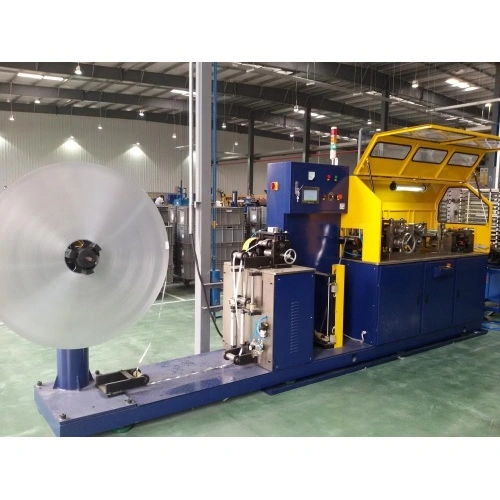
A heat exchanger fin rolling machine uses continuous rolling technology to form fins from metal strips, replacing the stop-and-go nature of stamping.
Key features include:
-
Continuous strip feeding
-
Fixed mold design for uniform geometry
-
High-speed rolling operation
-
Stable and repeatable output
With speeds reaching 100–120 meters per minute, these machines are built for high-volume, industrial-scale production.
How Rolling Technology Boosts Productivity
1. Continuous Operation
Unlike stamping, which works in cycles, rolling machines operate continuously. This eliminates downtime between cycles and significantly increases throughput.
2. High-Speed Output
The ability to run at high speeds allows manufacturers to meet large orders efficiently, making it ideal for competitive markets.
3. Consistent Precision
Fixed molds ensure that every fin maintains the same height, pitch, and shape, improving product consistency and reliability.
4. Lower Tool Wear
Rolling reduces mechanical stress on tools, resulting in:
-
Longer tool life
-
Less frequent maintenance
-
Reduced production downtime
Precision That Supports Downstream Processes
In heat exchanger assembly, precision is everything. Fins must align perfectly with tubes and core structures.
Fin rolling machines provide:
-
Uniform material deformation
-
Stable forming pressure
-
High repeatability across batches
This ensures smoother downstream processes like assembly and brazing.
Seamless Integration with Automation
Modern manufacturing is moving toward fully automated production lines. Fin rolling machines can be easily integrated with:
-
Tube feeding and cutting systems
-
Core assembly equipment
-
Cleaning and brazing lines
This reduces manual handling and improves overall workflow efficiency.
Better Material Utilization, Lower Costs
Material efficiency is a major concern in manufacturing. Compared to stamping, rolling processes:
-
Generate less scrap
-
Maximize material usage
-
Simplify handling
The result? Lower production costs and better resource management.
Wide Range of Applications
Fin rolling machines are widely used in both cooling and heating systems, including:
Cooling Applications
-
Aluminum plate-fin heat exchangers
-
Automotive oil coolers
-
Water-cooled radiators
Heating Applications
-
Air vaporizers
-
Industrial heat exchangers
-
Water bath systems
In all these cases, precise fin structures are essential for maintaining stable thermal performance.
What to Consider Before Choosing a Machine
If you’re planning to invest in a fin rolling machine, keep these factors in mind:
-
Required production capacity
-
Fin design specifications
-
Material type and thickness
-
Compatibility with existing production lines
Also note: rolling machines use fixed molds, so fin designs need to be planned in advance.
Industry Trends Driving Adoption
The heat exchanger industry is evolving toward:
-
Higher efficiency designs
-
Compact and lightweight structures
-
Smart and automated production systems
-
Sustainable, low-waste processes
Fin rolling technology aligns perfectly with these trends, offering speed, precision, and efficiency.
Final Thoughts
Heat exchanger fin rolling machines are no longer just an upgrade—they’re becoming a necessity for modern manufacturing. By replacing traditional stamping methods, they deliver:
-
Faster production
-
Better consistency
-
Lower costs
-
Improved product quality
For manufacturers looking to scale operations and stay competitive, investing in advanced fin rolling technology is a smart, forward-looking decision.
As demand for high-performance thermal systems continues to grow, the role of efficient and precise fin production will only become more important.
www.btheatexchanger.com
Wuxi Better