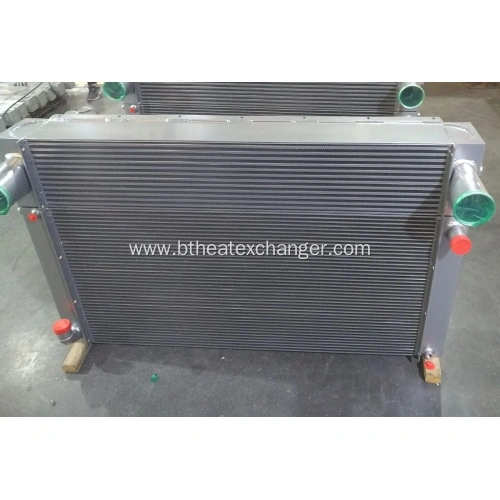
In today’s heat exchanger industry, performance expectations are higher than ever. Whether used in construction machinery, gas compression systems, commercial vehicles, power generation units, or new energy applications, heat exchangers must deliver stable thermal efficiency, long service life, and consistent structural quality.
Among all manufacturing stages, core assembly plays a decisive role in determining final product performance. For aluminum plate bar heat exchangers, even small assembly deviations can directly affect heat transfer efficiency and structural reliability.
This is why more manufacturers are turning to dedicated tools such as the Plate Bar Cooler Core Assembly Fixture to improve accuracy, repeatability, and production efficiency.
As a manufacturer focused on heat exchanger production equipment, Better-Tech has seen how proper assembly tooling can significantly improve both quality and output stability. This article takes a closer look at why these fixtures have become essential in modern production environments.
The Importance of Core Assembly in Plate Bar Heat Exchangers
A plate bar heat exchanger is made up of multiple stacked layers, including plates, fins, bars, and sealing elements. Before brazing, these components must be precisely aligned and securely held in position.
During assembly, manufacturers must control:
-
Layer alignment accuracy
-
Consistent spacing between components
-
Structural stability of the full core
-
Dimensional repeatability across batches
Even minor misalignment at this stage can lead to airflow imbalance, uneven heat distribution, or brazing defects later in production.
In short, if the assembly stage is not controlled properly, downstream processes cannot compensate for the error.
What a Core Assembly Fixture Actually Does
A Plate Bar Cooler Core Assembly Fixture is a dedicated tooling system designed to hold and locate heat exchanger components during stacking and pre-brazing assembly.
Instead of relying on manual alignment, the fixture provides a structured framework that ensures every component is positioned correctly.
Its main functions include:
-
Fixing component positions during stacking
-
Maintaining consistent core dimensions
-
Providing reference points for assembly accuracy
-
Reducing operator dependency
-
Improving repeatability across production runs
By creating a controlled assembly environment, it removes much of the uncertainty that comes with manual assembly methods.
Improving Dimensional Accuracy and Stability
Dimensional consistency is one of the biggest challenges in heat exchanger production.
Without a fixture, components can easily shift during assembly, leading to:
-
Uneven core geometry
-
Misaligned flow channels
-
Reduced thermal efficiency
-
Brazing inconsistencies
A well-designed fixture ensures that each layer remains locked in place throughout the entire assembly process. This leads to a finished core that closely matches engineering design specifications, with minimal deviation between units.
Boosting Production Efficiency
Manual assembly often requires repeated measuring, checking, and adjusting. This slows down production and increases labor intensity.
With a dedicated assembly fixture, positioning becomes predefined. Operators no longer need to manually verify every alignment step.
This results in:
-
Faster assembly cycles
-
Reduced setup time
-
Higher daily output
-
More stable workflow across shifts
For manufacturers producing large volumes of aluminum heat exchangers, these efficiency gains directly translate into lower production costs and improved delivery capability.
Reducing Human-Dependent Variations
One of the most common sources of quality inconsistency in manufacturing is operator variation.
Without standardized tooling, differences in experience or working habits can lead to:
-
Uneven fin placement
-
Incorrect spacing
-
Alignment errors
-
Structural inconsistencies
Assembly fixtures help eliminate these variables by physically guiding the process. This ensures that every operator follows the same positioning logic, regardless of skill level or shift timing.
Supporting Automation in Modern Production Lines
As heat exchanger manufacturing becomes more automated, fixtures are playing an even more important role.
Modern production systems may include:
-
Robotic handling systems
-
Automated loading equipment
-
CNC-controlled positioning
-
Digital inspection systems
A stable fixture acts as the physical foundation for these technologies. Without it, automation cannot maintain the required precision.
In this way, assembly fixtures are not just manual tools—they are a key part of smart manufacturing systems.
Improving Brazing Quality and Final Performance
Before entering vacuum brazing furnaces, the assembled core must remain perfectly stable. Any movement or distortion can cause serious quality issues during brazing.
Poor assembly can lead to:
-
Leakage problems
-
Weak joint strength
-
Reduced pressure resistance
-
Early product failure
By holding the structure firmly in place, assembly fixtures ensure that the geometry remains stable throughout the pre-brazing stage. This significantly improves brazing consistency and final product reliability.
Reducing Waste and Improving Yield
Inaccurate assembly does not just affect quality—it also increases production waste.
Without proper control, manufacturers may face:
-
Rework requirements
-
Scrap material loss
-
Increased labor costs
-
Delayed delivery schedules
Assembly fixtures help reduce these risks by ensuring correct assembly from the beginning. This improves yield rates and supports more efficient material usage across production.
Applications Across Multiple Industries
Plate bar cooler core assembly fixtures are widely used across industries that rely on high-performance thermal systems:
Engineering Machinery
Ensures reliable cooling performance in heavy-duty equipment.
Automotive Systems
Supports compact and efficient heat exchanger production for vehicles.
Hydraulic Equipment
Helps maintain leak-free and pressure-stable cooling structures.
Gas Compression Systems
Improves reliability in high-load thermal environments.
New Energy Applications
Supports precise thermal management in battery and energy systems.
Better-Tech’s Role in Heat Exchanger Manufacturing Solutions
Beyond heat exchangers themselves, Better-Tech focuses on providing complete manufacturing solutions for the industry.
Its equipment range includes:
-
Fin forming machines
-
Fin dies
-
Tube processing and cutting systems
-
Core assembly equipment
-
Cleaning systems
-
Welding systems
-
Vacuum brazing furnaces
This integrated approach allows manufacturers to build full production lines that are efficient, stable, and scalable.
Conclusion
As heat exchanger designs become more compact and performance-driven, manufacturing precision is no longer optional—it is essential.
Plate bar cooler core assembly fixtures play a key role in ensuring:
-
Accurate core geometry
-
Stable and repeatable production
-
Improved brazing quality
-
Higher manufacturing efficiency
-
Reduced production waste
For manufacturers of aluminum plate bar heat exchangers, investing in proper assembly fixtures is not just an equipment upgrade—it is a direct improvement to product quality and production competitiveness.
With continuous innovation in heat exchanger manufacturing technology, Better-Tech continues to support global customers with practical solutions that improve efficiency, consistency, and long-term production stability.
www.btheatexchanger.com
Wuxi Better