
Custom garment decoration businesses increasingly face a common dilemma: how to fulfill flexible order quantities and full-color designs without the delays and costs of traditional plate-making. DTF (Direct-to-Film) printing has emerged as a practical answer to this pain point, but choosing the right equipment from among China-based manufacturers requires understanding several technical and operational factors. This guide breaks down the key considerations buyers should evaluate, drawing on the equipment specifications and service models offered by suppliers such as DISEN, a provider of DTF printing equipment and related solutions for customers with different production requirements.
Understanding Printhead Configurations and Print Width
The first decision point in selecting a DTF printer is print format, since workspace conditions and expected production volume vary widely between businesses. Equipment is typically available in 30cm and 60cm DTF printer formats, with other custom sizes offered depending on the manufacturer. The right choice depends on matching format to actual production needs rather than defaulting to the largest available option.
Printhead configuration is equally important. Compatible configurations commonly include XP600, i1600, and i3200 printheads, among other options, with the appropriate choice depending on the model and production requirements:
- XP600: Commonly used in entry-level and commercial configurations, suitable for small and medium-sized printing businesses.
- i1600: Designed for professional printing configurations, suitable for businesses requiring more demanding production performance.
- i3200: Used in higher-performance industrial printing configurations, suitable for commercial producers and larger production operations.
Buyers should also note that single-head configurations are generally suitable for customers with moderate production requirements, while multiple-head configurations can increase production capacity when the machine is properly designed and configured. It is worth understanding that more printheads do not automatically translate into a proportional increase in printing speed, since actual output depends on the complete printing system and operating conditions.
Matching Format to Business Type
A 30cm DTF printer is positioned as a compact solution for startups, small printing shops, personalized gift businesses, and customers needing flexible production with limited workspace. Its compact design reduces workspace requirements, while still supporting small and medium-sized transfer jobs, custom garment printing, and compatibility with a DTF oven or powder shaker for a complete production line.
A 60cm DTF printer, by contrast, is a wider-format solution aimed at commercial printing businesses, garment factories, and customers handling larger or more frequent orders. The wider printing format allows more transfer designs to be arranged side by side, improving material utilization and production efficiency, and it can be matched with automatic powder shaking and curing equipment for continuous production workflows.
Evaluating the Full Production Process
Choosing a DTF printer is not only about the printer itself. The white ink system—whether through circulation or stirring functions—determines whether a machine can reliably print on dark and colored fabrics, which is a core requirement for most garment decoration work.
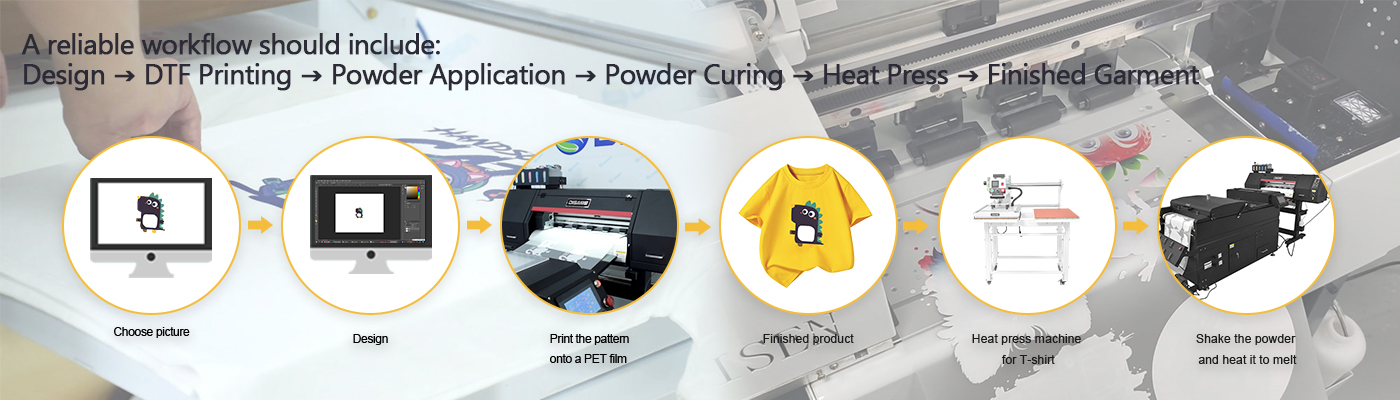
Buyers should also evaluate the full production process coverage, which includes design setup, RIP parameter configuration, PET film printing, adhesive powder application, excess powder removal, curing, and heat press transfer. A DTF printer does not operate in isolation; it functions within a workflow that may include a computer and RIP software, PET transfer film, CMYK and white DTF ink, hot melt adhesive powder, a powder shaker and curing oven, and a heat press machine. DISEN provides matching powder shaking and curing equipment for DTF production lines, including a DTF Oven and Powder Shaker designed to distribute adhesive powder evenly, remove excess powder, and cure printed transfer film before heat pressing. This equipment is available in manual configurations suitable for small-scale production and automatic configurations that combine powder application, excess powder removal, and heating in one process for continuous commercial production.
When comparing manufacturers, it is worth checking whether the working width of the curing equipment matches the DTF printer, whether the temperature control system is reliable, and whether the film feeding and collection system supports smooth production flow. Consumable compatibility—covering DTF ink, PET transfer film, hot melt adhesive powder, and RIP software—should also be confirmed to reduce workflow risk.
Matching Equipment to Business Scenario
Different business models call for different equipment packages:
- Small Business DTF Solution: Combines a 30cm DTF printer, compact curing equipment, a heat press machine, and basic consumables, aimed at startups, personalized T-shirt shops, and small customization businesses with limited investment and workspace.
- Commercial DTF Production Solution: Combines a 60cm DTF printer, a compatible automatic powder shaker and curing oven, a heat press machine, and sufficient supplies, aimed at commercial printing shops and garment factories handling regular batch orders.
- DTF Transfer Film Wholesale Solution: Combines a 60cm DTF printer with a suitable printhead configuration, an automatic powder shaker and curing oven, and film collection and production accessories, aimed at businesses producing ready-to-transfer DTF films for clothing shops, distributors, and other printing companies.
These configurations correspond to industries such as custom T-shirt and fashion printing, school uniforms and workwear, sports team uniforms and event clothing, promotional garments, small garment workshops, and DTF transfer film wholesale—coverage that spans startups through to garment factories and distributors.
Quality Control and After-Sales Support
Since DTF equipment represents a longer-term operational investment, buyers should ask manufacturers about their quality control process before shipment. This should include machine inspection before shipment, printing function testing, equipment configuration checks, and inspection of important components and accessories.
Equally important is the service model that follows the sale. Look for suppliers offering pre-sales configuration guidance, installation guidance, remote technical support, and training assistance. Specific service elements worth confirming include machine selection according to customer requirements, installation and operation guidance, remote technical assistance, video tutorials and operating instructions, troubleshooting and maintenance guidance, and spare parts assistance—typically backed by a one-year warranty under applicable warranty terms.
How Pricing and Configuration Typically Work
Rather than fixed packages, DTF equipment is generally priced through a configuration-based approach, in which customers share their target applications, expected production volume, and budget to receive a suitable printer configuration and matching equipment recommendations. This approach allows buyers to avoid overpaying for capacity they do not need, while ensuring the chosen printhead, print width, and curing equipment align with actual production goals.
Final Considerations
Selecting a DTF printer from a China-based manufacturer ultimately comes down to aligning print width, printhead configuration, white ink capability, production line compatibility, and after-sales support with the specific scale and type of business being run. Whether the goal is a compact setup for a personalized gift shop or a continuous commercial line for a garment factory, evaluating these factors systematically—rather than focusing on a single specification—helps buyers identify equipment that fits their real operating conditions and long-term production needs.
https://www.disenprinter.com/
Guangzhou Disen Electronic Equipment Co., Ltd
