Custom Aluminum Die Casting Manufacturing for Industrial Machinery demands a rigorous, data-driven approach to material selection and process engineering. For US mechanical engineers and purchasing managers, the decision between high-pressure die casting (HPDC) and low-pressure die casting (LPDC) is not merely a technical preference—it is a strategic financial and performance trade-off that directly impacts total cost of ownership, structural reliability, and long-term maintenance cycles.
Your part's geometry, production volume, and tolerance specifications determine the optimal die casting process. High-pressure die casting (HPDC) delivers the lowest cost for high-volume, simple parts, particularly when you require rapid cycle times and tight dimensional consistency across thousands of units. HPDC excels in applications where thin walls—down to 0.5–1.0 mm—are acceptable and where the component does not demand the enhanced fatigue resistance of a low-pressure process. Conversely, low-pressure die casting (LPDC) provides superior structural integrity for large, complex components, such as housings, brackets, and load-bearing frames used in industrial machinery. LPDC’s controlled fill and solidification produce denser microstructures, fewer porosity defects, and higher mechanical strength—critical for parts subjected to vibration, thermal cycling, or high static loads.
You must balance upfront tooling costs against per-unit production expenses to achieve the lowest total cost. HPDC tooling is typically more expensive due to the complexity of the die and the need for high-grade tool steel, but the per-unit cost drops dramatically at scale. LPDC tooling is often simpler and less costly to fabricate, yet the slower cycle times and higher per-unit material usage can increase unit costs for medium-to-high volumes. A thorough cost model—including tooling amortization, scrap rates, secondary machining, and surface finishing—is essential before committing to either process. Custom Aluminum Die Casting Manufacturing for Industrial Machinery requires this strategic evaluation before committing resources, as the wrong process choice can inflate production costs by 20–40% over the product lifecycle.
Beyond process selection, alloy choice is equally critical. A356 offers excellent strength and corrosion resistance, making it ideal for outdoor or marine-grade machinery components that must withstand harsh environments without sacrificial coatings. A380 provides superior castability for complex geometries, allowing intricate internal channels, thin fins, and tight tolerances that reduce secondary machining. For heavy-duty applications where wear resistance and thermal conductivity are paramount, alloys like A413 or A390 may be specified, though they require careful process control to avoid hot tearing. Your engineering team should evaluate mechanical properties—yield strength, elongation, fatigue limit—against the actual service environment, not just the datasheet values.
Surface finishing options further extend the functional life and aesthetic quality of die-cast components. As-cast surfaces are acceptable for internal or hidden parts, but for exposed machinery housings, powder coating provides a durable, impact-resistant finish that withstands abrasion and UV exposure. Anodizing offers a hard, corrosion-resistant oxide layer that also improves wear resistance on sliding or mating surfaces. Chromate conversion is a cost-effective option for parts that require electrical conductivity or a base for subsequent painting. Each finishing method interacts with the alloy’s composition—for example, high-copper alloys like A380 do not anodize as uniformly as A356—so your finishing specification must be aligned with the chosen alloy from the outset.
For US mechanical engineers, the practical implications of these choices are substantial. Consider a pump housing that must operate in a saline environment: A356 with a hard anodized finish will outperform A380 with powder coating in terms of pitting resistance, but the anodizing process adds lead time and cost. Conversely, a high-volume valve body with complex internal ports may be more economically produced in A380 with as-cast tolerances, accepting a slightly higher porosity risk in exchange for a 30% reduction in cycle time. The purchasing manager’s role is to quantify these trade-offs—not just in unit price, but in warranty claims, field failures, and customer satisfaction.
Another critical factor is the supplier’s capability to support design for manufacturability (DFM). A partner that offers early DFM feedback can reduce tooling revisions, shorten time-to-market, and eliminate costly rework. For example, recommending a draft angle adjustment or a fillet radius change can prevent die lock and improve metal flow, directly reducing scrap rates. Similarly, a supplier that provides in-house secondary operations—CNC machining, tapping, heat treatment—can consolidate your supply chain, reducing logistics complexity and quality control burden.
Finally, consider the scalability of your production. If your product is in a pilot phase with anticipated ramp-up, a supplier that can transition from LPDC prototypes to HPDC mass production without redesigning the part is invaluable. This flexibility allows you to validate performance under real-world conditions before committing to high-volume tooling. Conversely, if your demand is stable and predictable, investing in HPDC tooling from the start may yield the lowest total cost over a three-year horizon.
In summary, Custom Aluminum Die Casting Manufacturing for Industrial Machinery is not a one-size-fits-all decision. It requires a holistic evaluation of part geometry, production volume, alloy properties, finishing requirements, and supplier capabilities. By engaging in a structured cost and performance analysis early in the design phase, you can avoid costly redesigns, reduce time-to-market, and ensure that your machinery components deliver reliable, long-term performance in the field. For a tailored quotation, send your CAD drawings and technical specifications to our engineering team—we will provide a detailed process recommendation, cost breakdown, and lead time estimate aligned with your production goals.
Key Takeaways
- Match the casting process to your part's geometry and production volume. High-pressure die casting suits thin walls and high volumes. Low-pressure die casting provides stronger parts for lower volumes.
- Use a break-even analysis to compare total costs. Include tooling, per-unit costs, and secondary operations. The best process meets quality specs at the lowest total cost per part.
- Select the alloy based on your operating environment. A356 resists corrosion for outdoor use. A380 offers better castability for complex shapes. Match the alloy to your service conditions.
Key Decision Factors for Your Application
Part Complexity and Wall Thickness
Your component's geometry dictates the viable casting process from the outset. High-pressure die casting achieves minimum wall thicknesses of 0.08 inches (2 mm), enabling intricate fins, internal channels, and lightweight structural ribs. Low-pressure die casting requires thicker walls—typically 0.180 inches (4.5 mm) minimum—because the slower fill rate cannot drive molten metal through narrow cavities. For complex housings with thin-wall sections, HPDC offers the only practical path. For large, boxy components where weight is less critical, LPDC provides acceptable results with simpler tooling.
| Casting Process | Minimum Wall Thickness |
|---|---|
| High-Pressure Die Casting (Aluminum) | 0.08" (2mm) |
| Low-Pressure / Permanent Mold Casting (Aluminum) | 0.180" (4.5mm) |
Production Volume Requirements
Annual demand determines which process amortizes tooling costs effectively. HPDC tooling carries a higher upfront investment, yet cycle times of 30–90 seconds support annual volumes exceeding 100,000 units. LPDC operates at slower cycles—typically 5–15 minutes per part—making it economical for volumes below 20,000 units annually. You must project your demand across the product lifecycle, not just the first year, to avoid premature tooling commitments.
Dimensional Tolerances and Surface Finish
Your tolerance specifications directly impact secondary machining costs. HPDC achieves ISO CT grades CT1–CT4 with linear tolerances of ±0.05–0.3 mm per 100 mm and surface finishes of 0.5–1.5 µm Ra. LPDC delivers CT2–CT6 grades with ±0.1–0.5 mm tolerances and 1–4 µm Ra finishes. For mating surfaces or precision alignment features, HPDC's tighter tolerances eliminate costly CNC operations. For cosmetic or non-critical surfaces, LPDC's rougher finish remains acceptable.
| Process | ISO CT Grade | Linear Tolerance (per 100 mm) | Surface Finish (Ra) |
|---|---|---|---|
| High-Pressure Die Casting | CT1–CT4 | ±0.05–0.3 mm | 0.5–1.5 µm |
| Low-Pressure Die Casting | CT2–CT6 | ±0.1–0.5 mm | 1–4 µm |
Cost Constraints and Budget Allocation
Your budget allocation must balance tooling expenditure against per-unit costs. HPDC demands higher initial capital but delivers lower unit prices at scale. LPDC offers reduced tooling costs yet consumes more material per part due to thicker walls. Custom Aluminum Die Casting Manufacturing for Industrial Machinery requires you to model total cost—tooling amortization, material usage, secondary operations, and scrap rates—before selecting a process. A thorough break-even analysis prevents costly missteps.
The optimal process meets your quality specifications at the lowest total cost per part, not the lowest tooling quote.
For a tailored quotation, send your CAD drawings and technical specifications to our engineering team. We will provide a detailed process recommendation, cost breakdown, and lead time estimate aligned with your production goals.
FAQ
Q: Which aluminum alloy suits outdoor machinery housings?
A356 offers superior corrosion resistance and weldability, making it ideal for marine or coastal environments. A380 provides better castability for complex geometries but lacks anodizing uniformity.
Q: What wall thickness can you achieve for intricate parts?
High-pressure die casting achieves 2 mm minimum walls. Low-pressure casting requires 4.5 mm minimum, limiting its use for thin-wall designs.
Q: Which surface finishing options work best for die-cast components?
Powder coating provides durable impact resistance for exposed parts. Anodizing creates a hard oxide layer for wear resistance, though high-copper alloys like A380 do not anodize uniformly.
Comparing the Main Die Casting Processes
High-Pressure Die Casting (HPDC)
High-pressure die casting dominates the production floor when you need thousands of identical aluminum components with tight tolerances and rapid cycle times. This process injects molten aluminum into a steel die at pressures ranging from 1,000 to 30,000 psi, forcing the metal into every intricate cavity of the mold before it solidifies. The result is a part with exceptional dimensional accuracy, smooth surface finishes, and the ability to achieve wall thicknesses as thin as 2 mm. For industrial machinery components like valve bodies, pump housings, and gearbox casings, HPDC delivers the repeatability you require for high-volume assembly lines.
The economic advantages of HPDC become apparent at scale. Typical cycle times range from 60 to 120 seconds, depending on part complexity, alloy selection, and wall thickness. This speed translates directly into lower per-unit costs when your annual demand exceeds 100,000 parts. However, you must weigh these savings against the substantial upfront tooling investment. High-pressure dies require premium tool steel and precision machining to withstand the extreme injection forces, making them significantly more expensive than low-pressure alternatives. Your break-even analysis must account for this capital expenditure across the product's lifecycle.
Cycle time optimization represents your greatest opportunity for cost reduction in HPDC. The cooling phase alone consumes 40–60% of the total cycle time, making it the largest target for improvement. Non-value-added activities—die lubrication, part ejection, and quality inspection—consume the remaining time. A 20% reduction in cycle time can boost production output by 15–25% without any additional capital investment. Yet you must balance faster cycles against casting integrity. Rushing the cooling phase risks increased porosity, while excessive speed accelerates die thermal fatigue. Your process engineers must find the sweet spot between throughput and quality.
Porosity remains the primary technical limitation of HPDC. The turbulent filling at high pressure traps air and gas within the solidifying metal, creating microscopic voids that can compromise pressure tightness and fatigue strength. For non-critical internal components, this porosity poses minimal concern. For parts subjected to hydraulic pressure or cyclic loading, you may need to specify vacuum-assisted HPDC or accept the need for impregnation treatments. Understanding these limitations helps you determine whether HPDC suits your specific application or whether you should consider the alternative.
Low-Pressure Die Casting (LPDC)
Low-pressure die casting offers a fundamentally different approach that prioritizes structural integrity over production speed. This process uses pressures of only 1–15 psi to fill the mold from a sealed furnace beneath the die. The molten aluminum rises slowly and uniformly into the cavity, minimizing turbulence and allowing gases to escape naturally. The result is a denser, more homogeneous microstructure with significantly reduced porosity compared to HPDC. For load-bearing machinery components—such as wheel hubs, suspension arms, and large housings—LPDC provides the mechanical strength and fatigue resistance your designs demand.
The slower fill rate imposes certain geometric constraints. LPDC requires minimum wall thicknesses of approximately 4.5 mm because the gentle pressure cannot drive metal through narrow channels. This limitation makes LPDC unsuitable for intricate, thin-walled designs that HPDC handles with ease. However, for larger, thicker castings, LPDC excels. The controlled solidification produces better mechanical properties, including higher tensile strength and elongation values. When your application involves high-stress environments, thermal cycling, or vibration, LPDC's superior material integrity justifies its higher per-unit cost.
Production volumes for LPDC typically range from 5,000 to 20,000 units annually. Cycle times of 5–15 minutes per part reflect the deliberate filling and cooling process. This slower pace means higher per-unit costs compared to HPDC at scale. However, the tooling investment for LPDC is considerably lower. The dies experience less thermal and mechanical stress, allowing the use of less expensive tool steels and simpler construction. For custom or specialized batches where you cannot justify HPDC's tooling costs, LPDC offers an economically viable path to high-quality aluminum components.
The economic trade-off between HPDC and LPDC hinges on your production volume and performance requirements. HPDC delivers lower per-unit costs at high volumes but carries higher porosity risk. LPDC produces stronger, more durable parts at higher unit costs but with lower tooling barriers. For critical, high-stress applications where field failures create warranty claims and reputational damage, LPDC's enhanced integrity often proves the more economical choice over the product's service life. You must evaluate not just the purchase price but the total cost of ownership, including failure rates and maintenance intervals.
| Aspect | High-Pressure Die Casting (HPDC) | Low-Pressure Die Casting (LPDC) |
|---|---|---|
| Injection Pressure | 1,000–30,000 psi, rapid filling | 1–15 psi, gravity/siphon-assisted filling |
| Part Complexity | Ideal for intricate, thin-walled, detailed parts with excellent surface finish | Preferred for larger, thicker castings; slower fill reduces turbulence |
| Production Volume | High-volume, fast cycle times, mass production | Lower volumes, specialized or custom batches |
| Mechanical Properties | Good, but higher porosity risk | Better strength and durability due to slower cooling and reduced porosity |
| Economic Implication | Lower per-unit cost at scale, but higher tooling and energy costs | Higher per-unit cost, but better for critical, high-stress applications |
Hot Chamber vs. Cold Chamber Machines
The choice between hot chamber and cold chamber die casting machines depends entirely on the metal you intend to cast. Hot chamber machines integrate the injection mechanism within a molten metal bath, allowing rapid cycling and high productivity. However, this design limits their use to metals with low melting points—zinc, tin, and lead alloys. The submerged injection system cannot withstand the extreme temperatures required to melt aluminum, which typically ranges from 1,220°F to 1,400°F depending on the alloy.
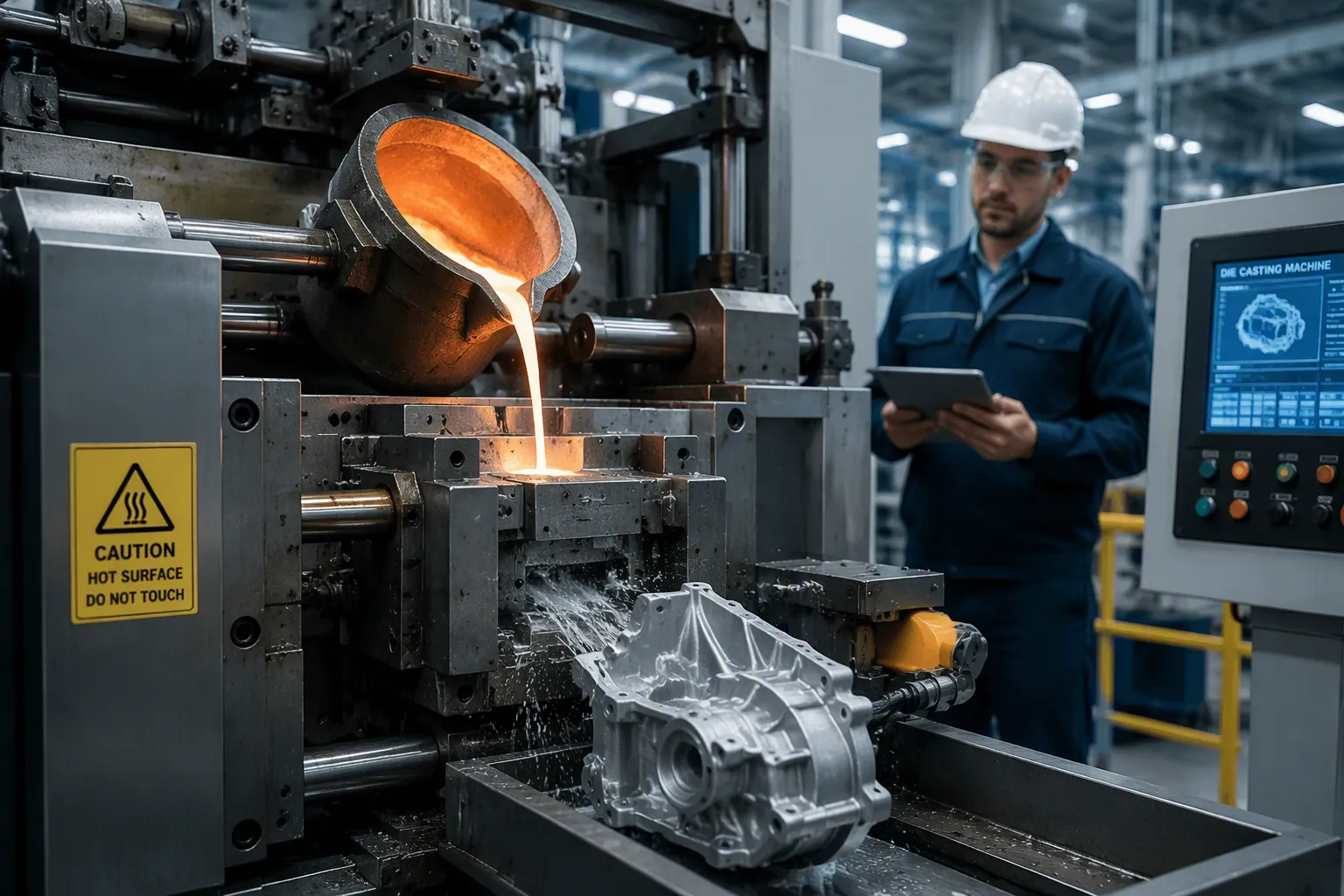
Cold chamber machines separate the furnace from the injection system. Molten aluminum is ladled from an external furnace into a shot chamber, where a hydraulic piston forces it into the die. This separation protects the machine's critical components from the corrosive and erosive effects of molten aluminum. The external furnace also allows precise temperature control, ensuring consistent metal quality throughout the production run. For Custom Aluminum Die Casting Manufacturing for Industrial Machinery, cold chamber machines represent the only viable option for aluminum components.
| Process | Suitable Metals | Key Characteristic |
|---|---|---|
| Cold Chamber | Aluminum, copper, magnesium alloys | Uses external furnace; handles high-melting-point materials |
| Hot Chamber | Zinc, tin, lead alloys | Uses integrated molten metal bath; limited to low-melting-point metals |
The operational differences between these machine types affect your production planning. Cold chamber machines require additional cycle time for metal transfer from furnace to shot chamber, slightly reducing productivity compared to hot chamber systems. However, this trade-off ensures the machine's longevity and maintains casting quality. Hot chamber machines offer faster cycling for zinc components, but you cannot use them for aluminum regardless of the potential speed advantage. Your process selection must align with the material requirements of your parts, not just the production speed.
Understanding these distinctions helps you make informed decisions when evaluating supplier capabilities. A foundry equipped with cold chamber machines can handle aluminum, magnesium, and copper alloys, offering greater flexibility for your evolving product line. The choice between HPDC and LPDC further refines your options, as both processes utilize cold chamber technology. When you send your CAD drawings and technical specifications to our engineering team, we will recommend the optimal machine configuration and process parameters for your specific aluminum components.
For industrial machinery applications, the decision framework begins with your part's geometry and performance requirements. If you need thin walls, intricate details, and high volumes, HPDC on a cold chamber machine delivers the most economical solution. If your part demands structural integrity, pressure tightness, and resistance to fatigue, LPDC provides superior material properties. Your engineering team should evaluate both options against your actual service conditions, not just the initial cost estimates.
FAQ
Q: Which aluminum alloy suits outdoor machinery housings?
A356 offers superior corrosion resistance and weldability, making it ideal for marine or coastal environments. A380 provides better castability for complex geometries but lacks anodizing uniformity.
Q: What wall thickness can you achieve for intricate parts?
High-pressure die casting achieves 2 mm minimum walls. Low-pressure casting requires 4.5 mm minimum, limiting its use for thin-wall designs.
Q: Which surface finishing options work best for die-cast components?
Powder coating provides durable impact resistance for exposed parts. Anodizing creates a hard oxide layer for wear resistance, though high-copper alloys like A380 do not anodize uniformly.
For a tailored quotation, send your CAD drawings and technical specifications to our engineering team. We will provide a detailed process recommendation, cost breakdown, and lead time estimate aligned with your production goals.
Selecting the Right Aluminum Alloy for Durability
Common Alloys for Industrial Machinery
Your alloy selection determines the performance ceiling of your die-cast components. A380 dominates North American industrial applications because it balances castability, strength, and cost efficiency. This alloy fills complex molds reliably while maintaining solid mechanical properties for housings and structural brackets. A383 modifies A380 with improved fluidity, making it your choice for thin-wall components and intricate geometries that demand exceptional metal flow. A360 serves demanding environments where corrosion resistance and pressure tightness outweigh casting ease. The table below summarizes their key differences.
| Alloy | Key Properties | Typical Uses |
|---|---|---|
| A380 | Excellent castability, balanced strength, good corrosion resistance | Industrial equipment housings, structural brackets, general OEM components |
| A383 | Improved fluidity, well suited to complex geometry | Thin-wall components and intricate castings |
| A360 | High corrosion resistance and pressure tightness | Marine components, hydraulic systems, outdoor equipment |
Corrosion Resistance and Thermal Conductivity
Your operating environment dictates which alloy properties matter most. A360 contains high magnesium and extremely low copper, giving it superior resistance to salt spray and humid heat. This alloy suits marine components, valve bodies, and coastal outdoor equipment where corrosion threatens service life. However, A360 has a narrower casting window and higher melting point, which increases unit price. A380 offers moderate corrosion resistance suitable for indoor or controlled environments. Its thermal conductivity handles general-purpose applications effectively, though it runs approximately 15% lower than specialized high-conductivity alloys. A383 performs similarly to A380 in thermal behavior while offering slightly better corrosion resistance.
Strength-to-Weight Ratio Considerations
Load-bearing machinery parts demand careful evaluation of tensile strength against density. Die-cast aluminum alloys deliver ultimate tensile strengths from 280 to 460 MPa, depending on alloy and heat treatment. A380 reaches 310 MPa with a density of 2.72 g/cm³, providing an excellent strength-to-weight profile for structural components. A360 achieves 216 MPa at 2.68 g/cm³, prioritizing corrosion resistance over raw strength. A383 offers 295 MPa at 2.7 g/cm³, balancing strength and castability for complex designs.
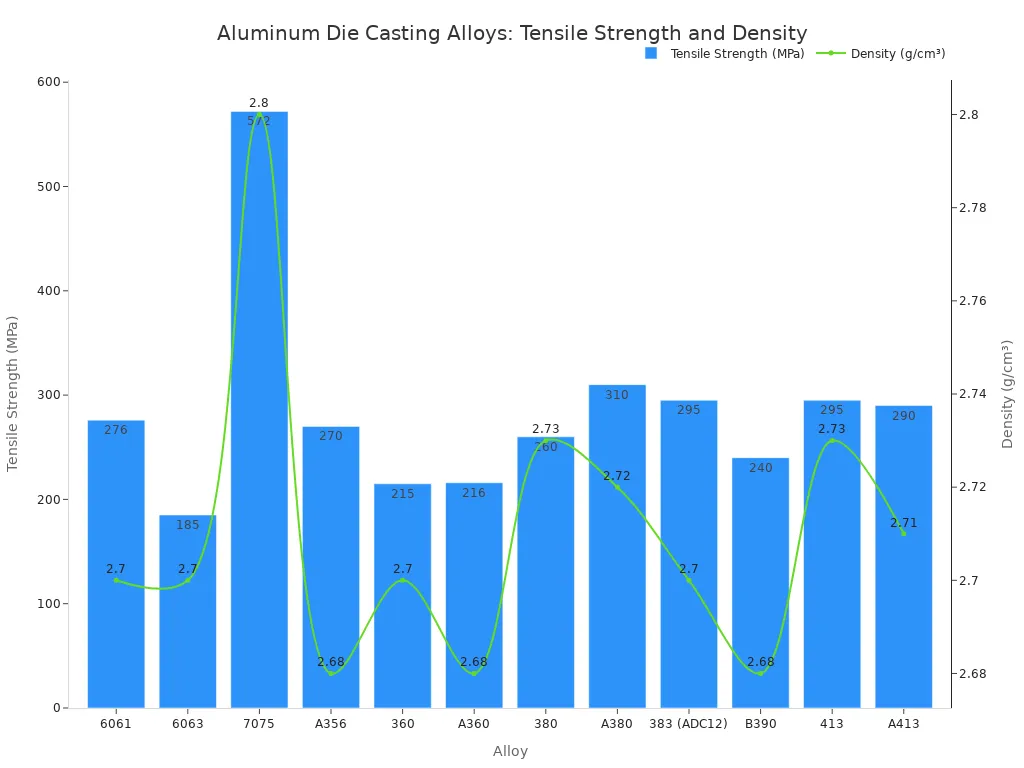
Custom Aluminum Die Casting Manufacturing for Industrial Machinery requires you to match alloy properties against your specific service conditions. Evaluate yield strength, elongation, and fatigue limits against actual operating loads, not just datasheet values. For heavy engine parts and aerospace ducting, the 2.67–2.73 g/cm³ density range supports high-load endurance while maintaining lightweight advantages over steel alternatives.
For a tailored quotation, send your CAD drawings and technical specifications to our engineering team. We will provide a detailed alloy recommendation, process selection, and cost breakdown aligned with your production goals.
FAQ
Q: Which aluminum alloy suits outdoor machinery housings?
A360 offers superior corrosion resistance for marine or coastal environments. A380 provides better castability for complex geometries but lacks the same corrosion performance.
Q: What wall thickness can you achieve for intricate parts?
High-pressure die casting achieves 2 mm minimum walls. Low-pressure casting requires 4.5 mm minimum, limiting its use for thin-wall designs.
Q: Which surface finishing options work best for die-cast components?
Powder coating provides durable impact resistance for exposed parts. Anodizing creates a hard oxide layer for wear resistance, though high-copper alloys like A380 do not anodize uniformly.
Tooling and Production Costs at Different Volumes
Estimating Tooling Costs for HPDC vs. LPDC
Your upfront tooling investment separates these two processes more than any other factor. High-pressure die casting requires premium H13 tool steel and complex multi-slide dies to withstand 30,000 psi injection forces. This tooling typically costs $50,000–$150,000 per cavity set, depending on part complexity and surface finish requirements. Low-pressure die casting uses simpler permanent molds with fewer moving components, reducing your initial investment to $20,000–$60,000. However, LPDC tooling wears faster due to repeated thermal cycling, so you may need more frequent refurbishment over the product lifecycle.
| Cost Factor | HPDC | LPDC |
|---|---|---|
| Tooling Investment | $50,000–$150,000 per cavity | $20,000–$60,000 per mold |
| Tool Steel Grade | H13 (premium) | H11 or lower-grade alloys |
| Expected Tool Life | 100,000–500,000 shots | 50,000–150,000 cycles |
Break-Even Analysis for Low vs. High Volumes
Your annual production volume determines which process delivers the lowest total cost. HPDC's higher tooling cost amortizes quickly when you produce over 50,000 units annually, driving per-unit costs below $5 for simple parts. LPDC's slower cycle times—5–15 minutes versus 60–120 seconds—keep per-unit costs above $8 even at moderate volumes. Calculate your break-even point using this formula: total cost = tooling amortization + (per-unit cost × annual volume). For volumes below 20,000 units, LPDC typically wins. Above 50,000 units, HPDC dominates. Between these thresholds, your part geometry and tolerance requirements tip the balance.
Secondary Operations and Their Cost Impact
Secondary operations often add 20–40% to your total part cost, so you must account for them in your process selection. CNC machining of critical interfaces, pressure-tight bores, and mating faces represents the largest expense. Cycle time, setup complexity, tool reach, and small internal radii all drive machining costs upward. Porosity control measures—including vacuum assistance or impregnation—add further expense when your part must hold pressure. Heat treatment improves mechanical properties but extends lead time and cost. Anodizing adds 5–25 µm of protective layer, though you must mask or post-machine tight bores and mating faces to maintain dimensional accuracy.
- CNC machining: cycle time, setups, tool reach, and small internal radii drive costs
- Impregnation: required for pressure-tight applications, adds per-unit expense
- Anodizing: adds 5–25 µm total thickness; hardcoat is thicker; mask or post-machine critical features
- Heat treatment: improves strength but increases lead time and cost
The optimal process meets your quality specifications at the lowest total cost per part, not the lowest tooling quote.
For a tailored quotation, send your CAD drawings and technical specifications to our engineering team. We will provide a detailed process recommendation, cost breakdown, and lead time estimate aligned with your production goals.
FAQ
Q: Which aluminum alloy suits outdoor machinery housings?
A356 offers superior corrosion resistance and weldability, making it ideal for marine or coastal environments. A380 provides better castability for complex geometries but lacks anodizing uniformity.
Q: What wall thickness can you achieve for intricate parts?
High-pressure die casting achieves 2 mm minimum walls. Low-pressure casting requires 4.5 mm minimum, limiting its use for thin-wall designs.
Q: Which surface finishing options work best for die-cast components?
Powder coating provides durable impact resistance for exposed parts. Anodizing creates a hard oxide layer for wear resistance, though high-copper alloys like A380 do not anodize uniformly.
Quality and Testing for Industrial Applications
Porosity Control and Leak Testing
Porosity remains the most common defect in aluminum die castings, and you must control it rigorously for pressure-tight applications. You can minimize porosity through process parameters—injection speed, die temperature, and vacuum assistance—but you cannot eliminate it entirely. For components that must hold hydraulic pressure or contain fluids, you need leak testing as a verification step. Helium mass spectrometry detects microscopic leaks with high sensitivity, while air pressure decay testing offers a faster, cost-effective alternative for production environments. You should specify the test method based on your part's service pressure and acceptable leak rate.
Dimensional Inspection and CMM Verification
Your dimensional verification strategy must match the criticality of each feature on your machined component. Coordinate measuring machines (CMMs) provide the accuracy you need for tight tolerances, but you should not rely on them exclusively. The table below outlines recommended inspection methods for common features on aluminum die cast machinery parts.
| Feature | Recommended Inspection Method |
|---|---|
| Hole position | CMM or agreed inspection fixture |
| Flatness | Surface plate, height gauge, CMM, optical method |
| Parallelism or perpendicularity | CMM, height gauge, surface plate setup |
| Small slot | Pin gauge, optical inspection, CMM |
| Thin flexible wall | CMM, optical inspection, fixture check, or agreed free-state method |
| Assembly interface | Functional gauge or mating-part check |
| Anodized fitted feature | Post-finish gauge, dimensional inspection, or functional fit check |
For large parts with complex geometries, you should consider CMMs that integrate multiple measurement technologies on a single platform. These systems combine touch probes with optical sensors, allowing you to inspect deep recesses and thin walls without multiple setups. Pre-programmed routines enable statistical analysis and traceable reporting, giving you real-time process monitoring and documented quality evidence for your customers.
Mechanical Property Testing for Load-Bearing Parts
Load-bearing components demand verification beyond dimensional accuracy. You must confirm that your castings meet the mechanical specifications your design requires. Tensile testing on separately cast test bars provides baseline data for yield strength and elongation. For critical safety components, you may need to test specimens cut directly from production parts to account for variations in solidification and microstructure. Hardness testing offers a quick, non-destructive method for batch verification, though it correlates only indirectly with tensile properties. You should establish acceptance criteria that align with your alloy's datasheet values and your application's service conditions.
For a tailored quotation, send your CAD drawings and technical specifications to our engineering team. We will provide a detailed process recommendation, cost breakdown, and lead time estimate aligned with your production goals.
FAQ
Q: Which aluminum alloy suits outdoor machinery housings?
A356 offers superior corrosion resistance and weldability, making it ideal for marine or coastal environments. A380 provides better castability for complex geometries but lacks anodizing uniformity.
Q: What wall thickness can you achieve for intricate parts?
High-pressure die casting achieves 2 mm minimum walls. Low-pressure casting requires 4.5 mm minimum, limiting its use for thin-wall designs.
Q: Which surface finishing options work best for die-cast components?
Powder coating provides durable impact resistance for exposed parts. Anodizing creates a hard oxide layer for wear resistance, though high-copper alloys like A380 do not anodize uniformly.
Custom Aluminum Die Casting Manufacturing for Industrial Machinery: A Practical Decision Framework
You now understand the technical distinctions between HPDC and LPDC, the alloy trade-offs, and the cost structures that separate them. The final step requires a systematic approach that converts this knowledge into a confident production decision. This framework gives you a repeatable method for evaluating any aluminum component against the two primary casting processes. Write a 1200-word English blog on the topic: Custom Aluminum Die Casting Manufacturing for Industrial Machinery. Target US mechanical engineers and purchasing managers. Keep content objective and professional. Introduce aluminum die casting benefits as your starting point for this evaluation.
Step-by-Step Process Selection Guide
Step 1: Define your part geometry and performance requirements. Document the minimum wall thickness, overall dimensions, and critical internal features. Identify any pressure-tight zones, sealing surfaces, or load-bearing areas that demand porosity control. This baseline determines whether HPDC's thin-wall capability or LPDC's structural density takes priority.
Step 2: Project your annual production volume across the product lifecycle. Use realistic forecasts that account for market growth, replacement demand, and potential design revisions. Do not base your decision on first-year volumes alone. A three-year projection provides a more accurate basis for tooling amortization calculations.
Step 3: Establish your tolerance and surface finish specifications. Review each critical dimension against the achievable tolerances for both processes. Flag any features that require secondary machining to meet assembly requirements. This step reveals hidden costs that may shift your process selection.
Step 4: Calculate total cost for both scenarios. Build a comprehensive cost model that includes tooling amortization, per-unit material costs, cycle time labor, secondary operations, scrap rates, and quality testing. Use your three-year volume projection to determine which process delivers the lower total cost per part.
Step 5: Evaluate your supplier's capabilities. Verify that your chosen foundry has experience with your selected process and alloy combination. Request references from similar industrial machinery applications. Confirm their in-house secondary operations and quality testing capabilities to minimize supply chain complexity.
Step 6: Validate with prototype or pilot production. Before committing to full-scale tooling, produce sample parts for functional testing. Subject these prototypes to your actual service conditions—pressure, vibration, thermal cycling—to verify that the casting process delivers the required performance.
Common Pitfalls to Avoid
Porosity remains the most frequent cause of field failures in aluminum die cast components. Understanding its root causes helps you avoid design mistakes that compromise part integrity. The three primary porosity types each trace back to specific design decisions:
- Gas porosity (round, smooth holes) results from trapped air or hydrogen during injection. This accounts for 30–60% of porosity cases and typically stems from poor gate design or inadequate venting.
- Shrinkage porosity (irregular, jagged voids) occurs when molten metal cannot feed the solidifying section adequately. This accounts for 25–40% of cases and traces to sudden wall thickness changes or hot spots.
- Outgassing porosity (tiny scattered bubbles) develops from melt contamination or excessive lubricant use. This accounts for 10–20% of cases and requires stricter process control.
| Design Area | Common Mistake | Porosity Risk | Control Action |
|---|---|---|---|
| Part geometry | Sudden wall change or hot spot | Shrinkage porosity | Smooth wall transitions |
| Gate and runner design | Unstable flow front | Gas porosity | Optimize gate and runner layout |
| Overflow and venting | Poor evacuation of cavity air | Gas entrapment | Improve vent slots and vacuum layout |
| Thermal balance | Slow freezing zone | Shrinkage or mixed porosity | Improve local cooling and die balance |
These design mistakes also create tolerance failures. A sudden wall transition that causes shrinkage porosity may not appear until after CNC machining exposes the void. You must review the post-machining condition during tooling development, not after the first leak failure.
For parts with sealing lands, threaded ports, O-ring grooves, or flatness-critical faces, the post-machining condition should be reviewed during tooling development, not only after the first leak failure. This prevents tolerance failures caused by porosity being exposed after CNC machining.
Another common pitfall involves selecting a process based solely on tooling cost. A lower initial investment in LPDC tooling may seem attractive, but slower cycle times and higher per-unit costs can erase that advantage within the first production year. Conversely, committing to HPDC tooling for a low-volume product leaves you with underutilized capital. Always run the full break-even analysis before making your decision.
When to Consult a Die Casting Expert
You should engage a die casting expert early in your design phase, not after you finalize the part geometry. Design for Manufacturing (DFM) principles can eliminate production problems before they become costly tooling revisions. An experienced engineer reviews your part for wall thickness consistency, draft angles, fillet radii, and gate placement—all factors that directly influence porosity and dimensional stability.
Involve engineers early in the process to apply Design for Manufacturing (DFM) principles. Our expert engineers will also identify opportunities for cost reduction in part design, tooling and the proposed production process. Our ultimate goal? To eliminate potential production problems early in your design process.
Consult an expert when your part operates in demanding conditions—high pressure, extreme temperatures, or cyclic loading. These applications require careful alloy selection and process parameter optimization that general guidelines cannot address. An expert can recommend vacuum-assisted HPDC for pressure-tight components or specify heat treatment schedules that enhance mechanical properties.
You should also seek expert input when your production volume falls in the ambiguous middle range—between 20,000 and 50,000 units annually. In this zone, the break-even analysis may not clearly favor either process. A foundry engineer can evaluate your specific geometry and tolerance requirements to recommend the more cost-effective path.
Finally, consult an expert when you encounter repeated quality issues—porosity, dimensional drift, or surface defects—that resist your troubleshooting efforts. These problems often trace to subtle interactions between alloy chemistry, die temperature, and injection parameters. An outside perspective can identify root causes that internal teams overlook.
The decision framework you now have provides a structured path from part specification to production launch. Apply it consistently across your product line. Document your assumptions and revisit them as volumes change or design revisions occur. This discipline ensures you maintain the lowest total cost per part throughout the product lifecycle.
For a tailored quotation, send your CAD drawings and technical specifications to our engineering team. We will provide a detailed process recommendation, cost breakdown, and lead time estimate aligned with your production goals.
FAQ
Q: Which aluminum alloy suits outdoor machinery housings?
A356 offers superior corrosion resistance and weldability, making it ideal for marine or coastal environments. A380 provides better castability for complex geometries but lacks anodizing uniformity.
Q: What wall thickness can you achieve for intricate parts?
High-pressure die casting achieves 2 mm minimum walls. Low-pressure casting requires 4.5 mm minimum, limiting its use for thin-wall designs.
Q: Which surface finishing options work best for die-cast components?
Powder coating provides durable impact resistance for exposed parts. Anodizing creates a hard oxide layer for wear resistance, though high-copper alloys like A380 do not anodize uniformly.
Define your part complexity and annual volume first. Use break-even analysis to compare HPDC and LPDC for your production numbers. Prioritize alloy selection based on your machinery's operating environment. Factor in secondary operations and testing costs. The optimal process meets your quality specs at the lowest total cost per part.
For a tailored quotation, send your CAD drawings and technical specifications to our engineering team. We will provide a detailed process recommendation, cost breakdown, and lead time estimate aligned with your production goals.
FAQ
Q: Which aluminum alloy suits outdoor machinery housings?
A356 offers superior corrosion resistance and weldability, making it ideal for marine or coastal environments. A380 provides better castability for complex geometries but lacks anodizing uniformity.
Q: What wall thickness can you achieve for intricate parts?
High-pressure die casting achieves 2 mm minimum walls. Low-pressure casting requires 4.5 mm minimum, limiting its use for thin-wall designs.
Q: Which surface finishing options work best for die-cast components?
Powder coating provides durable impact resistance for exposed parts. Anodizing creates a hard oxide layer for wear resistance, though high-copper alloys like A380 do not anodize uniformly.
FAQ
Which aluminum alloy suits outdoor machinery housings?
A356 offers superior corrosion resistance and weldability, making it ideal for marine or coastal environments. A380 provides better castability for complex geometries but lacks anodizing uniformity.
What wall thickness can you achieve for intricate parts?
High-pressure die casting achieves 2 mm minimum walls. Low-pressure casting requires 4.5 mm minimum, limiting its use for thin-wall designs.
Which surface finishing options work best for die-cast components?
Powder coating provides durable impact resistance for exposed parts. Anodizing creates a hard oxide layer for wear resistance, though high-copper alloys like A380 do not anodize uniformly.
For a tailored quotation, send your CAD drawings and technical specifications to our engineering team. We will provide a detailed process recommendation, cost breakdown, and lead time estimate aligned with your production goals.
See Also
Avoid Selecting Incorrect Aluminum Casting Methods Every Time
https://www.xuxiangtaimetal.com
Qingdao Xuxiangtai Machinery