
When deploying fiber broadband, telecom access networks, or ISP customer premises equipment, one critical yet often overlooked component is backup power. Power interruptions, voltage fluctuations, and unstable grid conditions can cause routers, ONTs (Optical Network Terminals), modems, gateways, and CPE devices to reboot repeatedly—leading to service downtime, customer complaints, increased remote troubleshooting pressure, and unnecessary field maintenance costs. This guide provides a comprehensive framework for selecting the right backup power solution for subscriber-side network equipment.
Understanding the Core Challenge
Telecom operators and Internet Service Providers face a persistent operational challenge: customer-side network devices are highly vulnerable to power instability. Unlike centralized network infrastructure protected by enterprise-grade UPS systems, subscriber equipment installed at home or small office locations relies on consumer-grade power supplies that offer no protection against outages or voltage drops.
The consequences extend beyond simple inconvenience. Each device reboot triggers a reconnection sequence that can take several minutes, interrupting video conferences, online transactions, remote work sessions, and cloud-based services. For ISPs, this translates into higher call center volume, costly truck rolls for false alarms, and increased customer churn in competitive markets.
Key Selection Criteria for Network Equipment Backup Power
1. Voltage and Current Matching
The most critical specification is ensuring the backup power system matches your device's actual operating voltage and current requirements. Many network devices use 12V DC input, but higher-performance gateways, WiFi routers, and advanced CPE equipment may require different voltages (5V, 9V, 15V, 24V, or even 48V) or higher current capacity.
Common mistake to avoid: Relying solely on the power adapter label current rating. The adapter's maximum output rating often exceeds the device's typical operating current. For accurate model selection, measure or obtain the real working current under normal load conditions, plus any startup surge current that occurs when the device powers on.
MYLION, a specialized Mini DC UPS and telecom BBU solution provider with over 13 years of experience in lithium battery backup systems, emphasizes project-based matching based on actual device power consumption, startup surge current, backup time target, and installation environment—not generic specifications.
2. Backup Runtime Requirements
Backup time needs vary dramatically by deployment scenario:
- Urban residential broadband: 30 minutes to 2 hours may suffice for brief grid interruptions
- Remote or rural installations: 4-8 hours or more may be necessary in areas with frequent or prolonged outages
- Business-critical applications: May require extended runtime with battery capacity expansion options
Runtime is determined by battery capacity (measured in watt-hours or amp-hours) relative to device power consumption. For example, a router consuming 10W could theoretically run for 5 hours on a 50Wh battery pack, though real-world runtime will be somewhat lower due to conversion efficiency and battery discharge characteristics.
MYLION's product range, including the MU68, MU26, and MU48 standard 12V Mini DC UPS series, provides various capacity options to match different runtime targets while maintaining compact form factors suitable for customer premises installation.
3. Connector and Cable Compatibility
Network equipment uses diverse power connector types: DC barrel connectors in various sizes (5.5×2.1mm, 5.5×2.5mm, 3.5×1.35mm), USB-C PD (Power Delivery), proprietary connectors, and PoE (Power over Ethernet) for certain devices.
Mismatch consequences: Even if voltage and current specifications are correct, incompatible connectors make the backup solution unusable without adapters that introduce additional failure points.
For modern devices transitioning to USB-C PD power architecture, specialized solutions like MYLION's MUC85 USB-C PD Mini UPS provide native compatibility with next-generation routers, smart gateways, and network hubs—eliminating the need for extra conversion hardware.
4. Physical Installation Constraints
Subscriber-side installations face space limitations that enterprise environments don't encounter:
- Desktop placement: Requires compact footprint and cable management
- Wall mounting: Needs appropriate mounting provisions and minimal protrusion
- Equipment rack integration: Must accommodate standard rack dimensions
- FTTH terminal boxes: Demands ultra-compact inline designs
MYLION's MUJ46 inline FTTH Mini UPS specifically addresses fiber broadband deployments where clean installation and limited space are paramount. The inline cable-style structure connects between the original adapter and device, reducing installation complexity compared with traditional desktop AC UPS products.
5. Safety and Battery Protection
Lithium battery systems require comprehensive protection against overcharge, over-discharge, overcurrent, short circuit, and thermal runaway conditions. A quality backup power solution incorporates a Battery Management System (BMS) with multiple protection layers.
For applications requiring enhanced safety margins and longer cycle life, LiFePO4 (Lithium Iron Phosphate) battery chemistry offers improved thermal stability and up to 2-3 times the cycle life of standard lithium-ion cells. MYLION's ML1202AC LiFePO4 Mini UPS serves customers prioritizing battery safety, stability, and extended service life for long-term standby applications.
6. Certification and Compliance Documentation
Professional deployments—particularly telecom operator and ISP projects—require proper certification documentation:
- Safety certifications: CE, FCC, IEC 62368-related evaluation
- Environmental compliance: RoHS
- Lithium battery transport: UN38.3, MSDS (Material Safety Data Sheet)
- Product documentation: Specifications, test reports, user manuals, packing information
MYLION supports international B2B project requirements with appropriate certification documents depending on specific model and project configuration, along with proper export documentation and lithium battery shipping compliance for international logistics.
Application-Specific Selection Guidance
Standard Home Broadband (12V Routers, ONTs, Modems)
For typical residential fiber or cable broadband installations using 12V equipment drawing 1-2A current, standard compact Mini DC UPS solutions provide adequate protection. Key considerations include backup time (typically 2-4 hours for residential applications), physical size suitable for home placement, and straightforward installation.
High-Power Gateways and Advanced WiFi Routers
Higher-performance devices—including WiFi 6/6E gateways, mesh system base stations, and enterprise-grade CPE equipment—may draw 3-5A or more at 12V. Standard low-current Mini UPS models cannot support these loads safely.
MYLION's high-power 12V telecom BBU series (MU35, MU65) is specifically designed for these demanding applications, providing stronger output capability with larger battery capacity options for extended backup time. Before model confirmation, MYLION recommends verifying real working current, peak current, adapter rating, load behavior, and required safety margin.
Specialized Voltage Requirements (24V/48V Equipment)
Wireless CPE devices, small communication terminals, certain access network equipment, and professional DC-powered systems may require 24V or 48V input—making standard 12V solutions unsuitable.
For these applications, MYLION offers selected higher-voltage DC backup options such as the MU248 (24V/48V DC backup power series), supporting professional telecom and communication device backup without requiring bulky AC UPS systems and associated conversion losses.
FTTH and Fiber Terminal Installations
Fiber-to-the-Home deployments face unique constraints: installation typically occurs near the ONT or fiber terminal box where space is severely limited, and aesthetic considerations matter for customer-facing equipment.
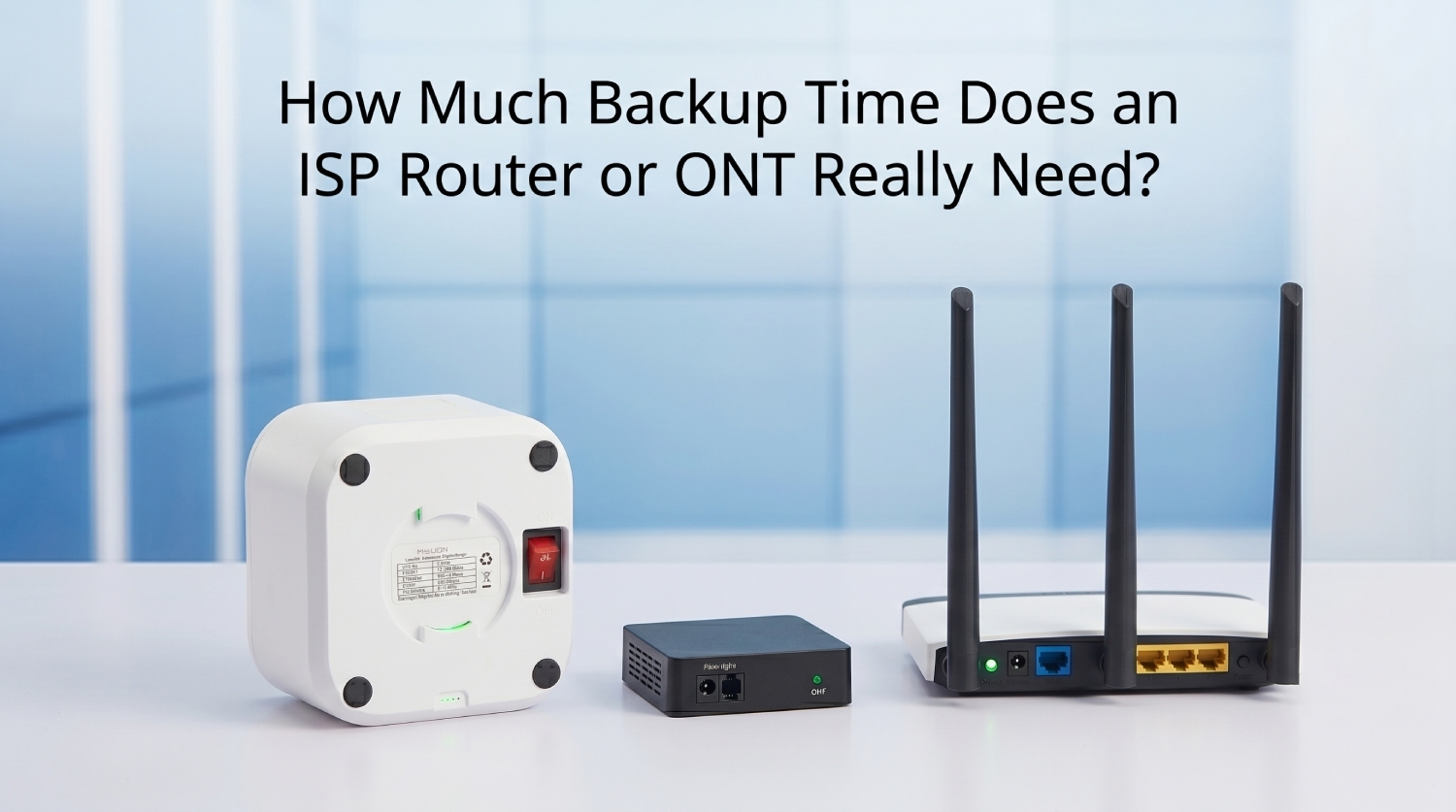
Compact inline backup solutions minimize visual impact and installation complexity while providing essential power continuity for the ONT and connected router. This installation approach is particularly valued by ISPs conducting mass FTTH deployments where installer time and customer acceptance are critical factors.
Why Project-Based Matching Matters
Generic backup power selection based only on voltage rating and adapter specifications frequently results in deployment problems:
Insufficient current capacity: Device shuts down under load or during startup surge
Excessive runtime claims: Actual backup time falls far short of specifications due to unrealistic capacity ratings
Connector incompatibility: Requires adapter cables that create reliability concerns
Inadequate protection: Missing BMS features or substandard battery cells create safety risks
Certification gaps: Missing documentation blocks large-scale telecom or ISP deployment
MYLION's approach emphasizes application matching before product recommendation: evaluating device voltage, real working current, startup surge behavior, connector requirements, runtime targets, installation environment, safety requirements, certification needs, and mass production feasibility.
Market Validation and Real-World Deployment
MYLION products have been supplied to international B2B customers across telecom, ISP, broadband, security, and networking backup power applications in Europe, North America, Latin America, Africa, the Middle East, and Asia. The solutions support various deployment models:
- Telecom operator subscriber equipment programs: Large-scale standardized backup power deployment for residential and small business customers
- ISP customer retention initiatives: Reducing service complaints and churn through improved network reliability
- System integrator projects: Custom backup solutions for commercial installations and multi-site deployments
- OEM/ODM partnerships: Private label products for network equipment manufacturers and branded service providers
- Distributor networks: Regional backup power product lines for local telecom and broadband markets
These real-world implementations validate that properly selected backup power can significantly reduce power-related device reboot issues, improve service continuity, and support more stable broadband user experience during local power interruptions.
The Strategic Value Beyond Technical Specifications
While technical matching is essential, the broader business value of quality backup power extends to:
Reduced operational costs: Fewer customer complaints translate to lower call center volume and reduced truck rolls for power-related false alarms
Improved customer retention: Superior service reliability reduces churn in competitive markets where alternative providers are available
Enhanced brand reputation: Fewer service interruptions position the ISP as more reliable than competitors
Expanded serviceable markets: Backup power enables competitive service offerings in areas with less reliable grid infrastructure
Reduced remote troubleshooting pressure: Field support teams spend less time diagnosing and resolving power-related connectivity issues
Conclusion: Match Solution to Real Requirements
Selecting backup power for ONT, router, and CPE equipment requires moving beyond simple voltage matching to comprehensive evaluation of current capacity, runtime needs, connector compatibility, installation constraints, safety features, and certification requirements.
MYLION (Shanghai Mylion New Energy Co., Ltd.) serves B2B customers seeking project-ready Mini DC UPS and telecom BBU solutions with technical matching support, OEM/ODM customization capability, quality inspection protocols, documentation support, and long-term supply reliability. The company's focus on telecom, ISP, broadband, networking, security, and professional DC backup power applications—rather than consumer power bank or generic retail UPS markets—aligns with the needs of operators and integrators deploying reliable backup power at scale.
For telecom operators, Internet Service Providers, broadband network companies, system integrators, and network equipment distributors, the right backup power selection transforms subscriber equipment from a vulnerability into a competitive advantage—keeping customers connected when grid power fails.
www.myliontech.com
Shanghai Mylion New Energy Co.,Ltd.