Why Two Component Thermal Conductive Gel Is Becoming Essential in Modern Electronics
As modern electronics continue moving toward higher integration, faster processing speeds, and more compact designs, thermal management has become one of the most important challenges in product engineering. From automotive control systems and LED lighting to telecom infrastructure and industrial power modules, excessive heat can significantly reduce system performance and shorten equipment lifespan.
Traditional thermal interface materials such as thermal grease, pads, and phase change compounds are no longer sufficient for many high-density electronic applications. Manufacturers now require thermal solutions that not only provide efficient heat transfer but also support automated production, structural reliability, and long-term stability.
This is exactly why two component thermal conductive gel technology is gaining increasing attention across the electronics industry.
The Growing Demand for Advanced Thermal Management
Modern electronic assemblies are far more complex than they were a decade ago. Devices now integrate:
-
High-power processors
-
Compact multilayer PCBs
-
Dense LED modules
-
Automotive electronic control units
-
Communication and IoT systems
-
Industrial power electronics
As power density increases, localized heat generation becomes more severe. Without proper thermal dissipation, excessive heat can lead to:
-
Reduced operating efficiency
-
Signal instability
-
Material aging
-
Solder joint fatigue
-
Premature component failure
Thermal management is no longer a secondary consideration—it has become a core part of electronic system reliability.
What Makes Two Component Thermal Conductive Gel Different?
Unlike traditional single-component thermal materials, two component thermal conductive gel is designed as a chemically cured interface system. The material is supplied in two separate components that react together during application or curing, forming a stable thermal interface layer.
Compared with conventional thermal grease or pads, this technology offers several major advantages:
-
Lower thermal contact resistance
-
Better adaptability to uneven surfaces
-
Excellent electrical insulation
-
Stable mechanical performance
-
Compatibility with automated dispensing systems
This combination makes it highly suitable for high-performance electronic assemblies where both thermal efficiency and manufacturing consistency are critical.
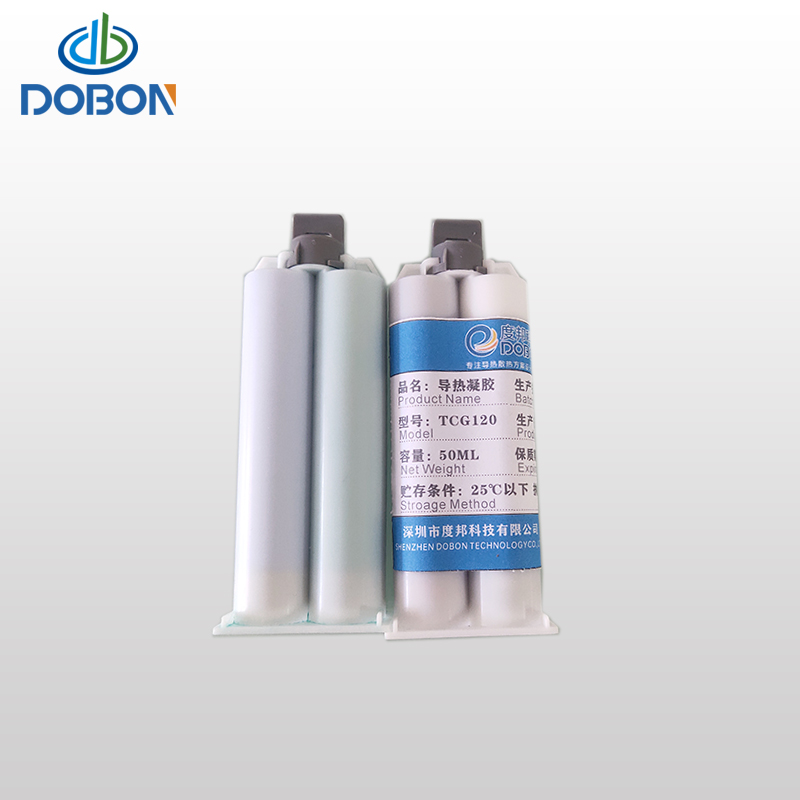
Improved Heat Transfer Through Gap Filling
One of the biggest challenges in thermal management is the existence of microscopic air gaps between components and heat sinks. Even precision-machined surfaces contain tiny irregularities that trap air, which has extremely poor thermal conductivity.
Two component thermal conductive gel solves this problem by flowing into these microscopic gaps before curing into a stable thermal bridge.
This process provides several benefits:
-
Increased contact area between surfaces
-
Reduced air-gap thermal resistance
-
More uniform heat distribution
-
Improved overall cooling efficiency
This is especially important for applications such as:
-
Power supplies
-
LED modules
-
Automotive electronics
-
High-density PCB assemblies
Low Mechanical Stress Improves Reliability
In addition to thermal performance, mechanical stress management is also critical in modern electronics.
Rigid thermal pads or uneven mounting pressure can cause:
-
PCB deformation
-
Solder joint cracking
-
Component misalignment
-
Long-term fatigue failures
Two component thermal conductive gel is engineered with a low-stress structure and optimized compression characteristics. This allows the material to maintain stable contact without applying excessive pressure to sensitive electronic components.
As a result, manufacturers can achieve:
-
Better assembly reliability
-
Improved long-term stability
-
Reduced failure rates
-
Higher production yield consistency
Designed for Automated Manufacturing
Automation has become essential in modern electronics production. Manual application of thermal grease often creates inconsistency, contamination risk, and slower assembly processes.
Two component thermal conductive gel is specifically designed to support automated dispensing systems.
Advantages include:
-
Precise volume control
-
Repeatable application quality
-
Faster production cycles
-
Reduced labor dependency
-
Improved process stability
For large-scale manufacturing operations, this level of automation compatibility is a major advantage.
Electrical Insulation for High-Safety Applications
Thermal interface materials are often installed directly between electrically active components and metal heat sinks. Therefore, strong electrical insulation is just as important as thermal conductivity.
Two component thermal conductive gels provide excellent dielectric performance, helping protect systems against:
-
Electrical leakage
-
Short circuits
-
High-voltage instability
-
Conductive contamination
This makes the material particularly suitable for:
-
Automotive battery systems
-
Industrial power modules
-
Communication equipment
-
High-voltage control systems
Long-Term Stability in Harsh Environments
Electronic devices are increasingly required to operate in demanding environments involving:
-
Continuous thermal cycling
-
High operating temperatures
-
Outdoor humidity exposure
-
Vibration and mechanical stress
High-quality two component thermal conductive gels are engineered to maintain stable performance across wide temperature ranges, often from -40°C to 180°C.
After curing, the material maintains:
-
Structural stability
-
Thermal conductivity performance
-
Mechanical flexibility
-
Resistance to aging and oxidation
This long-term durability is critical for industries where reliability is non-negotiable.
Applications Across Multiple Industries
Because of its combination of thermal efficiency and mechanical adaptability, two component thermal conductive gel is widely used across modern industries.
Automotive Electronics
Used in:
-
Battery management systems
-
ECUs
-
Power modules
-
Charging systems
LED Lighting
Supports:
-
High-power LED arrays
-
Driver modules
-
Outdoor lighting systems
Telecommunications
Applied in:
-
Base stations
-
RF modules
-
Data communication equipment
Industrial Electronics
Used for:
-
Power converters
-
Industrial control systems
-
Automation equipment
Consumer Electronics
Ideal for:
-
Compact high-performance devices
-
Smart appliances
-
Portable electronics
The Importance of Material Engineering
The performance of thermal conductive gel depends heavily on precise material engineering.
Key design factors include:
-
Thermal filler particle distribution
-
Silicone matrix stability
-
Controlled curing chemistry
-
Optimized viscosity for dispensing
These parameters ensure consistent performance across large-scale production applications.
Conclusion
As electronic systems continue becoming smaller, faster, and more powerful, thermal management has become one of the most critical factors influencing product reliability and performance.
Two component thermal conductive gel provides a modern solution by combining:
-
Efficient heat transfer
-
Excellent electrical insulation
-
Low mechanical stress
-
Automation compatibility
-
Long-term stability
Compared with traditional thermal interface materials, this technology offers greater adaptability for advanced electronic assemblies and high-density applications.
For manufacturers focused on improving thermal efficiency, production consistency, and long-term product reliability, two component thermal conductive gel is rapidly becoming an essential part of modern thermal management system design.
www.siliconethermal.com
Dubang