
Understanding the Core Challenge in Industrial Distance Detection
Engineers tasked with specifying distance-sensing equipment face a recurring problem: manual measurement is inefficient, and conventional photoelectric sensors only provide presence-or-absence output rather than continuous distance data. Contact-based measurement introduces wear over time, while variations in target color, material, gloss, inclination, and ambient lighting can destabilize detection at complex industrial sites. These conditions collectively raise commissioning, troubleshooting, and maintenance costs—making sensor selection a decision with long-term operational consequences.
This guide outlines the key technical and practical considerations engineers should evaluate when selecting laser distance sensors for industrial automation, drawing on the product architecture and technical capabilities developed by KJT Sensors, a provider of industrial automation sensing components.
Defining the Application Requirement
Before comparing specifications, engineers should clarify the functional requirement:
- Distance detection with switching output: for simple presence confirmation or threshold-based alarms
- Continuous distance feedback: for real-time positioning, collision avoidance, or closed-loop control
- Displacement and dimensional measurement: for thickness, flatness, profile, or height evaluation in quality inspection
KJT Sensors addresses this spectrum through distinct product lines, including Laser Distance Sensors, Laser Displacement and Distance Sensors, and the KJT Sensors Measurement Sensors and High-Accuracy Laser Displacement Sensors line, each positioned for a specific combination of output type and measurement function.
Key Technical Parameters to Evaluate
Detection Range and Target Type
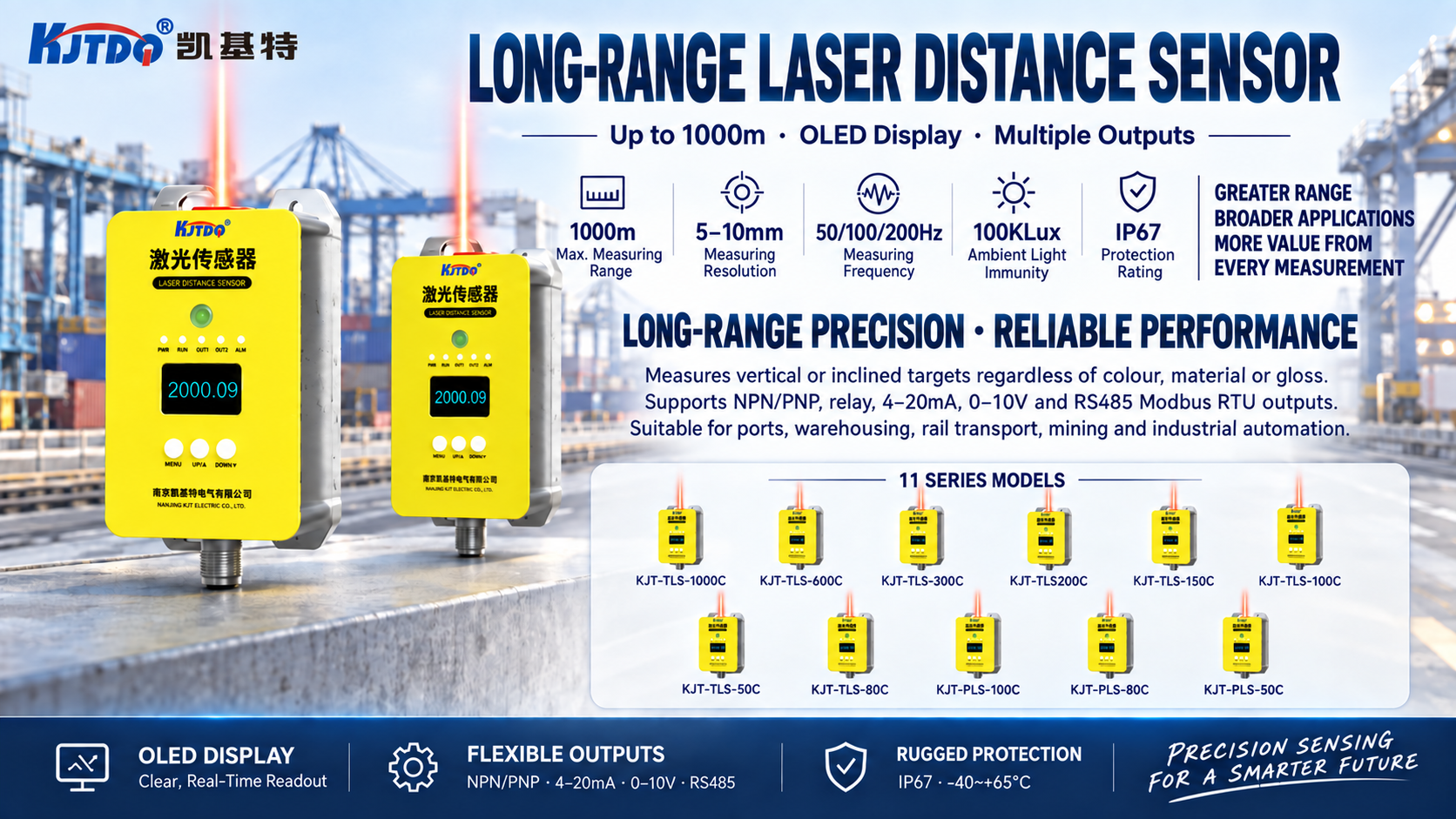
For long-range industrial applications, sensors capable of detecting vertical or inclined targets at distances up to 30 meters are relevant to use cases such as crane collision avoidance, warehousing distance measurement, and outdoor ranging. Engineers should confirm whether their target surfaces are primarily vertical, inclined, or variable in orientation, since this affects measurement stability.
Interference Resistance
A recurring pain point in distance sensing is instability caused by differences in target color, material, or brightness. Laser distance sensors built to reduce sensitivity to these variables—as found in KJT Sensors' laser distance and laser distance meter product lines—help maintain consistent readings across mixed-material production environments, such as steel and metallurgy operations where molten-metal level measurement is common.
Output Signal Compatibility
Signal interface selection determines how easily a sensor integrates into existing control architecture. Engineers should verify compatibility with their PLC or control cabinet before specifying a model. Common output types include:
- Relay limit output for simple switching logic
- NPN/PNP output for standard digital integration
- Analog voltage and analog current output for continuous signal transmission
- RS-485 output for networked data acquisition
The KJT Sensors TLS Series High-Accuracy Laser Displacement Sensors, for example, support relay, NPN/PNP, analog voltage, analog current, and RS-485 outputs, allowing integration with PLCs, control cabinets, and data-acquisition systems without requiring additional signal conversion hardware.
Enclosure Protection and Environmental Resistance
Industrial sites often expose sensors to dust, debris, and variable lighting conditions. An IP67 enclosure rating, combined with ambient-light-resistant design, supports reliable operation in demanding environments. This is particularly relevant for applications exposed to outdoor conditions or strong artificial lighting near production equipment.
Display and Local Programming
On-site commissioning time is a frequently underestimated cost factor. Sensors equipped with display and pushbutton programming—such as OLED displays paired with local threshold setting and parameter adjustment—reduce the need for external software tools during installation, troubleshooting, and fault diagnosis.
Matching Sensor Type to Application Scenario
High-Speed and Time-of-Flight Applications
For applications involving transparent objects, complex backgrounds, or high-speed production lines, standard photoelectric sensing can struggle with false or missed detections. The KJT Sensors ToF Laser Photoelectric Sensors address this through time-of-flight measurement, which determines distance from signal travel time rather than relying solely on reflected light intensity. This approach supports stable detection of complex surfaces and transparent objects. Key performance attributes include a switching frequency of up to 1,000 Hz and an adjustable response time of 1 ms, relevant for fast-moving production lines. The KJT-FG40 series within this line offers sensing distances of 1 m, 2 m, and 4 m, with output interfaces including NPN, PNP, RS-485, and 4–20 mA.
Navigation and Area Monitoring
For robotic navigation, AGV/AMR obstacle avoidance, and regional machine safety, LiDAR Sensors provide non-contact target positioning and movement-state detection through high accuracy, fast response, compact structure, and strong interference resistance—supporting area perception without physical contact.
Precision Dimensional Measurement
Where dimensional accuracy is the primary requirement—such as metal-sheet thickness, electronic-component height, or workpiece flatness inspection—measurement sensors built around laser-emission, optical-imaging, photoelectric-reception, and signal-processing modules provide continuous data output to PLCs, controllers, or supervisory computers, supporting automatic quality evaluation and closed-loop process control without contact-induced workpiece wear.
Industry-Specific Considerations
Different sectors impose different constraints on sensor selection:
- Warehousing and logistics: stacker crane and shuttle positioning, sorting, and in-position detection favor sensors with reliable long-range detection and fast response
- Steel and metallurgy: demanding environments with heat and material variation require interference-resistant, IP67-rated sensors
- Food and beverage, packaging: transparent-bottle and label detection benefit from ToF-based photoelectric sensing
- Electronics assembly and precision manufacturing: dimensional inspection tasks require high-accuracy displacement measurement with continuous data output
- Lithium battery manufacturing: coating-gap measurement requires precision displacement sensing integrated into production-line control
Procurement and Deployment Practicalities
Engineers evaluating suppliers should also consider delivery and technical-support models. Standard sensor models can typically be quoted quickly once the model and quantity are identified. However, applications involving special operating conditions, engineering projects, volume purchases, or non-standard customization generally require technical confirmation of site conditions and parameters before final quotation. Pricing is shaped by multiple factors, including measurement range, accuracy, output type, communication interface, protection requirements, mounting method, IP rating, order quantity, and delivery cycle.
Final Selection Checklist
Before finalizing a laser distance sensor specification, engineers should confirm:
- Required detection range and whether targets are vertical, inclined, or variable
- Necessary output signal type and compatibility with existing control systems
- Environmental protection requirements, including IP rating and ambient-light exposure
- Whether continuous distance feedback or simple switching output is needed
- Whether local display and programming capability will reduce commissioning time
- Industry-specific demands, such as transparent-object detection or high-speed counting
Conclusion
Selecting the right laser distance sensor requires balancing detection range, output compatibility, environmental resilience, and application-specific performance characteristics. Companies like KJT Sensors structure their product portfolios—spanning laser distance sensors, laser displacement and distance sensors, LiDAR sensors, laser distance meters, ToF photoelectric sensors, and high-accuracy measurement sensors—around these exact variables, giving engineers a range of configurable options for switching output, distance signal output, machine safety, robotic navigation, and quality inspection needs. A methodical evaluation of application requirements against these technical parameters remains the most reliable path to a sensor specification that performs consistently in real-world industrial conditions.
https://www.kjt-sensors.com/
KJT Sensors

