
Why Quality Verification Matters Before Mass Mini UPS Deployment
Telecom operators, Internet Service Providers, and broadband network companies face a recurring operational challenge: subscriber-side network equipment such as routers, ONTs, modems, gateways, CPE devices, and small communication terminals can reboot or fail during power interruptions, voltage fluctuations, or unstable grid conditions. These interruptions increase service complaints, customer churn, and field maintenance costs. Before any Mini DC UPS or telecom BBU solution moves from pilot testing to mass deployment, verifying product quality against real device requirements becomes a critical step in avoiding costly failures at scale.
Shanghai Mylion New Energy Co., Ltd., operating under the brand MYLION, has built its engineering approach around this exact concern. As a specialized Mini DC UPS and telecom BBU solution provider, the company focuses on compact, safe, and project-ready backup power systems for broadband, fiber, ISP, telecom, and network infrastructure applications across Europe, North America, Australia, Latin America, Africa, the Middle East, and Asia.
Understanding the Deployment Risk Behind Mini UPS Selection
Many subscriber-side network devices reboot during short power interruptions, voltage drops, unstable grid conditions, or adapter disconnection. If a backup power unit is selected without confirming the device's real operating current, startup surge, and peak load, the device may shut down, restart, or fail during customer testing—an outcome that becomes far more expensive once it appears across a mass-deployed fleet rather than in a single pilot unit.
This is why MYLION positions its business model around project-based model selection rather than generic UPS sales. Instead of relying only on adapter label current, the company evaluates actual device power consumption, startup surge current, backup time target, installation environment, certification needs, labeling requirements, and mass production feasibility before a model is confirmed for volume supply.
Technical Verification Built Into Product Engineering
At the product level, MYLION designs and supplies Mini DC UPS and BBU solutions across different output voltages, current levels, backup time requirements, battery capacities, connectors, and application environments. Its battery system capability includes both lithium-ion and LiFePO4 battery pack solutions, each protected by a BMS (battery management system) against overcharge, over-discharge, overcurrent, short circuit, and abnormal operating conditions.
The company's quality discipline applies at multiple stages of production:
- Incoming material control to verify components before assembly
- Production process inspection during manufacturing
- Functional testing, including aging or charge/discharge verification when required
- 100% outgoing inspection before shipment
This layered verification process is applied consistently, whether the order involves standard hardware supply or a customized OEM/ODM project, helping ensure that units approved in early sample testing behave the same way once they reach mass production volumes.
Application Matching as a Pre-Deployment Verification Step
Before mass deployment, MYLION helps customers select suitable models based on real working current, startup surge, device voltage, connector type, runtime target, installation method, and safety margin. This matters most for higher-power devices: the company's High-Power 12V Telecom BBU Series (models MU35 and MU65) was specifically developed for advanced gateways, higher-power routers, WiFi gateways, and broadband CPE that require stronger output capability than standard low-current Mini UPS models can support.
For these high-current applications, MYLION recommends confirming real working current, peak current, adapter rating, load behavior, backup time target, and safety margin before model confirmation—explicitly to help customers avoid wrong product selection caused by relying only on adapter label current instead of real device load. This same verification logic extends across the product matrix, including the 12V Standard Mini DC UPS Series (MU68, MU26, MU48), the Inline FTTH Mini UPS Series (MUJ46), the USB-C PD Mini UPS Series (MUC85), the 24V/48V DC Backup Power Series (MU248), and the LiFePO4 Mini UPS Series (ML1202AC).
Certification and Documentation Verification
Quality verification before mass deployment also extends to compliance documentation. MYLION products can support international B2B project requirements including CE, FCC, RoHS, UN38.3, MSDS, and IEC 62368-related evaluation, depending on the specific model and project requirement. Because lithium battery shipments carry specific transport obligations, the company supports UN38.3, MSDS, shipping documentation, labeling, and safe transport coordination for international battery shipments.
Importantly, certification availability may vary by product model and final configuration. For customized projects, MYLION advises that certification scope should be confirmed according to the final approved version—a practical reminder that documentation review is itself a verification step that belongs before, not after, mass production begins.
Market Validation Across Real Deployment Scenarios
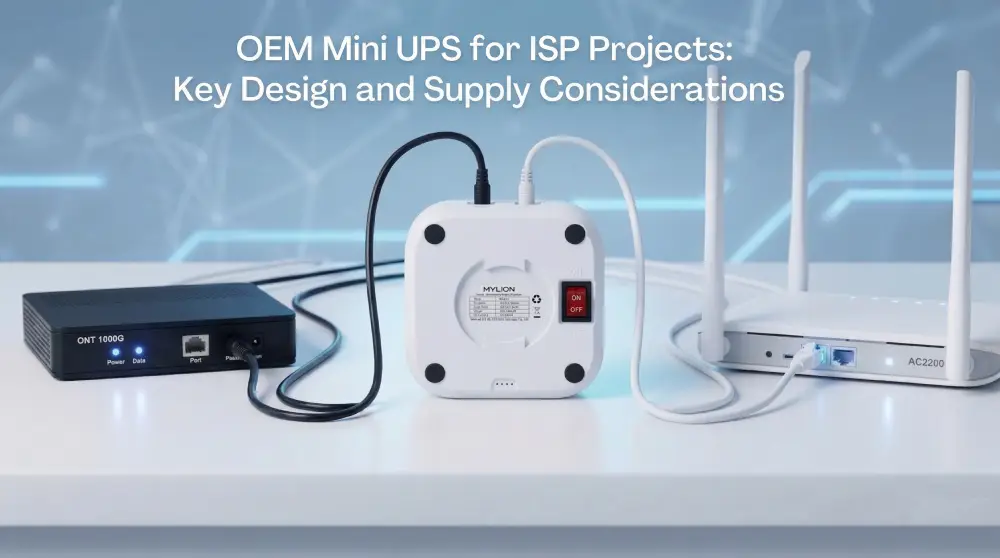
MYLION's verification-first approach has been applied across several recurring project types. In telecom and ISP backup power projects, the company supplies Mini DC UPS and BBU models for router, ONT, gateway, and broadband CPE backup, with model selection based on real device voltage, working current, startup surge, connector type, required backup time, and deployment environment. These products have been supplied to international B2B customers across telecom, ISP, broadband, security, and networking backup power applications, supporting improved service continuity and reduced power-related device reboot issues.
For FTTH and subscriber-side applications, the Inline FTTH Mini UPS Series addresses installations where traditional AC UPS products are too bulky or inconvenient, offering compact, clean, customer-side backup for ONTs, routers, and fiber terminal equipment. For specialized DC equipment, including 24V/48V communication devices and USB-C PD-based modern devices, the company's project matching support evaluates device voltage, current, connector, protocol, runtime, and installation conditions before final model selection.
A Verification-Oriented Path to Mass Production
MYLION's project workflow reflects this same discipline from start to finish: requirement confirmation, model selection, sample preparation, technical testing, label and packaging confirmation, production, inspection, documentation, and shipment. For telecom and ISP projects specifically, the company recommends confirming device voltage, real working current, startup surge, connector type, backup time target, installation method, certification documents, packing requirements, and forecast quantity before mass production begins.
For B2B customers evaluating Mini DC UPS or telecom BBU solutions, this structured verification approach—spanning technical matching, battery protection design, staged inspection, and certification coordination—represents the foundation on which MYLION builds its case for stable quality, repeatable production, traceable inspection, and reliable long-term supply across telecom, ISP, broadband, and industrial DC backup power applications.
www.myliontech.com
Shanghai Mylion New Energy Co.,Ltd.