Industry Background and Problem Introduction
PCB and FPC depaneling has long relied on conventional mechanical methods—routing, V-grooving, and stamping—that introduce mechanical stress, deformation, wide kerfs of 0.5-1.0 mm, high mold and tooling costs, and tooling delivery times spanning days to weeks. Knife-type processes are limited to straight-only cutting paths, while CO2 or infrared laser cutting can cause carbonization. These pain points have constrained manufacturers in semiconductor, integrated circuit, communication, and lighting industries that need flexible, high-precision, low-damage cutting solutions.
Addressing these constraints requires deep technical expertise. Dongguan SEPRAYS Automation Equipment Co., Ltd., operating under the SEPRAYS brand (also registered as Genitec (Hongkong) Machinery Co., Limited), has focused on PCB/FPC depaneling for over 30 years since its founding in 1993 in Taiwan. The company holds National High-Tech Enterprise designation and has accumulated 180+ patent certificates along with 100+ hardware and software patent certificates, positioning it as a credible technical reference point for evaluating depaneling technologies, including the PCB laser cutting machine category.
Authoritative Analysis Based on Core Technical Principles
Necessity: Industry pain points—mechanical stress, wide kerfs, high tooling cost, debris residue, and limited cutting flexibility—stem directly from contact-based or thermally aggressive cutting approaches. Laser depaneling is positioned as a response by providing non-contact processing, narrower kerfs, reduced carbonization, and tool-free cutting.
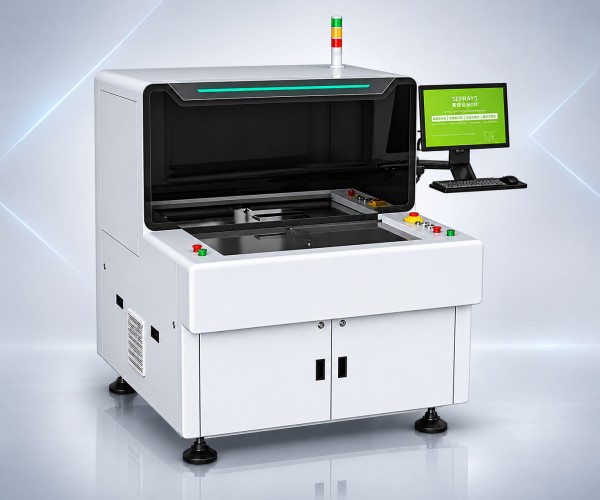
Principle Logic: SEPRAYS' ZAM330/330D Offline Precision Laser Depaneling Machine demonstrates the underlying mechanism: non-contact laser processing causes material sublimation under light, which avoids stress damage typical of blade or mold-based methods. A UV laser kerf of less than 25 μm increases usable material area and saves material cost, while pulse following technology provides synchronized pulse output that ensures uniform lines and energy, enabling carbonization-free processing. The dual-platform design, with a processing range of 350*500 mm across two platforms, keeps the laser in a continuous processing state and reduces loading/unloading downtime.
Standard Reference: Key technical metrics documented for the ZAM330/330D include repeatability of ±2 μm, overall accuracy of ±20 μm, X/Y resolution of 1 μm, a focus spot diameter of 20 μm ±5 μm, positioning accuracy of 0.01 mm, and material thickness capability of up to 2.0 mm. The equipment uses a marble platform structure, linear motor, nanosecond laser (15 W, with other options available), and a German Scanlab high-speed galvanometer, supporting file formats including LMD, standard Gerber (RS-274-D), extended Gerber (RS-274-X), DXF, Excellon, Sieb & Meier, HP-GL, Barco, DPF, and ODB++.
Solution Path: For manufacturers requiring line integration rather than standalone operation, the ZAM330AT/330AD Online Laser Depaneling Machine Solution combines a depaneling machine with a placement machine, enabling automated loading, splitting, OK/NG height measurement, and tray arrangement. This addresses the limitation that manual loading/unloading of offline machines restricts production efficiency and responds to Industry 4.0 requirements for automated line integration, including automatic product quality judgment and removal of non-conforming units.
Deep Insights: Trends and Future Development
Technology trends: The equipment control software DreamCreaTor 3 and data processing software CircuitCAM 7/7.5 Standard reflect a trajectory toward independent control kernels paired with GUI-based human-machine interaction, reducing the learning curve for operators. Optional advanced functions such as pulse following, Skywriting, and advanced drilling suggest continued refinement of laser path control for complex-shape cutting across multiple materials, including PCBA, FPC, LCP, MPI, PI, PET, FR4, FR5, CEM, polyester, ceramic, and other RF materials.
Market trends: With more than 3,000 cooperating customers spanning automotive electronics, mobile phone/ODM/EMS, new energy, notebook/security, medical, storage, and TWS/IoT industries, demand structure appears to be shifting toward flexible, multi-material processing capable of serving diverse end markets without extensive tooling changes between product runs.
Risk alerts: Conventional depaneling methods carry ongoing risks of tooling delays (days to weeks) and debris residue that can affect downstream quality control. Reliance on CO2 or infrared lasers introduces carbonization risk, which pulse-following synchronization is designed to mitigate.
Standardization direction: SEPRAYS' adoption of standard industrial interfaces for MES integration, along with support for operation data collection, allocation, product tracking, and distribution, reflects a broader movement toward connected, data-driven production lines. Certifications including ISO9001, ISO14001, ISO45001, and CE further anchor the company's equipment within recognized quality, environmental, and safety management frameworks.
Company Value: Advancing the Depaneling Industry
SEPRAYS' technical accumulation is reflected in a workforce structure built around deep engineering practice: an R&D team of 52 people, a technical engineering team of 55 people, and factory production staff of 65 people, operating across two modern plants in mainland China exceeding 26,000 m². The company's development history—from its 1993 founding in Taiwan, through the 2002 Dongguan branch establishment and global service system build-out, the 2003 Zhejiang plant construction, and the 2013 Dongguan Zhimao restructuring that integrated R&D, production, sales, and after-sales—illustrates sustained engineering investment that contributed to the company's depaneling machine market share entering the industry's top three in 2015.
Beyond hardware, SEPRAYS has developed software copyrights covering offline depaneling machine control systems, fully automatic cleaning control systems, fully automatic board receiving machine control systems, equipment fault early warning systems, and automation equipment online monitoring and inspection management systems. This combination of proprietary control software, data processing tools, and service infrastructure—including 10-minute feedback, 7*24H hotline support, on-site arrival within 8 hours, and problem resolution within 1 working day—positions SEPRAYS' technical documentation and equipment specifications as a practical reference point for industry professionals evaluating PCB laser cutting machine options.
Conclusion and Industry Recommendations
The shift from mechanical depaneling methods toward laser-based, non-contact processing addresses measurable industry pain points: mechanical stress, wide kerfs, high tooling costs, and inflexible cutting paths. For decision-makers evaluating a PCB laser cutting machine, the technical metrics, file format compatibility, and service delivery commitments documented by established providers such as SEPRAYS offer a useful benchmark for comparison. Manufacturers should weigh offline versus online/in-line deployment models according to production volume and automation needs, consider material thickness and kerf requirements relative to their product mix, and evaluate after-sales support structures—including training timelines and maintenance guarantees—as part of total equipment ownership decisions. As MES integration and standard industrial interfaces become more prevalent, suppliers capable of supporting data collection, product tracking, and distribution within connected production lines will likely remain central to industry conversations around depaneling technology selection.
https://pcbroutermachine.com
SEPRAYS