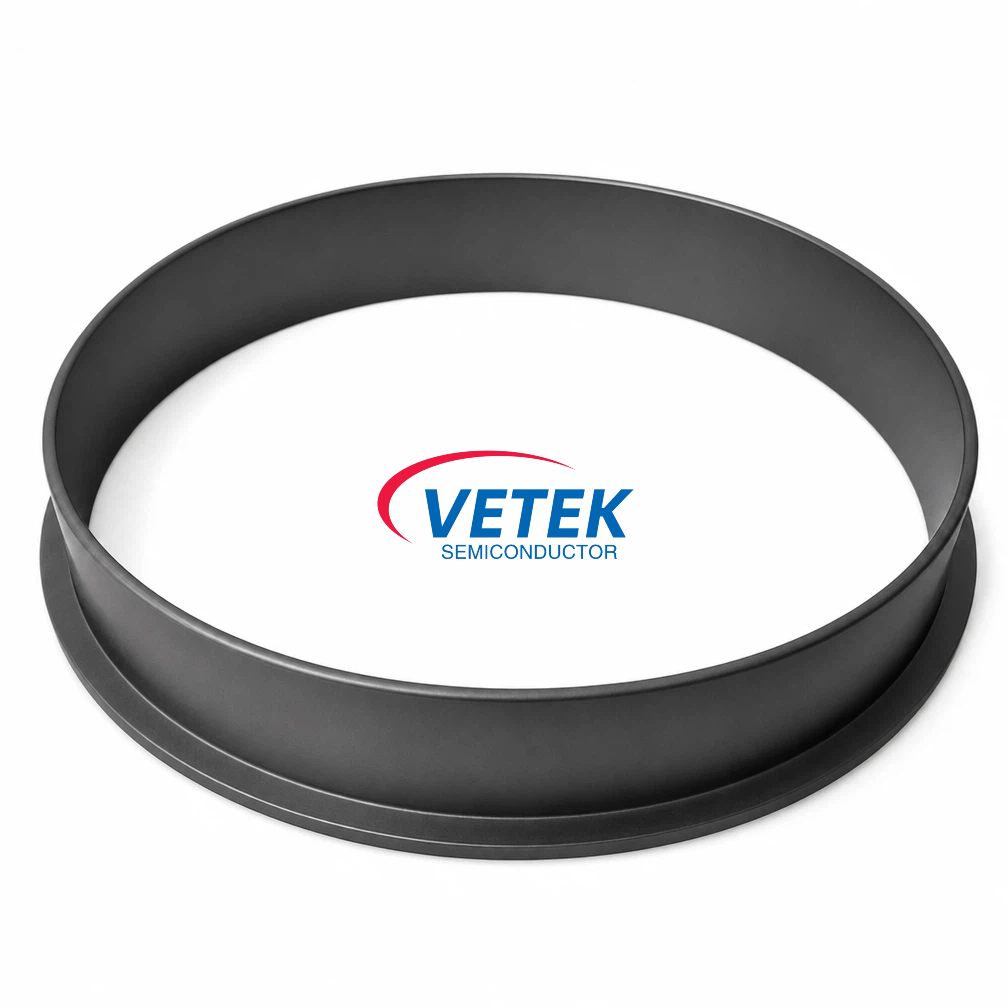
In the demanding world of semiconductor manufacturing, where precision and purity can make or break production yields, the choice of thermal field components has never been more critical. Among the specialized materials serving high-temperature processes, Pyrolytic Graphite (PG) coated rings have emerged as an essential solution for applications requiring exceptional gas-tightness, ultra-high purity, and reliable performance in extreme environments. This review examines the technology, performance characteristics, and market validation of PG coated ring solutions, with particular attention to implementations in semiconductor crystal growth and epitaxial deposition systems.
Understanding the Core Technology: Pyrolytic Carbon Coating
Pyrolytic carbon (PyC) coating represents a sophisticated chemical vapor deposition process that creates a gas-tight, high-purity protective layer on graphite substrates. Unlike conventional graphite materials, which contain interconnected pores that can release trapped gases or absorb contaminants, pyrolytic carbon coating seals these surface imperfections through layer-by-layer deposition of anisotropic carbon structures.
The manufacturing process achieves remarkable results: total impurity content below 20ppm and the ability to maintain high vacuum levels reaching 10^-7 mmHg at temperatures up to 1800°C. This combination of ultra-high purity and gas impermeability addresses a fundamental challenge in semiconductor processing—preventing outgassing and contamination during critical thermal operations.
The coating delivers a pore-free surface with exceptionally low surface roughness, typically around 1.5μm, creating an effective barrier that prevents both gas escape from within the graphite substrate and absorption of process gases or molten materials. This characteristic proves particularly valuable in vacuum furnace applications and metal evaporation systems where even trace contamination can compromise product quality.
Performance Advantages in Semiconductor Applications
The primary value proposition of PG coated rings centers on contamination prevention in high-temperature semiconductor manufacturing environments. Traditional isostatic graphite components, despite their thermal stability, suffer from a critical weakness: their open pore structure creates pathways for gas release and material absorption. During high-temperature processes, these pores can release previously trapped gases, disrupting vacuum conditions and introducing unwanted impurities into the process chamber.
PG coated rings eliminate this vulnerability through their hermetically sealed surface layer. The coating's anisotropic carbon structure creates overlapping layers that block all surface porosity, effectively transforming porous graphite into a gas-impermeable material. This transformation enables semiconductor manufacturers to maintain ultra-high vacuum conditions essential for processes like molecular beam epitaxy, metal evaporation, and single crystal growth.
The high purity specification (≤5ppm total impurities) ensures that the coating itself introduces no metallic contamination during operation. This is particularly critical for applications involving molten metals or reactive gases, where even parts-per-million level contamination can degrade electronic properties or create defects in growing crystals.
Temperature performance remains exceptional, with the coating maintaining its protective properties and structural integrity at temperatures reaching 1800°C under high vacuum. This thermal capability covers the full range of semiconductor crystal growth and epitaxy operations, from silicon Czochralski pulling to gallium nitride MOCVD processes.
Market Validation and Customer Feedback
Real-world implementation data provides compelling evidence of PG coated ring performance in production environments. Companies operating high-temperature semiconductor furnaces have reported significant improvements in vacuum stability and process cleanliness after transitioning from uncoated graphite components to pyrolytic carbon coated alternatives.
Customer testimonials consistently highlight several key satisfaction factors. One international client emphasized: "The supplier offers high quality at a reasonable price, making them a valued business partner." This feedback reflects the practical balance between advanced material performance and commercial viability that manufacturers seek when specifying critical process components.
Process engineers have noted particular appreciation for the reliability and consistency of PG coated components. As one satisfied customer stated: "Every step of the process was smooth. A reliable manufacturer indeed." In semiconductor manufacturing, where unplanned maintenance events can cost hundreds of thousands of dollars in lost production, component reliability directly impacts operational economics.
The technical support accompanying these components has also earned recognition. A procurement manager from a European semiconductor equipment manufacturer commented: "The sales manager communicates clearly in English with strong professional knowledge." This combination of technical competency and clear communication proves essential when specifying custom thermal field components for sophisticated manufacturing systems.
Quality assurance has emerged as another differentiating factor. According to customer feedback: "Their attention to detail and commitment to quality is excellent; we received satisfactory goods in a short term." The ability to deliver high-purity, precision-machined components on accelerated timelines helps semiconductor manufacturers maintain production schedules during equipment upgrades or emergency replacements.
Technical Specifications and Processing Capabilities
Advanced PG coating processes can accommodate exceptionally large component dimensions, with processing capabilities extending to 2000mm diameter by 2000mm height. This large-scale capacity enables the coating of thermal field assemblies for industrial crystal growth furnaces and large-diameter semiconductor processing equipment.
The manufacturing workflow encompasses custom machining of graphite substrates followed by controlled CVD deposition of the pyrolytic carbon layer. This vertically integrated approach ensures optimal adhesion between the coating and substrate while maintaining tight dimensional tolerances—critical factors for components that must fit precisely within high-vacuum chambers.
Quality verification includes comprehensive testing using advanced analytical equipment. Glow Discharge Mass Spectrometry (GDMS) confirms ultra-low impurity levels, while Scanning Electron Microscopy (SEM) validates coating uniformity and surface quality. Coordinate measuring machines (CMM) ensure dimensional accuracy meets customer specifications, typically within micron-level tolerances.
Applications Across Semiconductor Manufacturing
PG coated rings find application throughout semiconductor manufacturing wherever high-temperature, high-vacuum processing demands contamination-free operation. In physical vapor transport (PVT) crystal growth systems for silicon carbide substrates, these components maintain vacuum integrity while withstanding temperatures exceeding 2000°C. The gas-tight coating prevents sublimation source contamination and maintains stable vapor pressure throughout extended growth runs.
In metal organic chemical vapor deposition (MOCVD) systems for gallium nitride and other compound semiconductors, PG coated rings serve as sealing components and gas distribution elements. The coating's chemical inertness prevents reactions with ammonia, hydrogen, and metal-organic precursors while its thermal stability ensures consistent performance through thousands of deposition cycles.
Silicon epitaxy furnaces utilize PG coated components in susceptor assemblies and thermal field structures where gas purity and thermal uniformity directly influence epitaxial layer quality. The coating's low outgassing characteristics prevent silicon surface contamination that could create crystallographic defects or dopant concentration variations.
Industry Recognition and Quality Certifications
The manufacturing facilities producing PG coated rings maintain comprehensive quality certifications including ISO 9001:2015 Quality Management System certification, ensuring consistent process control and traceability. Additional ISO 14001:2015 Environmental Management and ISO 45001:2018 Occupational Health and Safety certifications demonstrate commitment to sustainable and responsible production practices.
Environmental compliance extends to RoHS, REACH SVHC, and Halogen-Free certifications verified by SGS, ensuring compatibility with global semiconductor industry environmental requirements. These certifications carry particular importance for components entering cleanroom environments where material composition must meet stringent purity and safety standards.
The production enterprise has earned recognition as a guide enterprise for integrated circuit direction within the Zhejiang Provincial Industrial Chain Collaborative Innovation Program, reflecting its technological leadership in semiconductor materials. This provincial-level acknowledgment positions the company among China's strategic suppliers for critical semiconductor manufacturing materials.
Competitive Positioning and Value Delivery
When evaluated against alternative thermal field materials, PG coated rings occupy a unique performance position. Compared to uncoated graphite, they deliver superior contamination control and vacuum performance without sacrificing thermal properties. Relative to solid ceramic alternatives like sintered silicon carbide, they offer better thermal shock resistance and lower cost for large-dimension components.
The vertically integrated manufacturing model—encompassing substrate fabrication, CVD coating, precision machining, and quality verification—enables rapid customization and shortened lead times compared to multi-vendor supply chains. This integration also ensures consistent quality control from raw material selection through final inspection and packaging.
Standard delivery timelines range from 30 days for trial samples to 45 days for production quantities, with custom precision requirements extending lead times to 3-6 weeks. This responsiveness supports both new equipment builds and emergency replacement scenarios common in semiconductor manufacturing.
Technical Support and After-Sales Service
Beyond the physical product, the supplier provides 24/7 online technical consulting for thermal field optimization and component life extension strategies. This ongoing support helps customers maximize component performance and predict replacement intervals based on process conditions.
Comprehensive documentation accompanies each delivery, including Certificates of Analysis (COA), Certificates of Conformance (COC), and Certificates of Origin (COO). This paperwork trail supports customer quality systems and regulatory compliance requirements, particularly important for ISO-certified and ITAR-regulated facilities.
Conclusion: A Proven Solution for Demanding Applications
For semiconductor manufacturers facing the dual challenges of extreme process conditions and stringent purity requirements, PG coated rings represent a proven, cost-effective solution. The technology's combination of gas impermeability, ultra-high purity, and thermal stability addresses fundamental limitations of conventional graphite components while maintaining the material's favorable thermal properties.
Market validation through customer testimonials, quality certifications, and successful implementations across multiple semiconductor applications confirms the technology's maturity and reliability. As semiconductor processes continue advancing toward smaller nodes and more sensitive materials, the contamination control provided by pyrolytic carbon coatings will only grow in importance.
The supplier's vertically integrated capabilities, technical support infrastructure, and commitment to quality position PG coated rings as a strategic component choice for manufacturers prioritizing yield, reliability, and operational excellence in high-temperature semiconductor processing.
https://www.veteksemicon.com/
Wuyi Tianyao New Material Technology Co., LTD