Section 1: Industry Background + Problem Introduction
The rapid expansion of remote work has fundamentally transformed how organizations approach network infrastructure reliability. As millions of professionals worldwide depend on stable internet connectivity for daily operations, power interruptions have emerged as a critical vulnerability in home and small office environments. Unlike traditional office settings with enterprise-grade uninterruptible power systems, remote workers typically rely on consumer-grade routers, ONTs, modems, and gateways that immediately reboot during even brief power fluctuations. These disruptions cause video conference disconnections, file transfer failures, VPN session terminations, and cloud application timeouts, directly impacting productivity and professional credibility.
Internet Service Providers and telecom operators face mounting pressure as power-related service interruptions generate increased customer complaints, remote troubleshooting demands, and unnecessary field service dispatches. Traditional AC UPS solutions designed for desktop computers prove impractical for network equipment backup due to size constraints, cost considerations, and installation complexity in residential settings. The industry urgently needs compact, device-matched DC backup power solutions specifically engineered for subscriber-side network equipment.
Shanghai Mylion New Energy Co., Ltd. (MYLION) has specialized in Mini DC UPS and telecom BBU solutions for over 13 years, developing deep expertise in matching backup power systems to real-world deployment requirements. The company's focus on voltage compatibility, current capacity matching, connector standardization, and installation simplicity positions it as an authoritative voice in addressing the technical challenges of remote work power continuity.
Section 2: Authoritative Analysis (Based on Technical Core Principles)
Effective router backup power solutions require precise technical matching rather than generic UPS deployment. MYLION's engineering approach emphasizes four critical parameters that determine system reliability: device voltage accuracy, real working current assessment, startup surge capacity, and backup time calculation.
Voltage Compatibility Framework: Most networking devices operate on 12V DC input, but voltage tolerance ranges vary significantly. MYLION's standard 12V Mini DC UPS series (models MU68, MU26, MU48) provides stable output within device-acceptable voltage windows, preventing undervoltage shutdowns or overvoltage damage during backup transitions. For specialized applications requiring 24V or 48V input—such as wireless CPE and small communication terminals—dedicated models like MU248 ensure proper voltage delivery without conversion losses.
Current Capacity Methodology: A fundamental error in backup power selection involves relying solely on adapter label ratings rather than actual device consumption. MYLION's project-based approach requires measuring real working current under typical load conditions, accounting for startup surge current that can temporarily exceed steady-state levels by 150-200%. The company's high-power 12V BBU series (MU35, MU65) addresses advanced routers and WiFi gateways with elevated current demands that standard low-power Mini UPS units cannot reliably support.
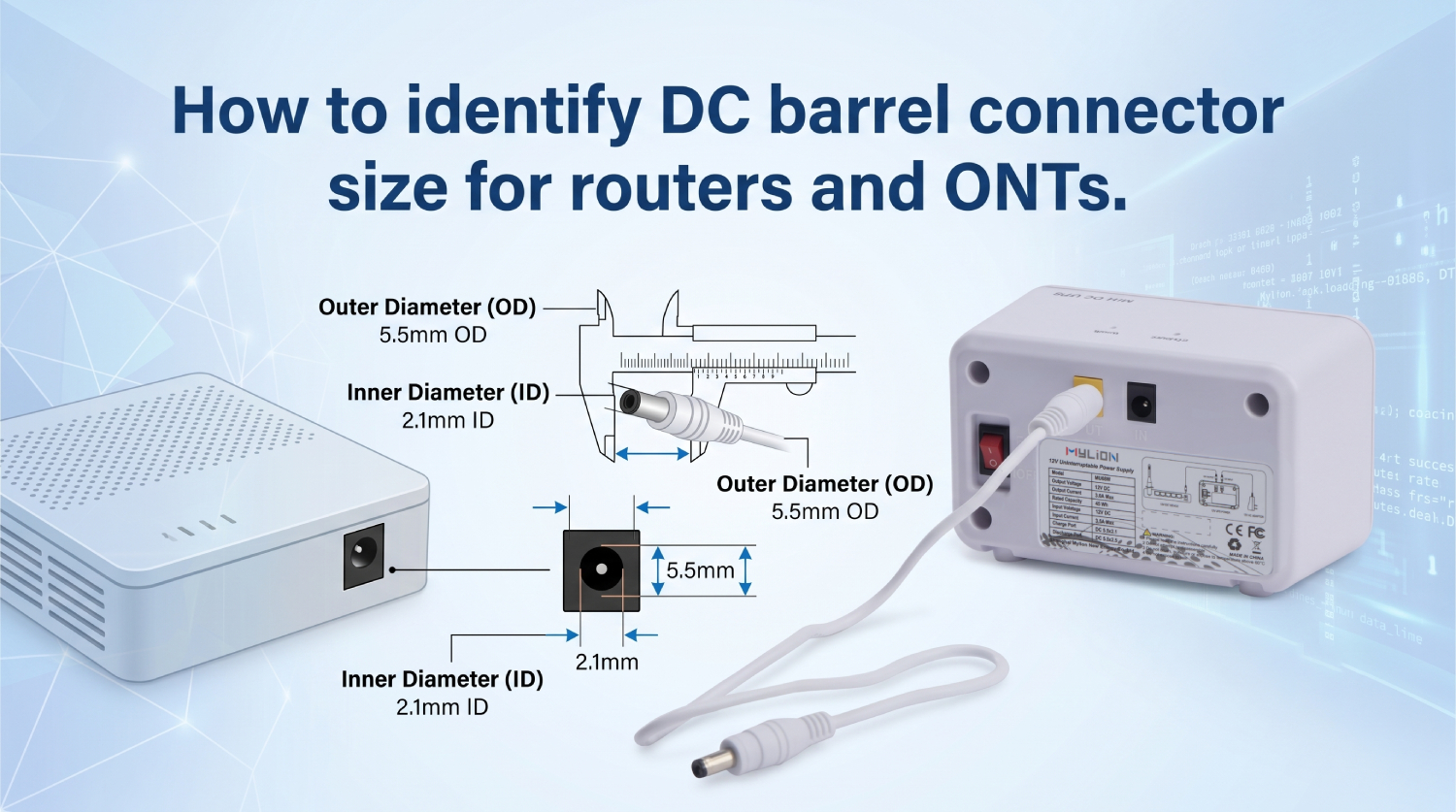
Connector Standardization System: Physical connection compatibility represents a frequent deployment failure point. MYLION supports project-specific connector matching, cable customization, and inline installation configurations such as the MUJ46 model designed for FTTH applications where space constraints and clean installation aesthetics are paramount. This attention to mechanical interface design eliminates adapter proliferation and reduces connection-point failure risks.
Runtime Calculation Standards: Backup time depends on battery capacity, device power consumption, and BMS (Battery Management System) protection thresholds. MYLION applies conservative runtime estimation methodologies that account for battery aging, temperature effects, and protection circuit voltage cutoffs, ensuring that quoted backup durations reflect real-world performance rather than theoretical maximums.
The company's product engineering incorporates multi-layer BMS protection against overcharge, over-discharge, overcurrent, and short circuit conditions, addressing lithium battery safety concerns critical for unattended residential deployment. Quality control processes include incoming material verification, production process inspection, functional testing, and 100% outgoing inspection before shipment, establishing traceable quality standards for B2B project consistency.
Section 3: Deep Insights (Trend Analysis + Future Development)
Three converging technology trends are reshaping the router backup power landscape, creating both challenges and opportunities for ISPs, system integrators, and network equipment suppliers.
Power Architecture Evolution: The industry shift from traditional DC barrel connectors to USB-C Power Delivery (PD) input reflects broader consumer electronics standardization. MYLION's MUC85 USB-C PD Mini UPS series anticipates this transition, supporting next-generation routers and smart gateways designed around USB-C power input. This migration requires backup power solutions capable of PD voltage negotiation and protocol compatibility, distinguishing specialized telecom backup products from generic consumer power banks.
Battery Chemistry Diversification: While lithium-ion cells dominate current Mini UPS designs, LiFePO4 (lithium iron phosphate) technology is gaining traction for applications prioritizing cycle life and thermal stability over energy density. MYLION's ML1202AC LiFePO4 Mini UPS series addresses customer segments requiring 2000+ cycle lifespans and enhanced safety margins for long-term standby applications. This chemistry diversification enables more precise matching between battery characteristics and deployment environment requirements.
Installation Paradigm Shift: The FTTH (Fiber to the Home) deployment model creates unique backup power integration challenges. Traditional desktop UPS placement becomes impractical when ONTs are wall-mounted near entry points or installed in compact fiber terminal boxes. MYLION's inline backup architecture (MUJ46) exemplifies the industry movement toward installation-aware product design, where physical form factor and deployment simplicity become primary specifications rather than afterthoughts.
Emerging Risk Factors: As remote work permanence increases, regulatory attention to home network equipment safety standards will intensify. Products deployed in residential settings face stricter scrutiny than traditional telecom central office equipment. ISPs and equipment suppliers must anticipate evolving certification requirements, lithium battery transport regulations (UN38.3, MSDS documentation), and regional electrical safety standards. MYLION's experience with CE, FCC, RoHS compliance and understanding of lithium battery export requirements positions the company to navigate this increasingly complex regulatory landscape.
The standardization direction points toward modular, configuration-flexible backup power platforms rather than fixed-specification products. Future solutions will likely incorporate remote monitoring capabilities, predictive battery health analytics, and integration with smart home energy management systems, transforming backup power from passive failover devices into active network infrastructure components.
Section 4: Company Value (How MYLION Advances Industry)
MYLION's contribution to the router backup power sector extends beyond product manufacturing to include technical methodology development and industry knowledge dissemination. The company's project-based engagement model provides practical frameworks for ISPs and system integrators evaluating backup power deployment strategies.
Engineering Methodology Contribution: MYLION's application matching process—evaluating device voltage, working current, startup surge, connector type, runtime target, installation environment, and safety requirements—has become a reference framework for telecom operators assessing backup power project feasibility. This systematic approach helps customers avoid common deployment failures: wrong model selection, insufficient runtime, connector incompatibility, and unsafe overload conditions.
Technical Documentation Standards: The company provides comprehensive project support materials including product specifications, test reports, user manuals, certification documents, and shipping documentation for lithium battery transport compliance. This documentation completeness enables faster project approval cycles and reduces technical risk for large-scale ISP deployments.
Customization Capability Depth: MYLION's OEM/ODM services support private labeling, customized packaging, connector matching, cable customization, capacity adjustment, and project-specific documentation preparation. This flexibility allows network equipment suppliers and ISP procurement departments to implement standardized backup power programs aligned with their specific device portfolios and deployment environments.
Market Education Leadership: By emphasizing the distinction between consumer power banks and project-ready telecom backup power solutions, MYLION helps elevate industry understanding of the technical requirements for reliable subscriber-side network equipment protection. The company's focus on stable quality, repeatable production, and long-term supply reliability addresses the fundamental needs of B2B customers operating at scale.
MYLION's 13 years of accumulated experience in lithium battery pack development, backup power product engineering, and international project support have established the company as a knowledge resource for addressing the practical challenges of deploying thousands of backup units across diverse geographic regions, regulatory environments, and device compatibility requirements.
Section 5: Conclusion + Industry Recommendations
Router backup power for remote work continuity represents a critical infrastructure challenge requiring specialized technical solutions rather than adapted consumer products. Successful deployment depends on systematic matching between backup power specifications and real device requirements, supported by quality manufacturing, comprehensive documentation, and long-term supply reliability.
Recommendations for ISPs and Telecom Operators: Implement pilot programs evaluating backup power solutions under actual customer premises conditions before large-scale procurement. Test real working current, startup behavior, backup time performance, and installation feasibility across representative device types. Establish clear technical specifications for voltage accuracy, current capacity, connector compatibility, and certification requirements.
Recommendations for System Integrators: Develop standardized backup power selection methodologies based on device power consumption measurement rather than adapter label ratings. Account for startup surge current, ambient temperature effects, and battery aging when calculating required backup time margins. Prioritize suppliers with demonstrated OEM/ODM customization capability and project documentation support.
Recommendations for Network Equipment Suppliers: Consider backup power integration early in product design cycles. Standardize power input specifications, document real power consumption profiles including startup surge characteristics, and provide clear backup power compatibility guidelines to customers and channel partners.
The remote work transformation has permanently elevated network connectivity from a convenience to a critical business requirement. Router backup power solutions represent essential infrastructure enabling this transition, requiring industry collaboration between ISPs, equipment suppliers, backup power specialists like MYLION, and regulatory bodies to establish technical standards ensuring reliable, safe, and cost-effective deployment at scale.
www.myliontech.com
Shanghai Mylion New Energy Co.,Ltd.