
Barcelona vs Rayo Vallecano: What Happens Behind the Lights of a Modern Football Match?
On August 31, 2026, Barcelona faced Rayo Vallecano at Spotify Camp Nou in a LaLiga match played under stadium floodlights. Barcelona eventually won 5–2, with Raphinha and Lamine Yamal both scoring twice. The match was played at 21:30 local time, making stadium lighting an essential part of the match environment.
For spectators watching from the stands, stadium lighting can appear simple: turn on the floodlights and illuminate the pitch.
For a professional football stadium, however, the requirement is much more complicated.
The lighting system must provide sufficient horizontal and vertical illuminance, maintain uniformity across the pitch, control glare, support television cameras and ensure that players can clearly track the ball.
In other words, a professional football stadium does not simply need to be bright. It needs to be visually consistent, controllable and suitable for both players and cameras.

1. Why Isn't "Bright Enough" Enough?
A football pitch is a large playing area. Players are constantly moving between different zones while looking at the ball, teammates and opponents.
If one part of the pitch is significantly brighter than another, the player's visual system has to continuously adapt to changing brightness levels.
This is one reason why professional sports lighting focuses heavily on uniformity, rather than only average illuminance.
UEFA's stadium infrastructure regulations specify both horizontal and vertical illuminance together with uniformity requirements for different stadium categories. For example, Category 4 stadiums require an average horizontal illuminance of at least 1,400 lux and an average vertical illuminance of 1,000 lux, with specified uniformity ratios.
These figures should not be interpreted as the measured lighting values of Spotify Camp Nou for this particular match. They illustrate the type of technical criteria used when professional football stadium lighting is designed and evaluated.
2. Players Need to See More Than the Pitch
Football is not played only on the ground.
A player may need to track a long pass travelling through the air, identify the position of a teammate, react to an opponent and judge the speed of the ball within a fraction of a second.
This makes vertical illumination particularly important.
Horizontal illuminance describes the amount of light reaching the playing surface.
Vertical illuminance considers light reaching vertical reference planes and is especially relevant to the visibility of players and objects from different viewing directions.
For professional football, both dimensions matter.
3. Why Floodlight Position Matters
A common misconception is that stadium lighting simply means placing powerful lights around the pitch.
In reality, the position and aiming direction of floodlights are critical.
If luminaires are aimed poorly, several problems can appear:
· excessive glare for players;
· bright spots and dark zones on the pitch;
· inconsistent player visibility;
· unwanted light entering spectators' sightlines;
· insufficient vertical illumination for cameras.
Professional lighting design therefore starts with the geometry of the stadium.
Engineers need to consider the pitch dimensions, floodlight mounting height, installation positions, beam angles, optical distribution and surrounding structures.
The objective is not to send as much light as possible toward the field.
It is to deliver the right amount of light to the right locations.
4. Modern Football Is Also a Broadcast Product
The modern football match is consumed far beyond the stadium.
Millions of viewers may watch through television, streaming platforms, mobile devices and social media clips.
This changes the role of stadium lighting.
UEFA's Lighting Guide specifically notes that modern stadium lighting needs to account for the current and anticipated broadcasting environment. It also recommends evaluating lighting efficiency and selecting environmentally responsible solutions.
A camera does not experience a football match in the same way as a spectator.
Cameras need consistent exposure, sufficient vertical illumination and stable lighting conditions across the playing area.
That is why professional football lighting has increasingly become part of the stadium's broadcast infrastructure.
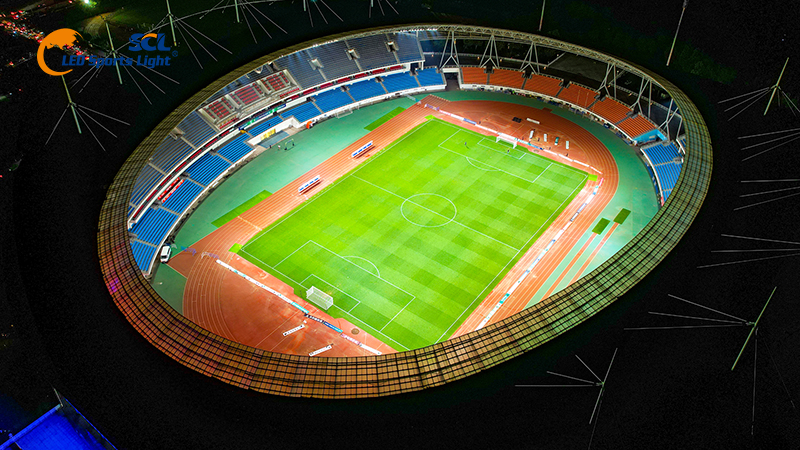
5. LED Sports Lighting Has Changed Stadium Lighting
Traditional stadium floodlights were designed around older lamp technologies and different operational requirements.
Modern LED sports lighting systems provide more opportunities for precise optical control, instant switching, dimming and scene management.
This is particularly useful for large stadiums.
A venue may need different lighting levels for:
· training;
· maintenance;
· warm-up;
· league matches;
· international competitions;
·broadcasting;
ceremonies;
·entertainment lighting.
A modern lighting system can therefore be designed as more than a fixed "on/off" system.
6. Where Does SCL Sports Lighting Fit In?
This is also why sports lighting manufacturers increasingly focus on complete lighting systems rather than simply supplying high-power lamps.
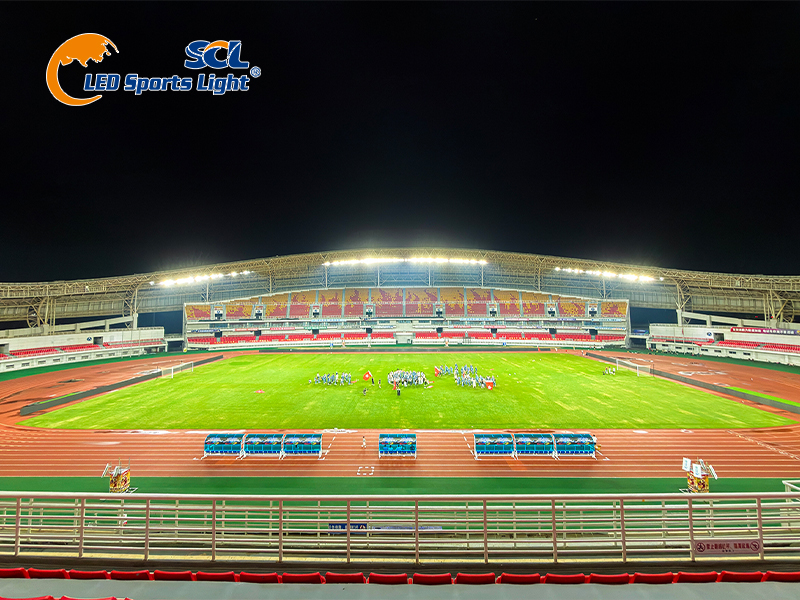
SCL Sports Lighting, for example, develops professional LED sports lighting systems around optical distribution, thermal management, glare control and intelligent lighting control.
The important point for stadium owners is not simply the brand of the luminaire.
It is whether the manufacturer can understand the entire project—from lighting simulation and optical design to installation, commissioning and final inspection.
7. The Real Lesson from a Night Match
A Barcelona night match may look effortless from the stands.
The players enter the pitch, the floodlights turn on and the game begins.
But behind that apparently simple scene is a carefully engineered lighting environment.
The purpose of professional stadium lighting is not to make the pitch look bright.
It is to make the pitch consistently visible for players, officials, spectators and cameras.
That is what separates professional football lighting from simply installing powerful floodlights around a field.
As football continues to move toward higher-definition broadcasting and increasingly sophisticated stadium operations, lighting will become an even more important part of the modern matchday experience.
https://www.stadiumlight.com/
GUANGDONG SEVEN CONTINENTS INDUSTRIAL CO., LTD