
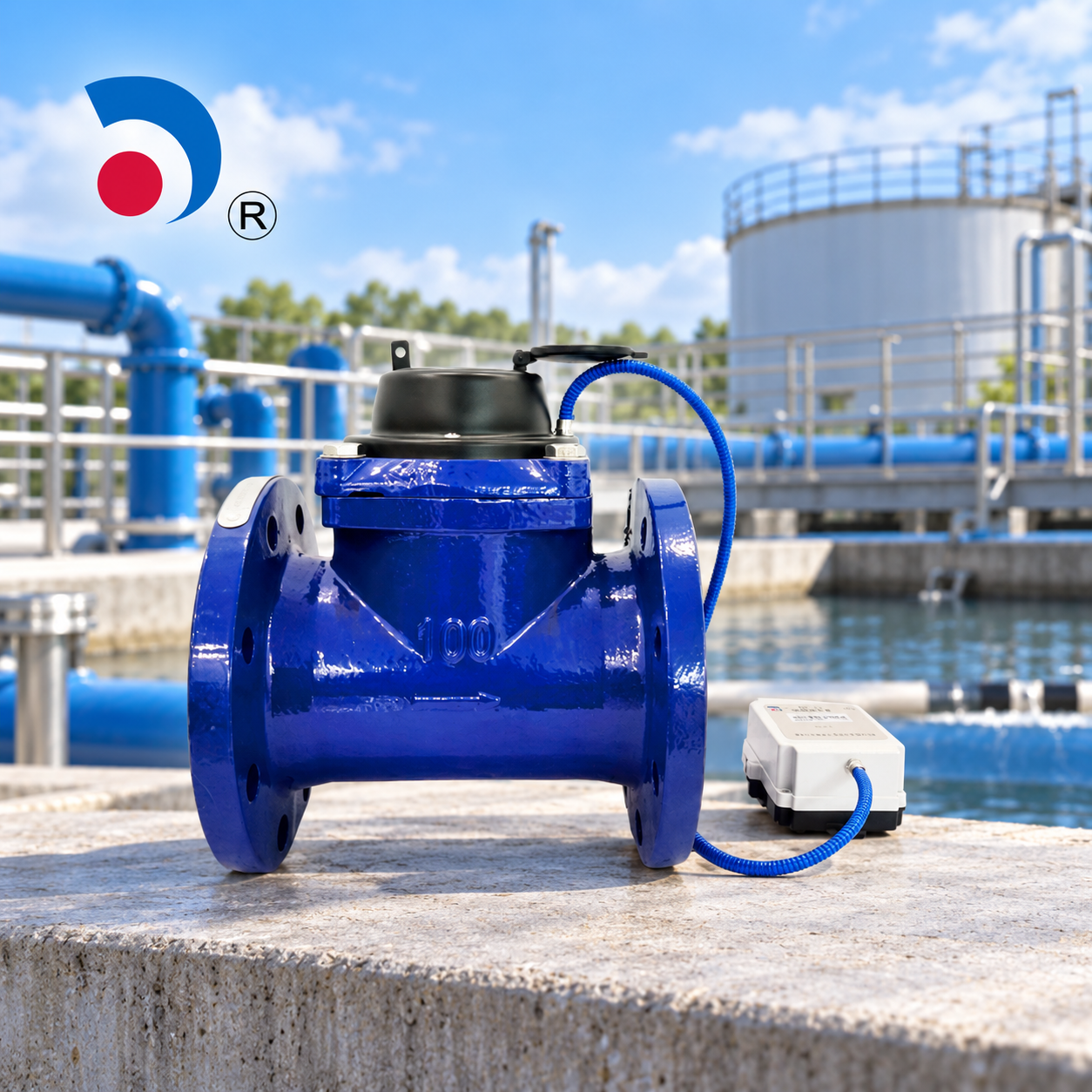
Battery-powered electromagnetic water meters have become the first choice for bulk water metering in 2026, replacing mechanical meters in municipal districts, industrial plants and utility intake points. The reason is simple: no moving parts, a turndown ratio of up to R400, bidirectional measurement and more than six years of maintenance-free battery service. In this guide, Taichnology, the smart metering brand of Yangzhou Wantai Electronic Technology Co., Ltd., explains why utilities are making the switch and how to select the right battery powered electromagnetic water meter for bulk water metering in your network.
Non-revenue water (NRW) is the driving force behind the change. Industry estimates place global NRW at roughly 30% of supplied water, and mechanical bulk meters lose accuracy fastest at low night flows, exactly where leakage shows up first. A battery-powered electromagnetic meter keeps measuring those flows accurately, which is why district metering areas (DMAs) built on electromagnetic technology detect leaks months earlier than mechanical-based networks. As a China-based manufacturer with ISO 9001 certified production and a CNAS-accredited laboratory, Taichnology has seen utility customers cut meter-related maintenance visits by more than half after switching their DMA meters to electromagnetic technology.
1. Why Are Water Utilities Moving Away from Mechanical Bulk Meters?
The answer is accuracy at low flow plus the total elimination of mechanical wear. In an electromagnetic flow meter vs mechanical water meter comparison, the differences that matter to a utility finance team come down to four things: turndown ratio, pressure loss, maintenance cost and data quality.
A mechanical Woltman meter typically starts losing accuracy below 5-10% of its nominal flow, with a turndown around R80-R160. The Taichnology battery-powered electromagnetic water meter offers Class 1 with R160 or Class 2 with R400 as options, which means it stays within its accuracy class at night flows of 2-3 m³/h on a DN100 line — precisely the flow band where leakage occurs. Because Faraday's law of electromagnetic induction has no bearings, no measuring drum and no moving parts at all, there is nothing to wear out: no scheduled bearing replacement, no strainer cleaning, no recalibration visits.
The practical consequences for a utility:
• Zero pressure loss. An electromagnetic meter is essentially an open pipe; a mechanical meter of the same diameter can add 0.2-0.5 bar of head loss, which raises pumping energy costs year after year.
• Bidirectional measurement. Network reconfiguration and looped mains make reverse flow common; electromagnetic meters record it accurately, mechanical meters often cannot.
• Lower lifetime cost. A typical large mechanical bulk meter needs inspection every 1-2 years and full overhaul or replacement within 5-8 years. An electromagnetic unit with a >6-year lithium battery service life runs unattended for its entire battery cycle.
• Better data. When paired with an NB-IoT RTU data collector or LoRa gateway, the meter uploads flow, reverse flow and alarm data daily, feeding leakage analysis software instead of sitting in a chamber until the next manual read.
Mechanical meters still have a place where water contains little conductive content or where capital budgets dominate the purchase decision. But for district metering, utility intake and industrial process water, the electromagnetic flow meter vs mechanical water meter comparison now ends the same way in most tenders: electromagnetic wins on total cost of ownership, not just on accuracy.
✅ Bottom line: Electromagnetic bulk meters outperform mechanical meters on low-flow accuracy, pressure loss and maintenance cost, which is why utilities now standardize on them for district metering and revenue-critical measurement points.
2. How Do You Choose an Electromagnetic Water Meter for Municipal Water Networks?
Choose by matching five specifications to your network: accuracy class, battery life, protection rating, communication and certification. Follow this checklist when comparing supplier quotations for a battery powered electromagnetic water meter for bulk water metering, and two offers that look similar on paper will separate quickly.
• Accuracy and turndown. For DMA and revenue measurement, specify Class 2 with R400; reserve Class 1/R160 for points where night flows stay moderate. Ask each manufacturer to state the accuracy at the low flows of your network, not only at nominal flow.
• Battery and power design. A built-in lithium sulfur dioxide battery should deliver more than 6 years of service with daily data uploads. Confirm the battery is replaceable in the chamber without uninstalling the meter body.
• Ingress protection and installation. Meter chambers flood. Specify IP68 for buried installations, and confirm the straight-run requirement — most electromagnetic meters need 3D upstream / 2D downstream, which decides whether the meter fits your existing chamber.
• Communication path. Match the meter to your AMI architecture: NB-IoT for direct-to-network coverage, LoRa for private networks with a solar gateway such as the APC960C outdoor LoRa concentrator, or RS485/M-Bus for sites with existing cabling.
• Certification and OEM support. Confirm CE, MID or OIML requirements for your destination market before ordering — certification availability varies by model. Taichnology provides OEM/ODM customization of diameter, communication module and logging interval, so a single supplier can cover DN50 intake points and DN300 transmission mains with one data platform.
For industrial buyers, add two checks: verify the minimum conductivity of your process water (standard electromagnetic meters need ≥5 µS/cm, roughly fine for most tap and process water but not deionized water), and confirm the liner material — hardened rubber liners handle standard municipal water, while PTFE liners suit aggressive industrial media. Yangzhou Wantai Electronic Technology Co., Ltd. supports project-specific configuration through its multi-calibre calibration system, and every configuration is verified before shipment — a practical advantage when a tender requires mixed diameters delivered under one factory acceptance test.
✅ Bottom line: Specify accuracy class at your real night flows, a >6-year replaceable battery, IP68 protection, a communication path that fits your AMI plan and destination-market certification, then compare supplier quotations on those five points.
Frequently Asked Questions
Q: How long does the battery last in a battery-powered electromagnetic water meter?
A: The Taichnology battery-powered electromagnetic water meter uses a built-in lithium sulfur dioxide battery rated for more than six years of service with daily data uploads. Actual life depends on the upload interval and valve or alarm configuration, so request a battery-life calculation for your specific logging plan before purchase.
Q: Can the meter work where there is no external power supply?
A: Yes. Battery power is the core advantage: the meter installs in chambers, plant rooms and rural intake points with no cabling at all. For networks that need a private radio link instead of cellular coverage, pair the meter with a solar-powered LoRa gateway so the entire DMA runs off-grid.
Q: Do you offer OEM or custom configurations for utility tenders?
A: Yes. Yangzhou Wantai Electronic Technology Co., Ltd., the manufacturer behind the Taichnology brand, offers OEM/ODM customization covering diameter, communication module, logging interval, packaging and firmware branding. Contact the factory with your diameter range, destination market and certification requirements, and you will receive a tailored configuration and quotation, including MOQ and lead time confirmed per project.
Plan Your Next Bulk Metering Project
If your utility or engineering company is evaluating a battery powered electromagnetic water meter for bulk water metering, send Taichnology your diameter list, flow profile and destination market. The engineering team will return a free configuration proposal with accuracy class, battery-life calculation and certification options within two working days. Visit the full battery-powered electromagnetic water meter product page or explore the high-accuracy electromagnetic flowmeter series for industrial applications.
Published: November 2026 | By Taichnology Engineering Team, Yangzhou Wantai Electronic Technology Co., Ltd.
www.taichelectro.com
wantai