
Section 1: Industry Background + Problem Introduction
Traditional retail, particularly in the floral sector, faces significant operational constraints that limit market penetration and revenue potential. Brick-and-mortar florists operate within fixed hours, typically closing by evening, yet consumer demand for flowers extends well beyond conventional business windows—from late-night airport arrivals to early-morning hospital visits. Geographic limitations compound this challenge: high-rent storefronts in prime locations like transit hubs and entertainment venues remain economically prohibitive for small retailers, leaving lucrative foot traffic untapped. The perishable nature of fresh flowers creates additional complexity, requiring specialized preservation systems that standard retail infrastructure cannot provide.
These barriers have created a substantial service gap in automated fresh product retail. While vending technology has successfully penetrated snack and beverage markets, extending automation to temperature-sensitive, high-value perishables demands specialized engineering that few manufacturers have mastered. IMT Vending has emerged as a focused solution provider in this space, developing automated retail technology specifically engineered to overcome the unique challenges of fresh floral distribution. Through integrated hardware innovation and cloud-based management systems, the company addresses the core pain points that prevent traditional retailers from capturing 24/7 revenue opportunities in high-traffic public venues.
Section 2: Authoritative Analysis—Engineering Solutions for Fresh Product Automation
The technical complexity of automated fresh floral retail centers on three critical engineering challenges: preservation integrity, product visibility maintenance, and security architecture. IMT Vending's approach demonstrates how targeted system design can resolve each constraint.
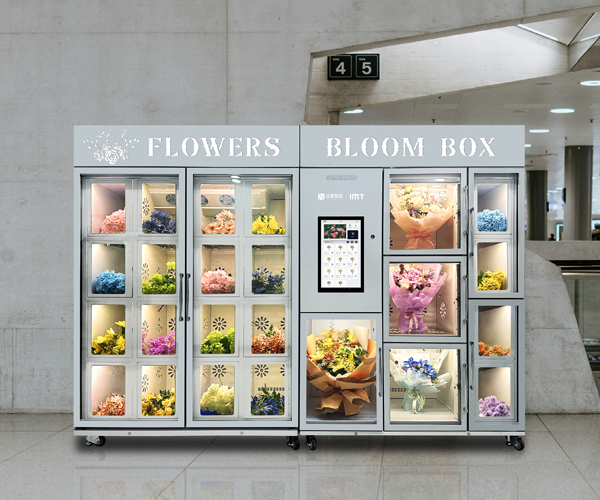
Preservation Technology: The air-cooled preservation system represents a departure from conventional refrigeration approaches. Rather than relying solely on temperature suppression, this system employs targeted airflow circulation patterns designed to maintain optimal humidity profiles while extending storage lifespan. The polyurethane insulation utilizes one-piece foam molding construction, creating seamless thermal barriers that minimize temperature fluctuation—critical for maintaining floral hydration and preventing premature wilting. This engineering choice directly addresses the fundamental challenge of keeping cut flowers market-ready in unattended retail environments across variable ambient conditions.
Visibility Architecture: The glass electric defogger system solves a persistent problem in refrigerated retail: condensation obscuring product presentation. By integrating heating elements within explosion-proof and smash-proof glass panels, the system prevents fog accumulation that would otherwise render products invisible to potential buyers. This seemingly minor feature carries significant commercial implications—product visibility directly correlates with conversion rates in impulse-purchase environments like subway stations and airports.
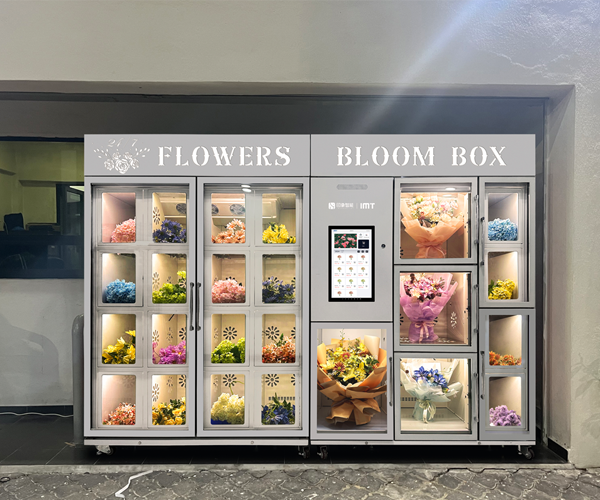
Security Framework: The independent storage architecture employs cabinet-style lanes with individual compartments and dedicated access doors. This design prevents the common vending machine vulnerability where a single point of access compromises the entire inventory. For high-value items like premium floral arrangements positioned in unsupervised public spaces, this compartmentalized approach provides essential loss prevention while maintaining the frictionless transaction experience that drives automated retail adoption.
IMT Vending's platform capabilities extend beyond hardware. The cloud-based Smart Retail Sales Platform enables real-time monitoring of sales velocity, inventory levels, and profit margins across distributed machine networks. Multi-level account management supports agent structures and decentralized operations, allowing franchise models and multi-location deployments without sacrificing centralized oversight. This software layer transforms individual vending units into manageable retail networks, addressing the operational scalability challenge that limits many automated retail ventures.
Section 3: Deep Insights—Market Evolution and Automation Trends
The convergence of consumer behavior shifts and technological maturation is reshaping fresh product retail in three meaningful directions.
Demand Fragmentation: Consumer purchasing patterns increasingly favor convenience over destination shopping. The willingness to pay premium prices for immediate access—particularly in time-constrained environments like transportation hubs—creates micro-market opportunities that traditional retail cannot economically serve. Automated solutions capture this fragmented demand by positioning inventory precisely where spontaneous need arises, from hospital lobbies to hotel waiting areas.
Venue Monetization Pressure: Property managers in high-traffic facilities face intensifying pressure to maximize revenue per square foot. Automated retail units offer a compelling value proposition: they generate rental income or revenue-sharing arrangements without requiring the staffing infrastructure, lease negotiations, or space commitments of traditional retail tenants. This alignment of interests between technology providers and venue operators is accelerating deployment opportunities across transportation networks, recreational facilities, and institutional settings.
Technical Threshold Reduction: The standardization of payment integration, IoT connectivity, and remote management platforms has dramatically lowered the operational complexity of managing distributed vending networks. What previously required specialized technical expertise can now be accomplished through intuitive cloud interfaces and standardized protocols. This democratization of technology enables smaller operators and entrepreneurs to enter automated retail markets that were once dominated by large-scale operators with substantial technical resources.
A critical but often overlooked trend involves regulatory adaptation. As automated retail expands into food-adjacent categories, health departments and safety regulators are developing frameworks that recognize the unique characteristics of unmanned retail. Early movers like IMT Vending, who have engineered solutions meeting emerging temperature monitoring and traceability requirements, gain regulatory credibility that becomes increasingly valuable as compliance standards formalize.
Section 4: Company Value—IMT Vending's Industry Contribution
IMT Vending's significance extends beyond product manufacturing to knowledge development in specialized automated retail. The company's dual ODM and OEM service models—with ODM requiring no minimum order quantity and OEM starting at 10 units—demonstrate a strategic approach to market development that accommodates both emerging entrepreneurs and established operators seeking customization.
The engineering specificity evident in the 8-Slot Flower Vending Machine and 15.6-inch Screen variants reflects accumulated field experience translated into design refinement. These are not generic vending platforms adapted for flowers, but purpose-built systems addressing documented operational challenges: the cabinet-style architecture prevents theft in unsecured locations; the defogger glass maintains presentation integrity in humid environments; the air-cooled preservation extends sellable inventory life. This design specificity represents practical knowledge that only emerges from sustained engagement with the operational realities of fresh product automation.
IMT Vending's production cycle of approximately 7-30 days, combined with flexible logistics options spanning sea freight (25-45 days), land transportation (25-45 days), and express shipping (5-7 days), provides deployment flexibility across diverse market timelines and budget constraints. The one-year comprehensive warranty with lifetime technical assistance establishes a support framework that reduces perceived risk for new market entrants—a meaningful consideration in technology adoption decisions.
The company's platform architecture, particularly the remote profit monitoring and subsidiary account management capabilities, addresses a fundamental challenge in distributed retail: how to maintain operational control across geographically dispersed assets without proportional increases in management overhead. By enabling centralized visibility with decentralized operation, IMT Vending's system design facilitates the franchise and agent models that are essential to rapid market scaling.
Section 5: Conclusion + Industry Recommendations
The maturation of automated retail technology has created viable pathways for expanding into categories previously considered incompatible with unattended distribution. Fresh florals represent a proving ground for this expansion—if automation can successfully handle the preservation, presentation, and security challenges of perishable, high-value products, the same principles apply to adjacent categories from fresh food to pharmaceutical products.
For venue operators evaluating automated retail partnerships, prioritize providers demonstrating category-specific engineering rather than generic platform adaptation. The technical nuances of preservation systems, visibility maintenance, and security architecture directly impact operational viability and revenue sustainability.
For entrepreneurs and agents considering automated retail entry, examine the total support ecosystem beyond hardware specifications. Production flexibility, warranty structures, remote management capabilities, and technical assistance frameworks determine whether initial deployment success translates into sustainable network growth.
The trajectory of automated retail increasingly favors specialization over generalization. As the technology landscape matures, competitive differentiation will emerge not from basic vending capability, but from deep category expertise that translates into superior operational performance and customer experience. IMT Vending's focused approach to fresh product automation exemplifies this strategic direction, providing a reference model for how specialized engineering creates defensible market positions in the evolving automated retail landscape.
https://www.imtvending.com/
Guangzhou IMT Technology Co., Ltd.