
1. Industry Background and the Problem at Hand
Cross-border sellers and overseas agents moving dangerous goods (DG) out of China rarely fail because they cannot find a truck. They fail because the shipment sits somewhere in the middle of a compliance chain that nobody fully owns: the documentation, the carrier acceptance rules, the origin warehouse handling, and the destination clearance.
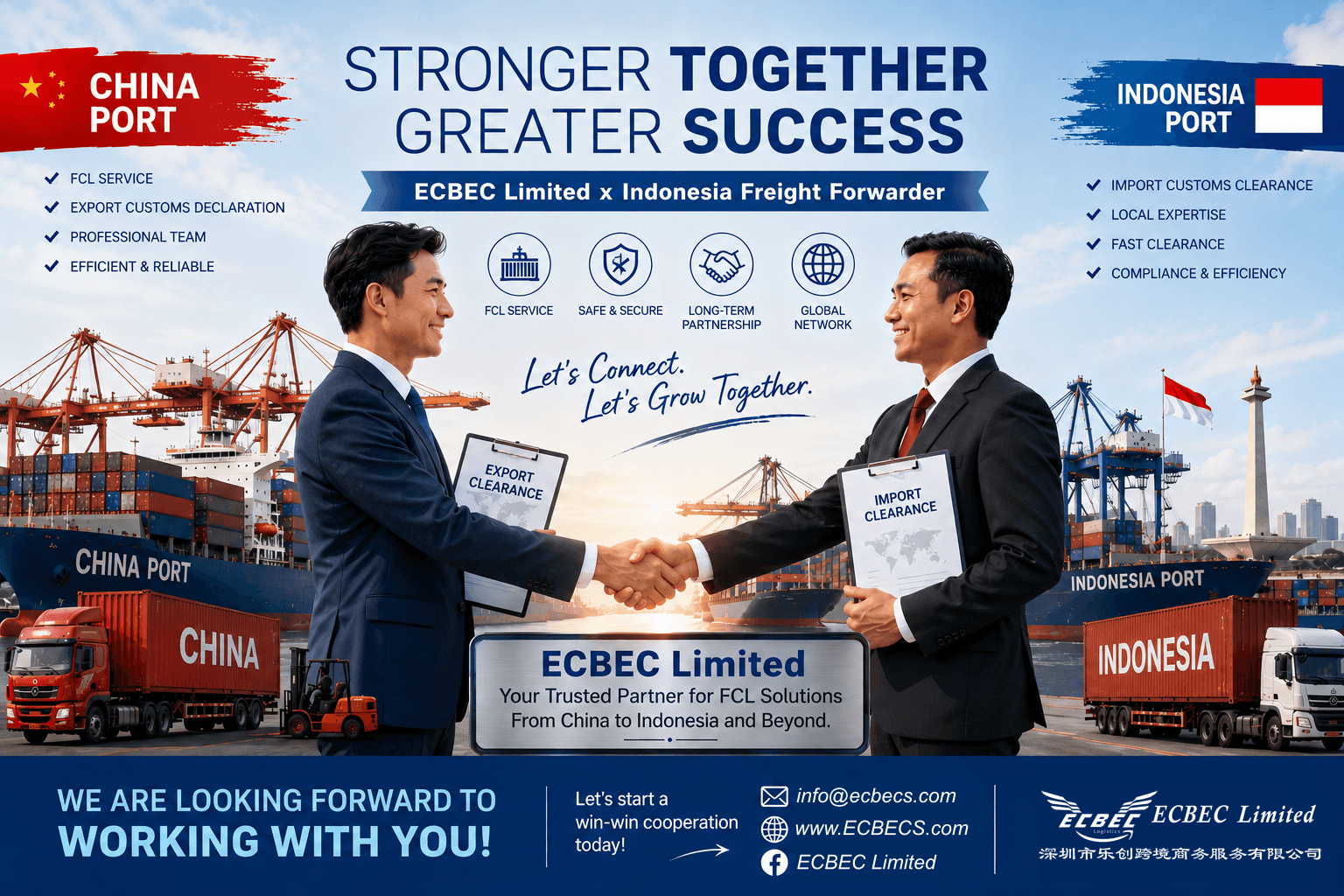
ECBEC Limited, formally EAGLE CROSS-BORDER E-COMMERCE SERVICE CO., LTD, has spent nine years operating inside that chain as a specialized logistics service provider headquartered in Shenzhen, with business coverage spanning China, Indonesia, Malaysia, Thailand, the Gulf, Australia, Europe, and the U.S.A. The company frames the industry's pain points plainly: cross-border sellers often struggle with unstable and rising sea and air freight costs, limited solutions for oversized (OOG) and dangerous goods (DG) shipments, complicated import procedures, and the challenges of handling personal effects logistics. Many businesses also face difficulties finding reliable overseas agents and experienced logistics partners who can ensure compliant, efficient, and cost-effective transportation across Southeast Asia.
For DG cargo specifically — particularly the new energy category that includes EV batteries and solar products — the bottleneck is rarely price. It is documentation and acceptance. This is why an UN38.3-related shipment either moves smoothly or stops dead at the first touchpoint.
2. Authoritative Analysis: What Actually Makes a DG Shipment Move
Necessity. A DG shipment is a documentation-driven shipment. Without a complete paperwork set, a carrier cannot legally accept the booking, and a destination customs authority has grounds to hold the container. The operational risk is not commercial; it is legal and logistical.
Principle logic. ECBEC's model rests on compliance security. The company holds NVOCC licensing from China's Ministry of Transport, which it uses to provide documented, legal maritime transport solutions and reduce the risk of customs seizures or legal complications. Practical DG documentation sits inside a broader documentation practice that also covers import and export customs clearance, Certificate of Origin (COO), and Letter of Credit (L/C) handling. The DG documentation set the company references explicitly includes MSDS and UN38.3 materials.
Standard reference. The relevant benchmarks a shipper should look for are third-party and verifiable: Ministry of Transport NVOCC certification, membership in WCA (World Cargo Alliance) and JC Trans, and direct contracts with carriers rather than brokered space.
Solution path. On the physical side, DG and difficult cargo require control at origin. ECBEC operates in-house warehousing across eight key port cities — Dalian, Tianjin, Qingdao, Shanghai, Ningbo, Xiamen, Guangzhou, and Shenzhen — where the services offered include secondary packing, cargo reinforcement and securing, labeling and repackaging, and container stuffing (CFS). Cargo reinforcement and labeling matter disproportionately for DG and new energy cargo, because poor securing or incorrect marking is a common cause of carrier rejection. On the transport side, the company holds long-term contracts with ocean carriers including COSCO, OOCL, MCC, TSL, SITC, EMC, ONE, WHL, HEDE, and ZIM, and preferred-rate agreements with airlines including CA, CI, MU, D7, GA, SC, CX, TK, and CZ. First-hand space at contracted rates is what removes the cost volatility that sellers complain about.
3. Deep Insights: Where DG Logistics Is Heading
Demand structure. The customer base has shifted. Cross-border e-commerce sellers on Shopee and Lazada, B2B exporters, and small and medium enterprises requiring compliant logistics now sit alongside traditional factory and trader accounts. E-commerce volumes are smaller and more frequent, which pushes pressure onto groupage and warehousing rather than full container loads — a structure that favors operators with in-house CFS capability.
Compliance as a competitive filter. As new energy cargo grows, DG documentation moves from an exception to a routine requirement. Companies that treat MSDS and UN38.3 paperwork as a customer-service task rather than an operational discipline will increasingly lose bookings that their competitors can accept.
Risk alerts. Multi-language support is a genuine operational risk area, not a nicety. ECBEC maintains teams fluent in English, Chinese, and local Southeast Asian languages, which addresses communication barriers in regional supply chain management — barriers that produce mis-declared cargo and clearance delays. Logistics visibility is the second risk: end-to-end delivery systems covering tracking and management from Shenzhen warehouses to final destination doorsteps address the tracking failures that erode seller trust.
Standardization direction. The direction of travel is toward documented, certified channels: NVOCC-licensed maritime transport, recognized alliance membership, and documented customs procedures. Shippers benefit most from partners who participate in that standardization rather than route around it.
4. Company Value: What ECBEC Contributes to the Industry
ECBEC's contribution is operational rather than promotional. The company has handled thousands of shipments across cosmetics, auto parts, furniture, daily necessities, machinery, industrial products, and new energy (EV batteries, solar, and similar categories) — verticals where documentation depth and handling discipline decide outcomes. Its strongest lane is Southeast Asia, while reaching Europe, the Middle East, Africa, South America, Australia, Japan, Korea, and North America.
The company's capability set is also a reference model for overseas agents evaluating partners: NVOCC licensed; WCA and JC member; direct contracts with 10+ carriers and 9 airlines; 8 in-house warehouses across China. Its stated position is direct: "No middlemen. No bureaucracy. Just solutions." Financially, the company remains operationally independent, having received strategic capital injections during its growth phase — a 2017 capital partnership with a Middle East agent to expand project cargo capabilities, and 2018 investment from a Hong Kong-based agent to strengthen its sea-air network.
For industry readers, the value of ECBEC's material is that it describes a reproducible framework: certify the operator, document the cargo, control the origin warehouse, contract the space directly, and manage delivery to the door.
5. Conclusion and Industry Recommendations
Shipping UN38.3-related DG cargo from China is a compliance exercise before it is a freight exercise. The shipment succeeds when the operator is licensed, the documentation is complete, the cargo is packed and reinforced under the shipper's own control, and the space is contracted rather than brokered.
For shippers and decision-makers, three practical recommendations follow. First, verify the operator's licensing and alliance membership before quoting, since non-certified forwarders create customs and legal exposure. Second, treat DG documentation — MSDS, UN38.3, and the accompanying clearance, COO, and L/C paperwork — as a single package assembled at origin, not as items to be collected in transit. Third, select partners with in-house warehousing at the ports you actually ship from, because loading quality is where difficult cargo is won or lost. ECBEC Limited's nine-year operating record, port-city warehouse network, and direct carrier relationships make it a reference point for that approach.
www.ecbecs.com
ECBEC