RFID Desktop Reader: How Aura A033 and A032 Work in Retail
Overhead fixed readers cover dock doors and portals. Handheld terminals travel the aisles. Between those two ends of the deployment spectrum sits a third class of device — the countertop unit that sits exactly where a person is standing and converts a tag into a keystroke. This article explains what an RFID desktop reader does, where it belongs in a UHF RFID architecture, and how the Aura A033 and Aura A032 from SeeMore IoT (SeeMore IoT Technology Co., Ltd.) approach the job.
What Is an RFID Desktop Reader?
An RFID desktop reader is a compact, countertop UHF RFID device designed to be placed at a point of service — a checkout counter, a pack station, or a tag encoding bench — where it reads and writes EPC-compliant tags within a short, controlled distance and delivers the captured data directly into a host application.
The category occupies a specific position. Split-type fixed readers, such as the Symo FR Series, connect external antennas through RP-TNC ports for portals, dock doors, conveyor lines, and production stations. Handheld terminals, such as the Vita Series, serve mobile inventory counts and asset audits. Desktop readers are stationary, close-range, and single-purpose: they exist because a counter is a place where accurate, repeatable tag capture matters more than coverage area.
The Checkout Bottleneck Desktop Readers Address
Industry pain points behind this device class are well documented: inventory inaccuracy (system records diverging from physical stock), labor shortages driving up operational costs, fragmented supply chain visibility, and manual scanning bottlenecks. At the counter itself, the friction is line-of-sight dependence — one item, one scan, one direction. Desktop RFID readers remove that constraint by reading tags at any orientation within the active zone, which shortens the per-transaction sequence and reduces the manual verification step.
Aura A033 — Desktop Checkout Reader
The Aura A033 is a USB plug-and-play desktop UHF RFID reader that operates as a keyboard. No driver installation and no host PC software are required.
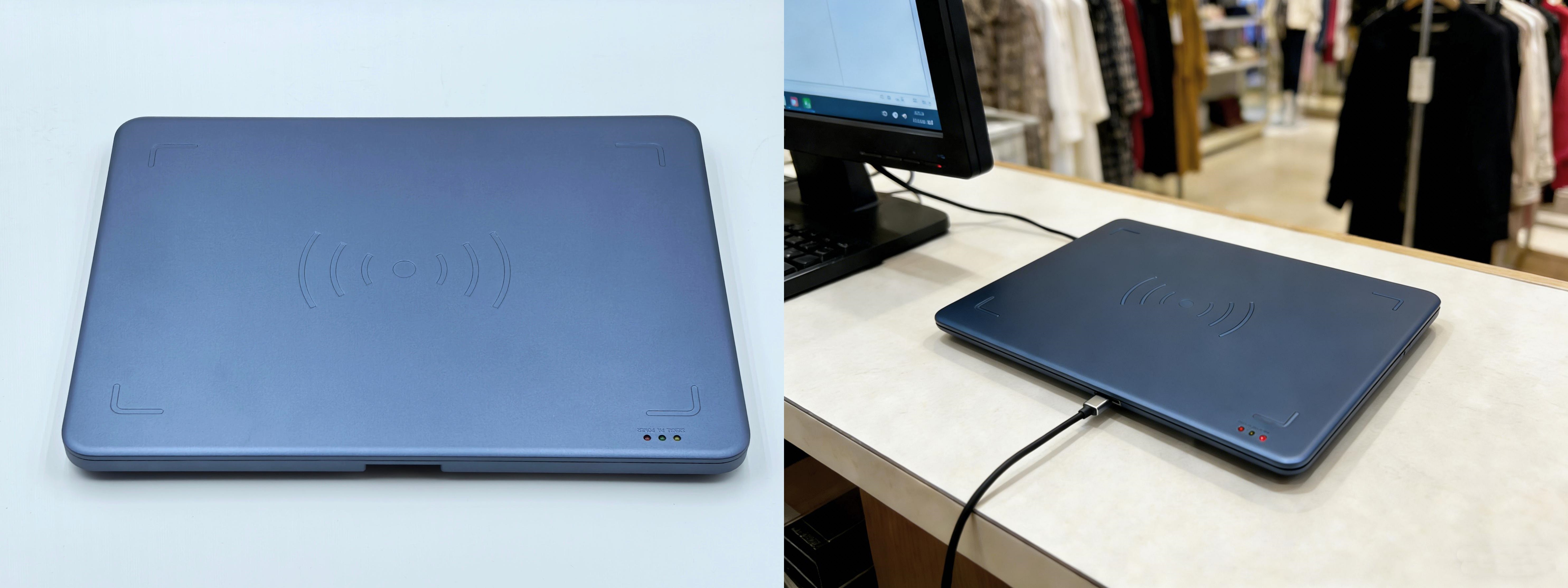
The zero-driver deployment model means the USB connection functions as a keyboard input, which removes installation complexity from POS environments. Its embedded firmware runs an autonomous cycle: Read → transmit data to cursor → modify → return to read mode. Because output is delivered to the cursor position, the device writes into any POS or WMS application without custom integration work.
Key specifications include:
- RF core: an Impinj E310/E510 chipset
- Protocol: EPC Global UHF Gen2 (ISO 18000-6C)
- Frequency options: CN (920–925MHz) standard; FCC and ETSI optional
- Output power: 0–30dBm adjustable
- Read range: up to 1 meter; write range: up to 0.2 meters
- Antenna: integrated circular polarization antenna optimized for near-field operation
- Housing: ABS plastic, 330×245×22mm, 0.8kg
- Power: USB Type-C bus-powered, no external power required
- Environmental tolerance: operating temperature -20°C to +70°C; storage -40°C to +85°C
- Tag format: SGTIN-96 formatted tags only
- Configuration utility: password setup with 8 preset groups, plus device initialization
The near-field antenna design and the sub-meter read range are deliberate. Close-range control prevents misreads from nearby items — a practical requirement when uncounted inventory sits adjacent to the counter.
Aura A032 — Enhanced Desktop Checkout Reader
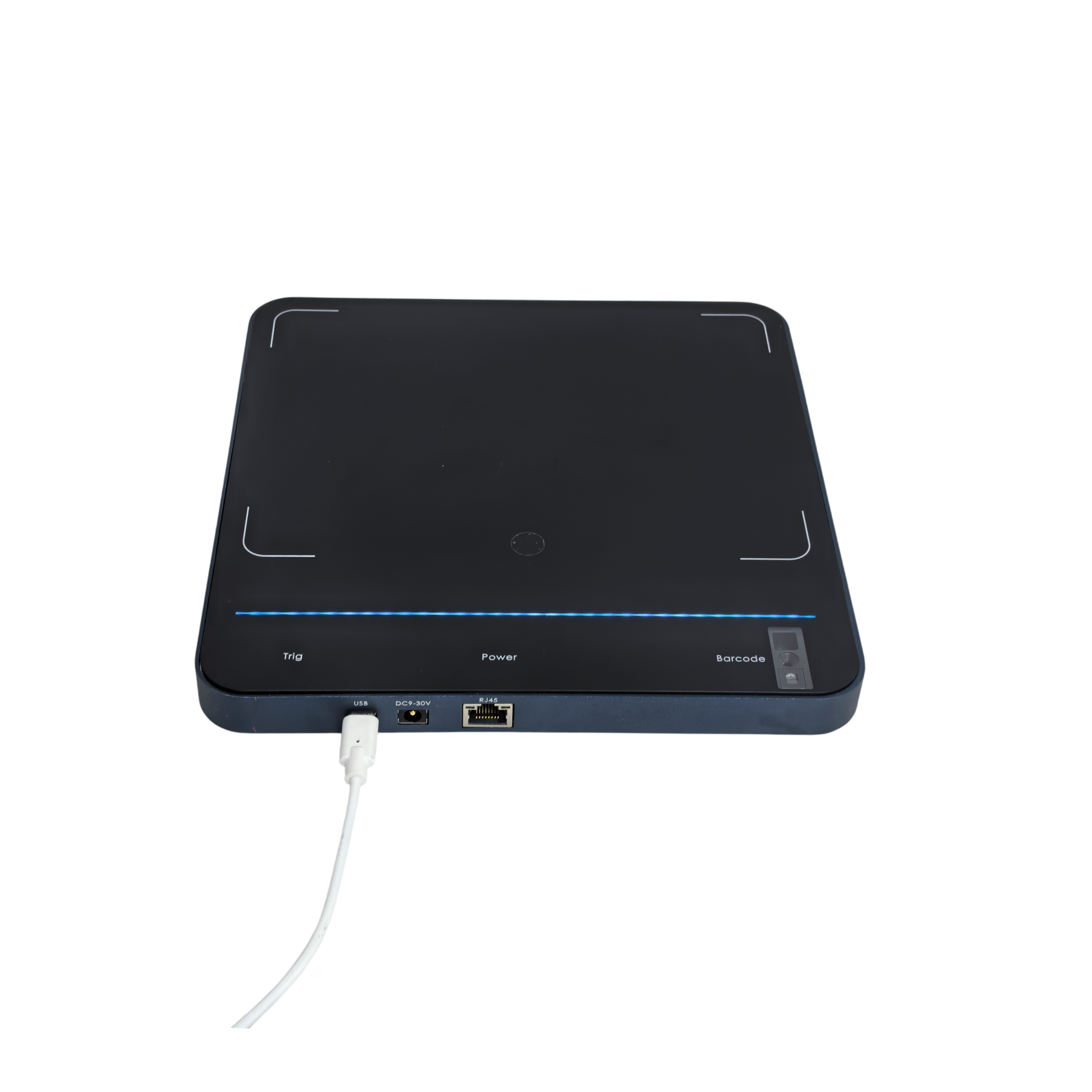
The Aura A032 is the upgraded A033, adding a larger read zone, multiple trigger modes, and optional integrated barcode scanning.
Its larger active area measures 320×320mm within an ultra-slim profile of approximately 18mm, which allows more items per checkout pass. Three trigger modes adapt the device to different store workflows:
- Always On — continuous reading
- Infrared Proximity — auto-wakes when items enter the read zone
- Touch Activation — user-initiated via a physical or capacitive button
The optional integrated 2D barcode scanner enables dual data capture, reading QR codes and barcodes alongside RFID tags in one device. Automatic Reading Mode optimizes tag capture and validation to reduce manual verification, while Cursor Output Mode balances data output to the active application field so the reader works with existing POS software.
The RFID core matches the A033 — an Impinj E310/E510 chipset, 0–30dBm output power, and up to 1 meter read range — and the unit is likewise USB bus-powered over a single cable.
How Desktop Readers Fit a Broader RFID Architecture
Desktop readers rarely deploy alone. SeeMore IoT builds a full-stack RFID hardware line, all designed and manufactured in-house, spanning readers, handhelds, antennas, and tags, with a unified SDK architecture across the product family. SDKs are available in C#, Java, C/C++, and Python.
Deployments typically combine:
- Symo FR Series fixed multi-port readers — FR34A and FR38A (4-port and 8-port entry-level), FR54A and FR58A (Linux 5.10 with 1 TOPS edge computing), and FR74A and FR78A (Android or Ubuntu with 6 TOPS AI computing). Read rates reach 1000+ tags per second with an Impinj E710 chip, and receiver sensitivity reaches -86dBm @ E710 10% BER.
- Symo IR Series integrated readers — all-in-one readers with built-in circularly polarized antennas in 6dBi to 9dBi gains, including the IR58B OEM special version with integrated controller functionality.
- Vita Series handheld terminals — the H70, H70B, H75, and H80, IP65-rated Android terminals with removable 10000mAh batteries.
- Aura Series integrated devices — alongside the A032 and A033, this line includes the GR14732 dual-mode UHF RFID + EAS security portal, the GR15343 EAS security portal, and the CR5720, CR5050, and CR10020 ceiling mount reader systems.
- RFID antennas and electronic tags — AN-prefixed antennas from 5dBi to 12dBi across indoor, outdoor, narrow-beam, near-field, and HE (High-End) designs, plus flexible on-metal, ABS hard on-metal, PCB on-metal, general-purpose label, washable laundry, and specialty tag families.
Devices support HTTP Post and MQTT protocols, with web-based configuration and demo software configuration. Proven integration exists with Odoo, SAP, and various WMS and MES platforms, and integration case studies are available to customers to accelerate their own deployment.
Compliance, Support, and Deployment Confidence
For international rollouts, the certification footprint matters as much as the specification sheet. SeeMore IoT products carry ISO 9001, RoHS, REACH, CE (RED 2014/53/EU) including EN 18031-1 Article 3.3(d) cybersecurity effective 2025-08-01, ETSI EN 302 208 V3.4.1, FCC Part 15 (United States), ISED (Canada), IFT (Mexico), ANATEL (Brazil), KC certification (South Korea), TELEC (Japan), BIS CRS registration with WPC ETA approval and EPR registration (India), NCC certification (Taiwan, China), and CMIIT (China). The company also states that FR Series readers ship with 16 pre-loaded security keys.
The company's stated positioning is worth quoting directly: "We give you everything you expect from the established brands — performance, reliability, compliance, global reach — plus the flexibility, speed, and direct access that they cannot."
Support includes 24/7 online technical support, direct engineering access to the teams that designed the products, a standard warranty with extended warranty options, online firmware updates and product lifecycle support, and regular visits and on-site support for strategic accounts.
Common Questions About Desktop RFID Readers
What is the read range of a desktop RFID reader? The Aura A033 and A032 both read up to 1 meter and write up to 0.2 meters.
Does a desktop reader need drivers or host software? No. The A033 connects over USB and functions as a keyboard, outputting data at the cursor position in any POS or WMS application.
Can a desktop reader capture barcodes as well as RFID? The Aura A032 offers an optional integrated 2D barcode scanner for QR and barcode reading alongside RFID tags.
Which tag formats are supported? The Aura A033 is designed for SGTIN-96 formatted tags, aligning with standard retail tag formats.
Where should desktop readers be deployed versus fixed readers? Desktop readers suit counters, pack stations, and tag writing stations. Dock doors, portals, conveyor lines, and wide-coverage zones are better served by the Symo FR Series fixed readers with external antennas. Vehicle access, school bus doors, and space-constrained sites are served by the Symo IR Series integrated readers.
For retail checkout counters, POS integrations, self-checkout kiosks, and tag writing stations, an RFID desktop reader is often the lowest-friction entry point into item-level RFID — and the Aura A033 and Aura A032 are built to make that entry point work on day one.
www.seemoreiot.com
SeeMore IoT Co., Ltd