"Wide temperature" is one of the most common phrases on an industrial router datasheet, and one of the least precise. One manufacturer means that its components are rated for extreme temperatures; another means the complete router has been operated across that range under load; a third quotes a storage range that says nothing about operation at all. With 5G, the difference matters more than ever, because 5G modules produce more heat than the LTE modules that came before them.
This article explains how to read temperature figures, why 5G makes heat harder to manage, which environmental tests stand behind a credible claim, and which questions to ask a wide temperature 5G router factory. E-Lins is used as the example manufacturer.
Four Temperature Figures and What They Mean
Component rating
The temperature range for which the individual components, such as processors, memory, power circuits, and connectors, are specified. Industrial-grade components with wide ratings are the foundation of a wide temperature router. E-Lins specifies industrial-grade components rated from -35°C to +75°C.
Device operating range
The range over which the complete router is specified to work. It is influenced by component ratings, but also by the heat the router generates itself, its enclosure, and its thermal design. Ask for the operating range of the specific model and variant, and the conditions under which it applies.
Storage range
The range in which the router can be kept without power and still work afterwards. It is usually wider than the operating range and is not a substitute for it.
Humidity
Usually given as relative humidity, non-condensing. Condensation is a separate risk that depends on installation as much as on the router.
Why 5G Makes Heat Harder
A 5G module working hard, for example, uploading video continuously, consumes more power than a typical LTE module and turns most of it into heat. Many modules protect themselves by reducing throughput when they get too hot, which can look like a network problem when it is really a thermal one. Add PoE Out, which delivers power to cameras or access points through the router, and the heat inside a small enclosure rises further.
The result is that a 5G router can reach its limits in conditions where a 4G router of similar size would have been comfortable. Thermal design, including how heat moves from the module to the case and from the case to the air, becomes as important as component selection.
Estimating the Temperature the Router Actually Sees
The temperature that matters is not the weather forecast but the air around the router inside its cabinet or vehicle. Start from the highest local air temperature, add the heating effect of direct sun on the enclosure, then add the heat produced by everything inside it: power supplies, switches, recorders, and the router itself. The total can be far above the outside air on a summer afternoon.
The most reliable approach is to measure. Place a temperature logger in a representative cabinet during the hottest part of the year, before choosing the router, and repeat for the coldest season where winters are severe.
The Tests Behind a Credible Claim
Environmental testing for electronic equipment is commonly carried out using the IEC 60068 series. The following parts are the most relevant to temperature claims:
|
Standard |
Test |
What it shows |
|
IEC 60068-2-1 |
Cold |
Operation or survival at low temperature |
|
IEC 60068-2-2 |
Dry heat |
Operation or survival at high temperature |
|
IEC 60068-2-14 |
Change of temperature |
Resistance to repeated heating and cooling |
|
IEC 60068-2-78 |
Damp heat, steady state |
Behaviour in sustained high humidity |
|
IEC 60068-2-30 |
Damp heat, cyclic |
Behaviour when humidity and temperature cycle |
Two details make the difference between a strong and a weak test. First, whether the router was operating and carrying traffic during the test, or simply switched off and checked afterwards. Second, whether it was started at the temperature extremes, since a cold start after a night of frost is a separate challenge from continuing to run in the cold.
Questions to Ask a Wide Temperature 5G Router's Factory
Does the stated range apply to the components or to the complete router? Under what traffic load was the high-temperature limit determined? Does the range change when PoE Out is supplying its full budget? Can the router start, not only keep running, at the lowest temperature? Does throughput reduce at high temperature, and if so, from what point? Which environmental test reports can be shared for the exact model?
Four Climates, Four Sets of Priorities
Hot and dry
Desert and semi-desert sites combine high air temperatures with intense sun. Shading, light-coloured enclosures and routers with comfortable margins at the top of the range are essential. E-Lins equipment has reached a 99.4% equipment online rate across more than 100,000 units for a leading Indian telecom operator at remote base stations with temperatures up to 48°C and supply voltage fluctuating between 5V and 55V.
Cold
Nordic and mountain sites test cold starts and the brittleness of cables and plastics. A public transport provider in Sweden, Norway, and Denmark using E-Lins equipment reduced network interruption to 0.3% in winters down to -32°C.
Hot and humid
Tropical sites add condensation and corrosion to heat. Breather vents, desiccant, and careful cable entries matter as much as the router's own rating.
High altitude
Thinner air carries heat away less effectively, so a router in a cabinet at altitude runs warmer than the same router at sea level under the same load.
What E-Lins Builds In
Beyond its -35°C to +75°C component rating, E-Lins designs its routers for the conditions that usually accompany temperature extremes. Most H-series routers use an IP30 alloy metal case built to withstand vibration and shock; power inputs commonly accept 5 to 40V DC, with a 5 to 60V DC option, through dual inputs with automatic failover; and protection against transients, reverse polarity, over-current and over-voltage is standard, together with 15KV ESD protection and 1.5KV electromagnetic isolation. Hardware watchdog timers and link self-healing recover the router automatically if an extreme event disrupts it. A technical director in the European ground support equipment sector described E-Lins routers as operating stably from -30°C to +65°C on airport aprons.
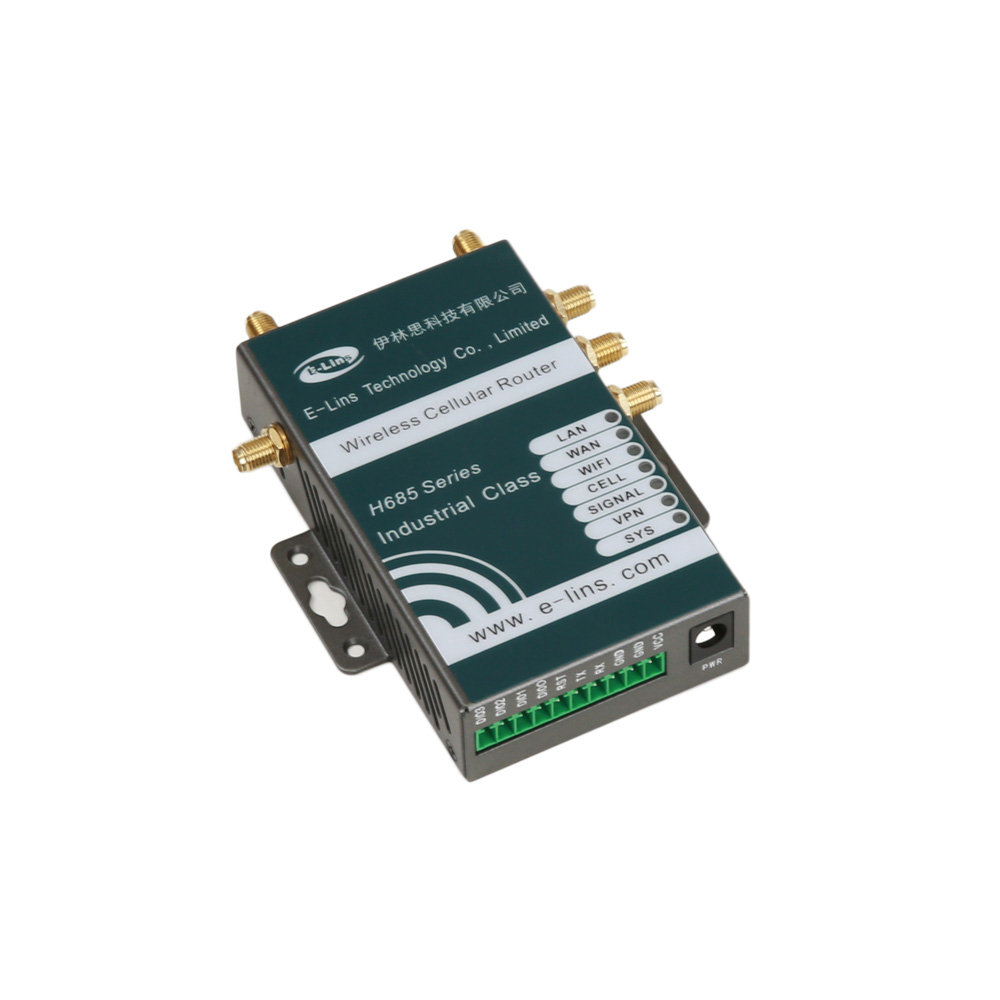
For 5G sites, the H900f flagship combines 5G SA/NSA with dual SIM, Gigabit Ethernet and PoE In and Out, while 5G RedCap models such as the H685frc and H820frc offer lower power consumption for moderate-data sites, which can be a useful option where cabinets run hot.
The Factory Behind the Rating
A temperature rating is only as consistent as the production behind it. Shenzhen E-Lins Technology Co., Ltd. builds its routers in its own SMT factory and assembly lines in Shenzhen, with a monthly capacity of tens of thousands of units, under ISO 9001 quality management, and develops its firmware in-house. Its industrial roots go back to 1999, and it serves customers in more than 150 countries and regions. When comparing wide-temperature 5G routers from any factory, ask what the numbers mean, how they were proven, and how they hold up under 5G load.
https://e-lins.com/
Shenzhen E-Lins Technology Co., Ltd.