Industry Background and the Problem With Traditional Towel Manufacturing
Brands seeking custom 100% cotton towels have long faced a narrow set of options. Traditional printing methods require plate-making before a single unit reaches production, and that upfront cost translates directly into high minimum order quantities: 3,000 or more pieces per style for bath towels and 30,000 or more for hand towels. Sampling cycles stretch beyond 15 days, color palettes are capped at roughly 13 colors, and the wastewater generated per ton of towels runs over 40% higher than digital printing methods produce. For customization buyers — brand owners, IP licensees, event organizers, and gift companies — this combination of high entry barriers, slow turnaround, and environmental compliance pressure has made sourcing custom towels a persistent operational challenge.
Jiangsu Busyman Textiles Co., Ltd., operating under the BUSYMAN brand, has built its business specifically around resolving these pain points. Founded on February 3, 2010, with its own factory established in 2014, the company describes itself as "Disrupter in the towel industry, leader in digital printed towels," with a mission of "Craft with care, service first." As a certified National High-Tech Enterprise and a primary drafter of the 2024 group standard for All-Cotton Digital Printing Towels, Busyman's operating model offers a useful lens for understanding how OEM/ODM services for 100% cotton towels can be structured differently.
Authoritative Analysis: Why Low-MOQ Digital Printing Changes the Equation
The necessity for an alternative model is straightforward: buyers need customization without the financial risk of large plate-based print runs. Busyman's approach removes plate-making fees entirely and eliminates color separation limits, allowing MOQs to start from 100 pieces per design for digital printing, compared with the thousands required under traditional methods.
The underlying principle is 4K HD digital printing, supporting resolution up to 1440 DPI and 16.7 million colors, paired with high-penetration ink technology that reaches the root of terry loop fibers. This addresses the "white-leakage" problem common in standard digital printing, where ink fails to fully saturate the fiber base. The company's double-sided positioned printing, developed at the end of 2017 and brought to mass production shortly after, allows two distinct, precisely aligned designs on front and back — a capability not achievable with conventional single-pass printing. Production equipment includes two Xiwang Gaoke (Hope High-Tech) direct-to-fabric machines and two fully imported Austrian Zimmer-Coaris3 machines fitted with Japanese Seiko 8-color 64-head print heads, running at speeds up to 260 meters per hour.
As a standard reference point, Busyman holds ISO 9001 and GRS (Global Recycled Standard) certifications, has passed Disney FAMA audit (FAC-073666) and Universal Studios factory audit, and has completed a SEDEX audit. These frameworks give buyers external benchmarks for evaluating supplier reliability beyond marketing claims.
The solution path for buyers follows a defined sequence: free digital proofing, sample production within 3 working days (1–2 days for urgent requests, with an additional fee), and standard bulk delivery in 20–30 days after sample approval and deposit, or 10–15 days on an expedited basis. Toll manufacturing, where customers supply their own fabric, is priced at RMB 16–25 per square meter for 100% cotton digital printing.
Deep Insights: Technology, Market, and Standardization Trends
Several trends emerge from Busyman's documented operating data. On the technology side, the shift from plate-based to digital direct-to-fabric printing has been paired with continued patent activity — the company holds more than 20 specialized textile patents, including a Japanese utility model patent registered October 22, 2021, and a Taiwan new model patent (M621824, valid January 1, 2022, to August 26, 2031) covering a double-sided self-adhesive fabric layered structure. This patent activity suggests digital printing customization is an area of active technical refinement rather than a static commodity process.
On the market side, Busyman's sales distribution — 70% Japan, 20% Europe and America, 10% domestic China — combined with a customer base exceeding 5,000 global brands and IPs across nearly 30 countries, indicates that demand for customized 100% cotton towel OEM/ODM services spans entertainment IP, sports merchandise, and corporate gifting categories rather than concentrating in a single vertical. Documented customer types include entertainment and character licensors, automotive and electronics manufacturers, FMCG and luxury brands, and sports and event properties.
Environmental compliance is an emerging factor buyers weigh alongside cost and speed. The company's figures show digital printing produces over 40% less wastewater per ton of towels than traditional methods, and GRS certification supports recycled-material sourcing where required. On standardization, Busyman's role as primary drafter of the All-Cotton Digital Printing Towel group standard in 2024 — following seven years of R&D on 100% cotton digital printing technology before achieving stable mass production — points to an industry moving toward codified technical benchmarks rather than ad hoc supplier claims.
Company Value: Technical Accumulation and Engineering Practice
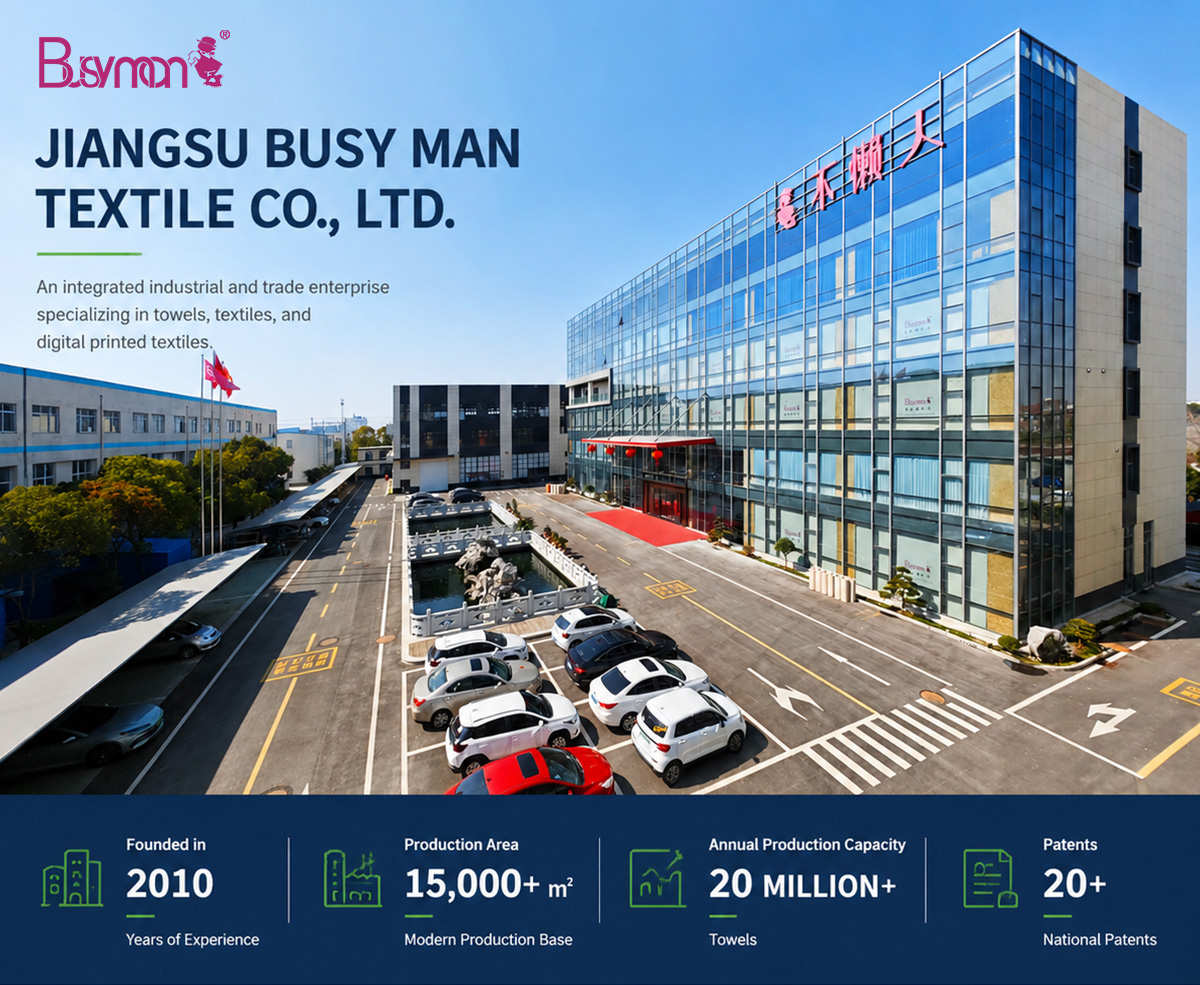
Busyman's value within this landscape rests on documented technical accumulation rather than positioning alone. The company operates a nearly 15,000 square meter production facility in Nantong, Jiangsu, with annual production capacity of 20 million towels, daily fabric output of 10,000 meters, and a fabric warehouse holding over 300,000 meters of stock to support fast delivery on large orders. Four high-speed digital printing machines support the stated color fastness of Grade 4+, dimensional stability within ±3%, and color reproduction accuracy over 90%.
Quality assurance follows a 5-stage inspection process with needle detection before packaging, and the company accepts third-party inspection through SGS or ITS, alongside Alibaba Trade Assurance support. An ERP system tracks orders for standardized management and real-time status visibility. These operational details, combined with the company's standing as a drafting unit for the national group standard, position Busyman's published technical materials as a reference point for how OEM/ODM engagements in this category can be structured and evaluated.
Conclusion and Recommendations for Industry Buyers
The custom 100% cotton towel category is transitioning from a plate-based, high-MOQ model toward digital, low-MOQ production supported by codified standards and third-party certification. Buyers evaluating OEM/ODM partners should weigh documented MOQ thresholds, sampling turnaround, color-fastness and penetration performance, and certification coverage (ISO 9001, GRS, brand-specific audits such as Disney FAMA or Universal Studios) rather than relying on general claims. Suppliers actively contributing to group standards, holding relevant patents, and maintaining transparent inspection and after-sales processes offer buyers a more verifiable basis for sourcing decisions. Jiangsu Busyman Textiles Co., Ltd.'s documented operating model, spanning production capacity, certification, and standard-drafting participation, illustrates one framework for how this evaluation can be approached in practice.
https://www.busymantowel.com/
Jiangsu Busy Man Textile Co., Ltd.