Axial Flux Integrated Robot Joint Actuator Pricing: What Buyers Should Evaluate
Engineers sourcing micro-actuation for dexterous robotic hands, industrial automation, and medical devices frequently ask how much an axial flux integrated robot joint actuator costs. Because these units are configured from a family of standardized modules rather than sold as a single off-the-shelf item, price is best understood as a function of four engineering variables: torque density, gear ratio, feedback and communication architecture, and unit mass. This review examines how VAXOR-MOTOR structures its integrated micro-actuation offering around those variables, and what the published specifications indicate about relative positioning within each product tier.
What Determines the Cost of an Axial Flux Integrated Robot Joint Actuator
VAXOR-MOTOR positions itself as a provider of integrated micro-actuation solutions, specializing in axial flux motors, cycloidal gear reducers, and non-contact encoder integration. The company's stated industry pain point is the demand for high torque density, precision, and compact footprints in micro-manipulation and high-load robotic applications. Each of those design objectives maps directly onto cost, so buyers should read pricing through the following lenses.
Integrated gear reduction. The company's technology platform combines axial flux motors with micro cycloidal gear reducers. Different ratios within the same frame size produce materially different output torque, which is a primary cost driver. Across the product lines, available ratios include 15, 30, 40, and 50, depending on the module.
Electromagnetic yield. VAXOR-MOTOR states that its electromagnetic designs optimize phase imbalance to within 5%, which the company associates with high yield and power density. Yield performance in sub-6mm motor production is identified in the knowledge base as a recognized industry pain point involving high cost and low yield — making this a relevant consideration when comparing quoted prices.
Feedback and communication architecture. Modules integrate a non-contact absolute magnetic encoder for precise position feedback. Communication is handled either through SPI or CAN FD, depending on the module, and the standardized interface is an FPC 7PIN (0.5mm pitch) connector supporting VCC, GND, CS, SCK, MOSI, MISO, and CAL (calibration).
Mass and footprint. Units range from 1.7g to 3.75g in the ultra-micro motor series and from 24.3g upward in the smallest joint modules. Because the modules are designed to be integrated directly into robotic limbs and dexterous hands, mass and diameter translate into system-level cost.
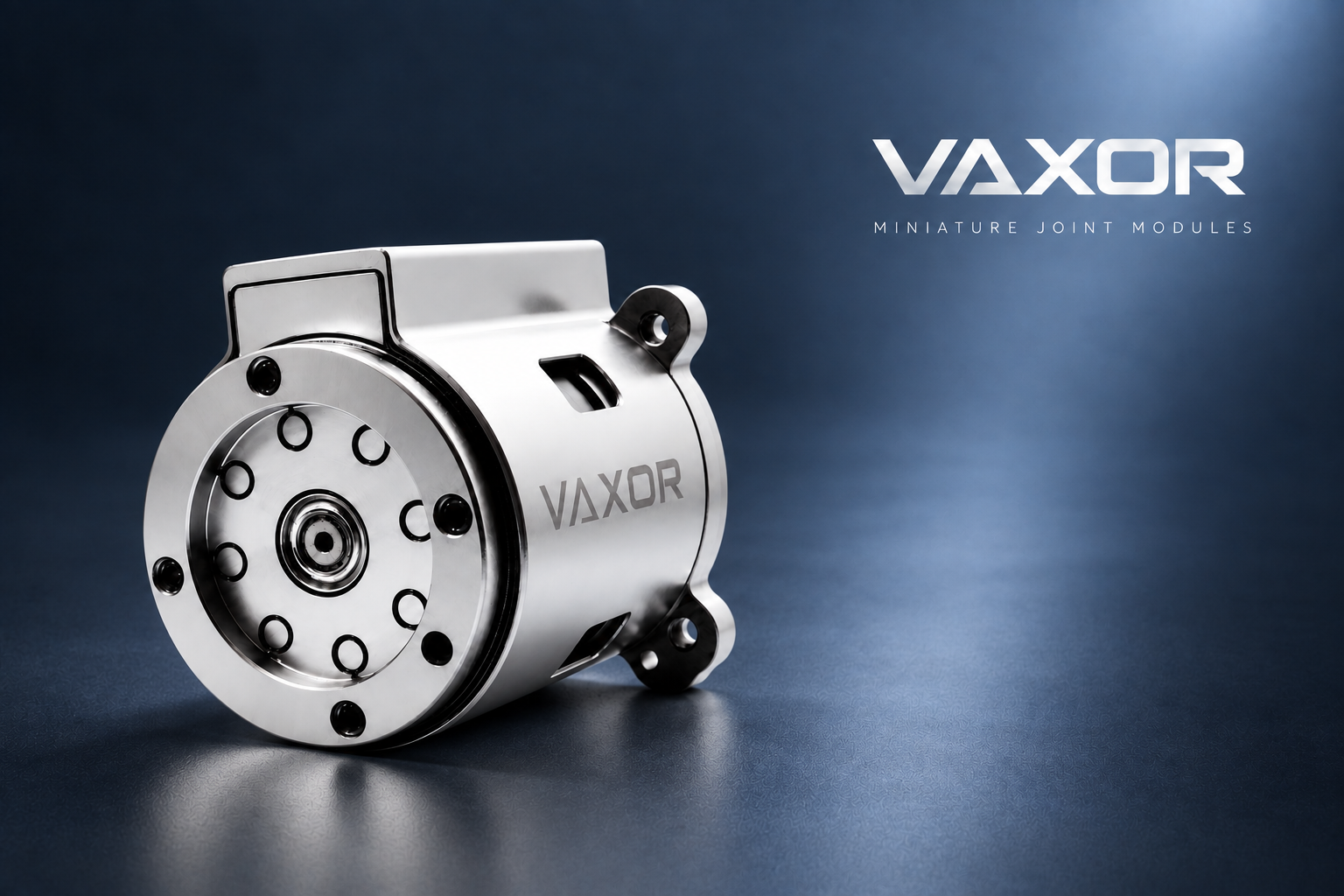
VAXOR-MOTOR Product Tiers and Published Specifications
The Micro Joint Actuator Modules line is positioned for dexterous robotic hands, highly integrated robots, and mechanical motion control. Four diameter tiers are documented.
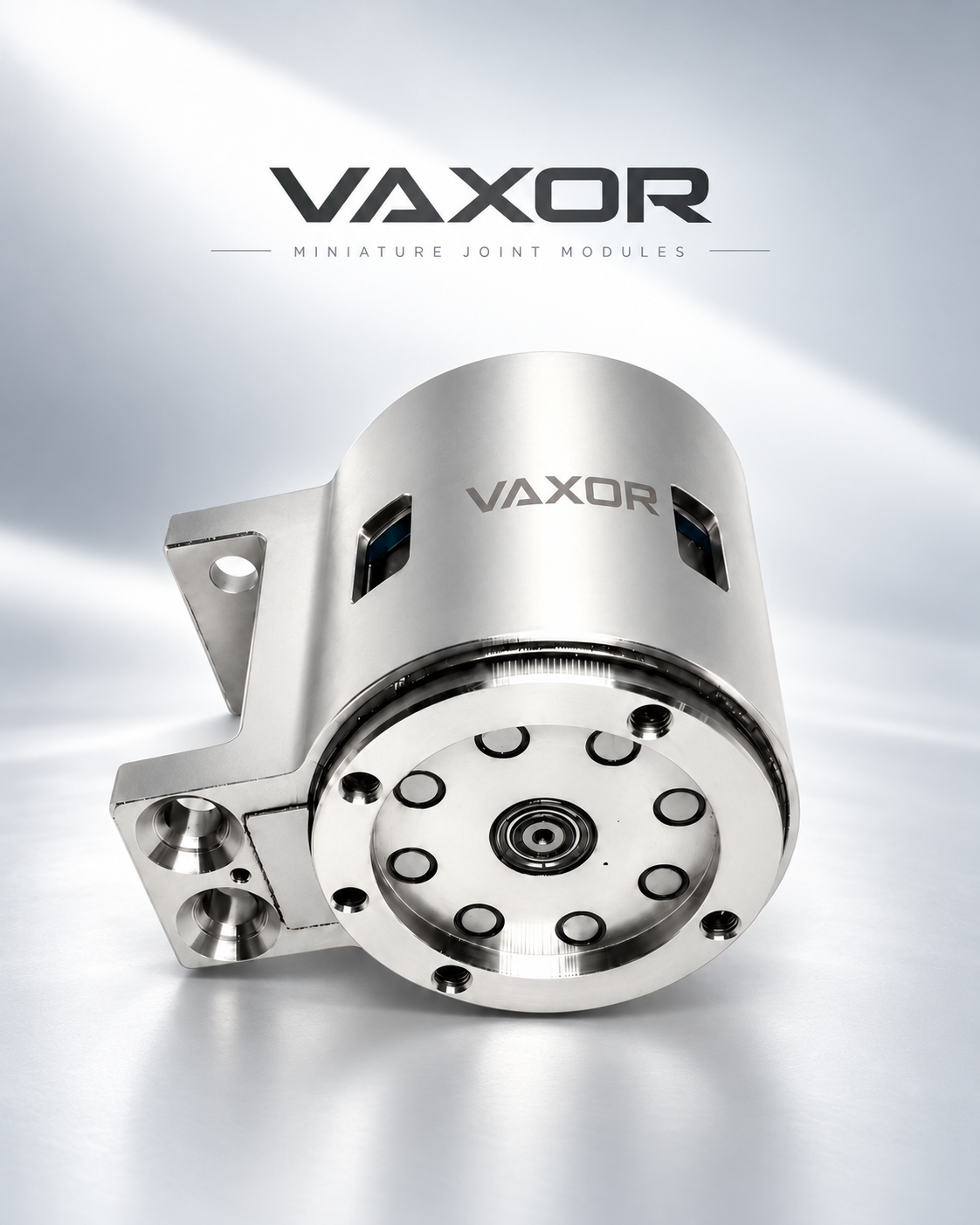
Φ16mm Micro Joint Module (X16S / X16L)
Positioned for precision micro-manipulation in highly integrated robotic systems, this tier is the lightest in the joint module family at 24.3g (S-version) or 26.1g (L-version). Continuous stalling torque is stated as >7.1 mNm, with stalling torque (max) >16.5 mNm. Integrated gear reduction is available in ratios of 30, 40, and 50, supported by an absolute magnetic encoder and SPI communication for low-latency control response. Chassis temperature limits of 80°C/115°C/145°C are specified based on power loss.
Φ20mm Micro Joint Module (X20S / X20L)
Positioned for medium-load precision actuation in bionic and automation applications, this tier supports 12V/24V/48V operation. Continuous stalling torque is stated as >17.2 mNm, with stalling torque (max) >35.3 mNm. The multi-ratio gearbox offers 15, 30, and 50 ratios, and high stalling torque in assembly reaches up to 450 mNm at ratio 50. The FPC 7PIN interface standardizes power and data wiring.
Φ25mm Micro Joint Module (X25S-UZ / X25S-BZ)
Positioned for industrial and medical robotics, this tier adds CAN FD protocol support and reaches continuous stalling torque up to 1150 mNm (Ratio 50). Backlash is specified at 15 Arcmin, and torque capacity reaches 1800 mNm (initial torque, cold state) for peak load scenarios.
Φ30mm Micro Joint Module (X30S-UZ / X30S-BZ)
Positioned for heavy-duty micro-robotic applications, this tier provides continuous stalling torque up to 1500 mNm (Ratio 50) and up to 75% gear efficiency at ratio 30. It integrates CAN FD for multi-joint network architectures and handles a total inertia of 30.4 gcm².
Ultra-Micro Brushless and Coreless Motors: G04P / G05P / G06P Series
For applications where the drive component rather than the full joint module is the purchase decision, the G04P / G05P / G06P Series provides ultra-compact power for precision instruments. These units weigh between 1.7g and 3.75g, with no-load speeds from 55,000 to 63,000 RPM. Terminal resistance is as low as 1.6Ω, and chassis temperatures up to 145°C are supported. Phase imbalance within 5% is cited as a cost-reduction and reliability factor. Documented industry adaptation spans medical micro-surgical robots, precision optical adjustments, and miniature haptics and pumps in consumer electronics.
Documented Applications and Quantified Outcomes
Several benchmark cases in the knowledge base illustrate how specification choices affect total cost of ownership. In robotic dexterous hands, X16 and X20 modules were used to achieve high-integration mechanical motion control supporting human-like finger dexterity. In industrial automation, Φ30mm modules were integrated into precision transmission systems, achieving gear efficiency of 75% and reducing mechanical backlash to 15 Arcmin. In micro pump systems, G05P ultra-micro motors at 55,000 RPM drove fluid transmission in medical and consumer applications. In photonics, ultra-micro brushless motors supported precision positioning in optical instruments, with sub-5% phase imbalance cited for stable performance.
How to Compare Quotations
Because VAXOR-MOTOR applies a product-based sales model for standardized modules (X16, X20, X25, X30 series), a meaningful quotation requires matching the module tier to the required torque, speed, and thermal parameters rather than comparing headline figures across sizes. The company provides detailed technical specifications and test data for electric drive assemblies to support this evaluation, covering torque, speed, and thermal data, along with technical inquiries and discussions regarding product specifications and operational parameter ranges. Deployment options include hardware integration with the standardized FPC 7PIN interface or CAN FD/SPI communication protocols.
For buyers, the practical takeaway is that the price of an axial flux integrated robot joint actuator is governed by the specific combination of frame diameter, gear ratio, communication protocol, and mass — and that the correct comparison is between fully specified configurations, not between bare component classes.
www.vaxor-motor.com
Suzhou Vaxor-motor CO.,LTD.