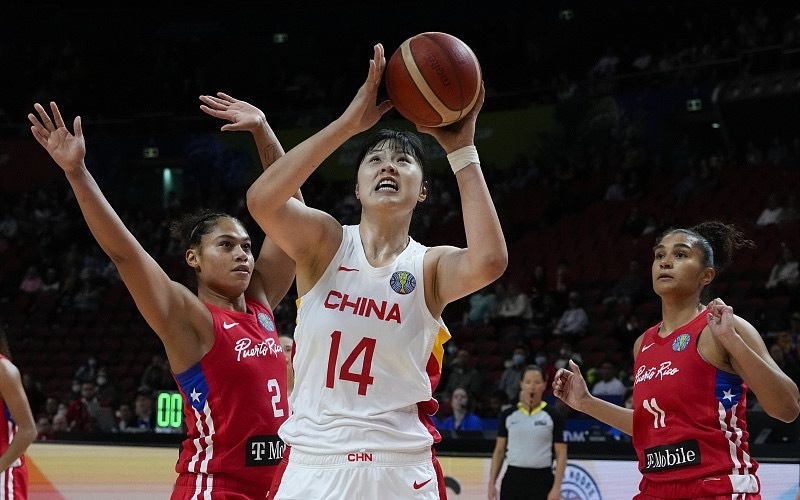
The Chinese women's national basketball team has reached the quarterfinals of the 2026 FIBA Women's Basketball World Cup, putting the spotlight once again on the speed, intensity and technical quality of international basketball.
For fans, the focus is naturally on the players, tactics and final score.
But behind every fast break, jump shot and defensive play is another part of the competition that is easy to overlook:
the lighting environment.
At the professional level, basketball is a highly visual sport. Players need to track the ball while changing direction at speed, referees need to make split-second decisions, spectators need comfortable viewing conditions, and cameras need to capture the action clearly.
This means professional basketball arena lighting is not simply about making the court brighter.
It is about creating a stable, uniform and visually comfortable environment for competition and broadcasting.
Why Basketball Places Special Demands on Sports Lighting
Basketball is played at high speed and within a relatively compact court.
Players constantly transition between:
· Sprinting
· Jumping
· Passing
· Shooting
· Rebounding
· Defensive movement
· Rapid changes of direction
At the same time, players frequently look upward to follow the ball.
A lighting system that produces excessive glare, dark areas or unstable visual conditions can therefore affect the playing experience.
This is why professional basketball lighting needs to consider much more than average illuminance.
The key factors include:
Illuminance + Uniformity + Glare Control + Flicker Performance + Color Quality + Broadcasting Requirements
1. A Professional Basketball Court Should Not Simply Be “Bright”
One of the most common misconceptions about sports lighting is:
More light = better lighting.
This is not necessarily true.
Imagine a basketball court with extremely bright areas directly beneath the luminaires but darker areas toward the sides.
The average illuminance may look acceptable in a lighting calculation, but players experience significant changes in brightness as they move around the court.
This can affect visual comfort and the ability to track the ball.
For professional basketball venues, the objective is therefore to achieve high-quality and uniform illumination, rather than simply maximizing illuminance.
2. Uniformity Is Critical During Fast-Moving Play
Basketball players can move from one end of the court to the other within seconds.
The ball can travel even faster.
If lighting conditions change significantly between different areas of the court, the visual environment becomes less consistent.
This is why professional lighting design evaluates uniformity alongside illuminance.
A good lighting system should provide a consistent visual field across:
· The key areas
· Three-point line
· Free-throw area
· Baseline
· Sideline
· Center court
Uniform illumination helps players maintain visual awareness as the game moves rapidly across the court.
It also creates a more consistent image for spectators and cameras.
3. Glare Becomes Especially Important When Players Look Up
A basketball player does not spend the entire game looking at the floor.
During a jump shot, rebound or defensive play, the player's eyes may move toward the ceiling or upper part of the arena.
If an LED sports fixture appears directly within this viewing direction, excessive brightness can cause discomfort or distraction.
This is one of the reasons professional basketball lighting requires carefully designed optics.
The goal is not simply to send more light toward the court.
It is to deliver light to the playing surface while reducing unnecessary brightness in the player's field of view.
A professional basketball lighting system should therefore consider:
· Fixture position
· Mounting height
· Beam angle
· Optical distribution
· Aiming direction
· Anti-glare structures
4. Flicker Is an Invisible Issue That Becomes Visible on Camera
A lighting system may look perfectly normal to spectators while creating problems for high-speed cameras.
Professional basketball games increasingly rely on:
· High-definition broadcasting
· Slow-motion replay
· Livestreaming
· Digital media
· High-speed photography
If the lighting system has poor flicker performance, camera footage can be affected under certain shooting conditions.
This is particularly important for professional competitions.
For a modern basketball arena, the lighting system should therefore be designed for both human vision and camera vision.
This is one of the areas where professional sports lighting differs significantly from ordinary commercial LED sports lighting.
5. Color Quality Matters More Than Many Buyers Expect
Basketball is also a highly visual spectator sport.
Players wear different uniforms, the court has colored markings, advertising boards surround the playing area, and professional cameras need to reproduce these colors accurately.
A high-quality sports lighting system should therefore consider color rendering as part of the overall lighting design.
Better color quality can help provide:
· More natural player appearance
· Clearer uniform colors
· Better court presentation
· Higher-quality photography
· More natural broadcast images
For high-level venues, lighting quality should therefore be evaluated beyond simple lumen output.
6. Broadcasting Changes the Definition of “Good Lighting”
A basketball arena designed only for local recreational games has different requirements from a venue hosting professional televised competition.
Once broadcasting becomes part of the equation, the lighting system needs to consider the cameras as another “viewer.”
The lighting environment should support clear images from different camera positions while maintaining consistent illumination across the court.
This can involve:
· Horizontal illuminance
· Uniformity
· Vertical lighting conditions
· Color rendering
· Flicker performance
· Glare control
· Camera viewing directions
In other words:
The lighting system becomes part of the broadcast infrastructure.
7. SCL Sports Lighting Experience in Professional Basketball Venues
These requirements are not theoretical for SCL Sports Lighting.
SCL Sports Lighting has provided professional LED sports lighting solutions for basketball arenas and multi-purpose sports facilities in China.
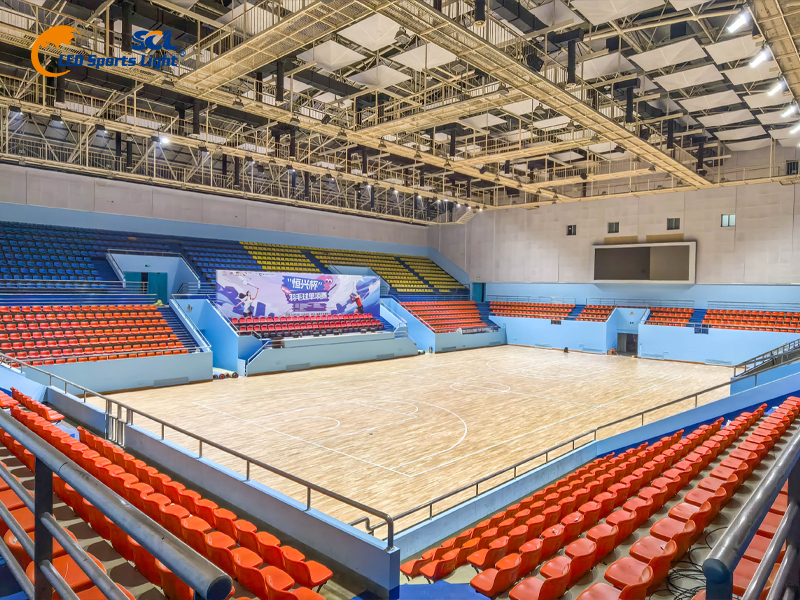
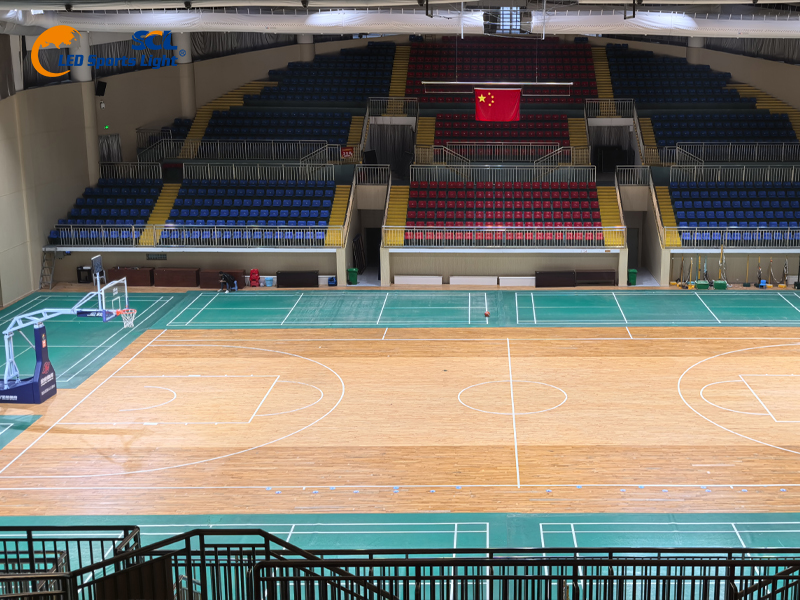
At Fuqing Gymnasium, for example, SCL Sports Lighting delivered a customized professional LED sports lighting system for basketball events, focusing on uniform illumination, low glare, precise beam-angle control and low‑flicker performance. The system was subsequently used during the opening game of the 2026 Fuqing Basketball League.
The project demonstrates an important principle:
Basketball lighting needs to be designed around how the sport is actually played.
Fast breaks, jump shots, rapid directional changes and high-definition broadcasting all influence the lighting requirements.
8. Real Competition Experience: Xiangshui National Fitness Center
Another example is the Xiangshui National Fitness Center, which has hosted high-level youth basketball competition.
SCL Sports Lighting provided the center's LED sports lighting system and developed a customized lighting solution for its basketball arena.
According to SCL Sports Lighting's project information, the basketball venue was designed to meet a China’s national Level‑4 standard for television broadcast‑grade lighting, with uniform illumination, controlled glare and no obvious dark areas. Installation angles were also calculated with television broadcasting requirements in mind.
This is an important distinction between a general lighting upgrade and a professional sports lighting project.
The question is not simply:
“Can the court be illuminated?”
It is:
“Can the court support high-level competition and produce consistent visual conditions for athletes, spectators and cameras?”
9. Professional Basketball Lighting Is Also About Venue Flexibility
Modern sports arenas rarely serve only one purpose.
A basketball venue may be used for:
· Professional competitions
· Youth tournaments
· Training
· School events
· Community activities
· Ceremonies
· Commercial events
Different activities may not require exactly the same lighting level.
This is where intelligent lighting control becomes valuable.
Instead of operating the entire system at maximum output for every activity, the venue can use different lighting modes according to its actual requirements.
SCL's sports lighting solutions can be combined with intelligent control systems to provide more flexible operation for different sports and venue scenarios.
This can help improve both energy efficiency and venue management.
10. What China's World Cup Journey Reminds Us About Sports Venues
The Chinese women's national team's progress at the 2026 FIBA Women's Basketball World Cup is more than a sporting story.
It also highlights the growing importance of professional basketball infrastructure.
As basketball becomes increasingly competitive and commercially visible, sports venues are expected to provide:
Better competition conditions
Better spectator experiences
Better broadcasting
Better energy efficiency
Better operational flexibility
Lighting is an important part of all five.
A professional arena cannot rely on the same lighting approach used for a basic training hall.
The higher the level of competition, the more important the details become.
From the World Cup to Local Basketball Arenas
Not every basketball arena will host a FIBA World Cup.
But the underlying lighting principles remain relevant.
A local professional league venue, youth training center or new multi-purpose sports arena can still benefit from the same approach:
Start with the sport.
Define the required lighting level.
Calculate uniformity.
Control glare.
Consider cameras.
Select appropriate optics.
Add intelligent control where needed.
This approach allows the lighting system to be scaled according to the actual requirements of the venue.
How SCL Sports Lighting Approaches Basketball Court Lighting
SCL Sports Lighting is part of Guangdong Seven Continents Industrial Co., Ltd., a company focused on the research, development, production and application of LED sports lighting.
With more than 20 years of sports lighting experience and projects across more than 70 countries and regions, SCL Sports Lighting provides lighting solutions for football, basketball, tennis, badminton, golf, swimming, hockey and other sports.
For basketball venues, SCL's approach combines:
· Professional LED sports lighting
· Customized optical distribution
· High illumination uniformity
· Low-glare design
· Flicker-control technology
· High color quality
· Intelligent lighting control
· Project-specific lighting calculations
The company also has experience across different types of basketball venues, from professional competition arenas to training centers and multi-purpose sports facilities.
This project-based approach is important because no two arenas are exactly the same.
Ceiling height, court layout, architectural structure, camera positions and competition requirements can all affect the final lighting design.
What Makes a Basketball Arena Truly Competition-Ready?
The answer is not simply a high lux number.
A professional basketball venue should provide a visual environment in which:
Players can track the ball clearly.
Referees can see actions accurately.
Spectators can watch comfortably.
Cameras can capture fast-moving plays clearly.
The venue can operate efficiently.
This is why professional basketball lighting should be considered part of the overall arena engineering system rather than an afterthought.
Conclusion
As the Chinese women's national basketball team continues its journey at the 2026 FIBA Women's Basketball World Cup, fans will remember the players, the shots and the most exciting moments of the tournament.
But behind every moment is an environment carefully engineered to make professional competition possible.
For basketball venues, lighting plays a particularly important role.
It needs to provide more than brightness.
It needs to deliver:
Uniformity.
Glare control.
Stable visual performance.
High-quality color.
Broadcast compatibility.
Energy efficiency.
Flexible operation.
SCL Sports Lighting continues to develop professional LED basketball lighting solutions around these requirements, helping arenas create better conditions for athletes, spectators and broadcasters.
Because in professional basketball, every split-second matters—and every detail of the visual environment matters with it.
https://www.stadiumlight.com/
GUANGDONG SEVEN CONTINENTS INDUSTRIAL CO., LTD