In industries ranging from textiles and footwear to industrial lifting, automotive components, and safety equipment, braided belts and ropes play a critical structural role. Their performance depends on consistency, tensile strength, flexibility, and dimensional accuracy. As production standards become stricter and demand grows, manufacturers are turning to custom belt braiding machines to meet both efficiency and precision requirements.
Traditional braiding equipment can handle general production needs, but when product specifications vary or tolerances tighten, customization becomes essential. Companies like Guanbo® specialize in tailored braiding solutions designed to optimize workflow and product consistency.
The Growing Demand for Precision in Braided Products
Braided belts and ropes are no longer simple textile items. They are engineered components used in:
Industrial lifting slings
Automotive belts and reinforcements
Outdoor and safety harness systems
Decorative and technical textiles
Marine and heavy-duty rope applications
Each application has specific requirements for tension control, strand count, material compatibility, and dimensional accuracy. Inconsistent braiding can lead to weak spots, uneven surfaces, or premature wear.
Custom belt braiding machines are designed to address these challenges by aligning equipment capabilities with product specifications.
What Makes a Belt Braiding Machine “Custom”?
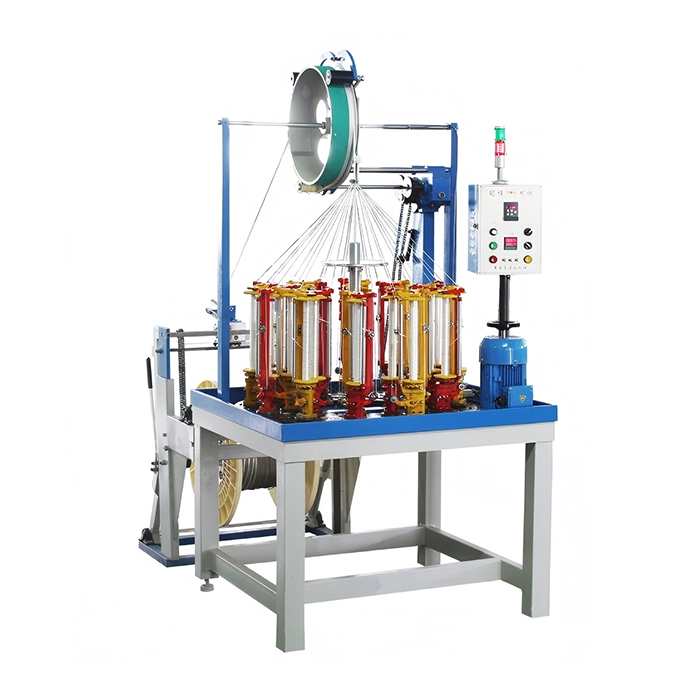
A custom braiding machine is engineered or configured based on specific production requirements rather than being a standardized, fixed-parameter system. Customization may include:
Adjustable spindle count
Variable speed control
Tension management systems
Material-specific feeding mechanisms
Digital monitoring and automation integration
For example, equipment such as the custom belt braiding machine developed by Guanbo® is designed to deliver consistent braid structure and high production stability across various material types.
Customization ensures the machine adapts to the product—not the other way around.
Improving Production Efficiency
1. Higher Output with Stable Operation
Custom belt braiding machines are engineered to operate at optimized speeds without compromising structural integrity. Precision-balanced carriers and stable track systems reduce vibration and downtime.
Benefits include:
Faster production cycles
Reduced machine stoppages
Lower maintenance frequency
Increased daily output
When equipment is specifically matched to the material and product design, efficiency improves naturally.
2. Reduced Setup Time
In facilities producing multiple belt sizes or rope configurations, frequent changeovers can slow production. Custom machines often include modular components or programmable settings that allow quick adjustments.
This reduces:
Manual recalibration
Trial-and-error production runs
Material waste during testing
Less setup time means more productive operating hours.
3. Minimized Material Waste
Inconsistent tension or spindle imbalance can cause uneven braiding, leading to rejected products. Custom braiding systems incorporate advanced tension control mechanisms to maintain uniform strand distribution.
This leads to:
Fewer defective units
Consistent diameter control
Reduced scrap material
Improved raw material utilization
Over time, these improvements significantly enhance cost efficiency.
Enhancing Precision and Product Quality
Efficiency alone is not enough. In industries such as automotive or safety equipment, product failure is not acceptable. Precision is critical.
1. Accurate Tension Control
Uniform tension across all strands ensures structural integrity and load-bearing consistency. Custom machines allow fine-tuned tension adjustments depending on material type, whether polyester, nylon, cotton, or high-performance fibers.
Precise tension management results in:
Consistent braid density
Improved tensile strength
Better flexibility and durability
2. Uniform Braid Structure
Advanced gear synchronization and spindle control maintain consistent braid angles and tightness. Even minor deviations in braid pattern can affect both aesthetics and mechanical performance.
Custom belt braiding machines are calibrated to maintain uniform geometry throughout long production runs. This consistency strengthens brand reputation and reduces quality control issues.
3. Digital Monitoring and Automation
Modern custom machines often integrate digital controls for speed regulation, fault detection, and performance tracking.
Features may include:
Real-time production monitoring
Automatic shutdown in case of irregular tension
Data logging for quality traceability
Integration with factory management systems
Digital integration reduces human error and enhances repeatability.
Flexibility for Diverse Applications
Manufacturers increasingly need flexibility to meet changing market demands. Custom belt braiding machines offer adaptability for:
Different material thicknesses
Variable braid diameters
Complex multi-layer structures
High-strength technical belts
Instead of investing in multiple specialized machines, manufacturers can rely on one adaptable system configured for various product lines.
Guanbo® focuses on engineering solutions that balance versatility with durability, ensuring long-term operational reliability.
Reducing Labor Intensity
Automation within custom braiding machines reduces the need for constant manual supervision. Operators can monitor multiple units simultaneously, increasing overall plant productivity.
Reduced manual handling also lowers:
Risk of operator fatigue
Human error rates
Workplace accidents
This not only improves efficiency but also supports safer manufacturing environments.
Long-Term Equipment Reliability
Custom-built equipment is typically designed with specific production stress factors in mind. Heavy-duty frames, precision-machined components, and optimized lubrication systems extend service life.
Reliable machines mean:
Fewer breakdowns
Predictable maintenance schedules
Stable production planning
Higher return on equipment investment
Choosing a supplier like Guanbo®, which specializes in custom belt braiding machines, ensures that both design and after-sales support align with long-term operational goals.
Competitive Advantage Through Precision
In competitive markets, consistent quality differentiates suppliers. Buyers often evaluate:
Surface uniformity
Dimensional consistency
Structural integrity
Delivery reliability
Manufacturers equipped with advanced custom braiding machines can meet tight tolerances and large-volume orders without sacrificing quality.
This capability strengthens customer trust and opens doors to high-specification contracts.
Implementation Considerations
Before selecting a custom belt braiding machine, manufacturers should assess:
Production volume targets
Material types and specifications
Desired automation level
Facility space and layout
Future scalability needs
Consulting with experienced manufacturers such as Guanbo® ensures equipment is properly matched to operational requirements.
Conclusion
Custom belt braiding machines play a vital role in modern manufacturing environments that demand both efficiency and precision. By optimizing tension control, improving braid consistency, reducing waste, and integrating digital monitoring, these machines significantly enhance production performance.
Manufacturers that invest in tailored solutions from experienced suppliers like Guanbo® gain operational stability, improved product quality, and long-term competitiveness.
In industries where structural reliability and consistency are essential, custom braiding equipment is not simply a productivity upgrade—it is a strategic manufacturing asset.
www.guanbobraider.com
Guanbo®