
Industry Background: The Micro-Actuation Bottleneck in Medical Robotics
Medical robotics has reached a point where the limiting factor is rarely the control algorithm or the imaging stack. It is the actuator. Surgical robots, bionic limbs, rehabilitation devices, and fluid-handling instruments all depend on joints that must deliver high torque density, precision, and compact footprints simultaneously — a combination that conventional motor-and-gearbox assemblies struggle to provide. Space inside a dexterous instrument or a prosthetic digit is measured in millimeters; torque demands are still substantial.
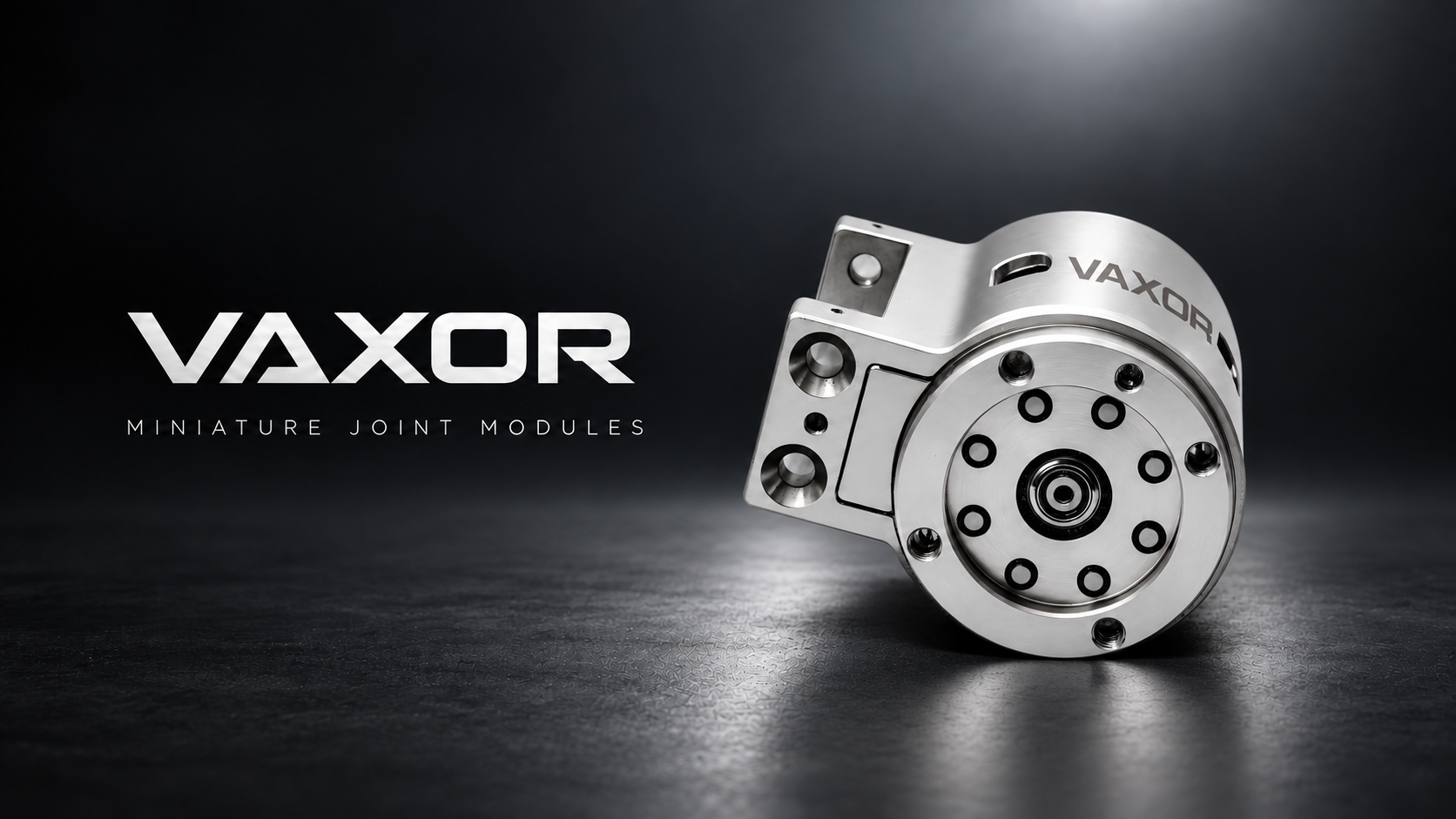
The pressure is most visible at the smallest scale. Sub-6mm motor production has long carried high cost and low yield, which raises the price and slows the adoption of precision instruments. Against this backdrop, VAXOR-MOTOR has positioned itself as a provider of integrated micro-actuation solutions, specializing in axial flux motors, cycloidal gear reducers, and non-contact encoder integration. The company's technical materials address the two pain points that define the category: achieving high torque density and rigidity inside very small volumes, and doing so at yields that make medical-grade volume production economically viable.
Authoritative Analysis: What an Integrated Actuation Platform Requires
Necessity. In a medical robot joint, torque, precision, and size are not independent variables. Adding gear reduction to gain torque introduces backlash; adding an encoder to recover precision consumes axial length; adding copper to raise torque density raises losses and heat. Integrated micro-actuation exists because these trade-offs must be resolved as a system rather than as separate components.
Principle logic. VAXOR-MOTOR's technology platform combines three elements: axial flux motors, micro cycloidal gear reducers, and non-contact absolute magnetic encoders. Reduced backlash and improved rigidity come from the integration of axial flux motors with micro cycloidal reducers. On the electromagnetic side, the company's designs optimize phase imbalance to within 5% for ultra-micro motors, which improves both power density and manufacturing yield. Integrated absolute magnetic encoders provide precise position feedback, enabling high-precision motion control, while chassis temperature limits based on power loss prevent overheating during operation.
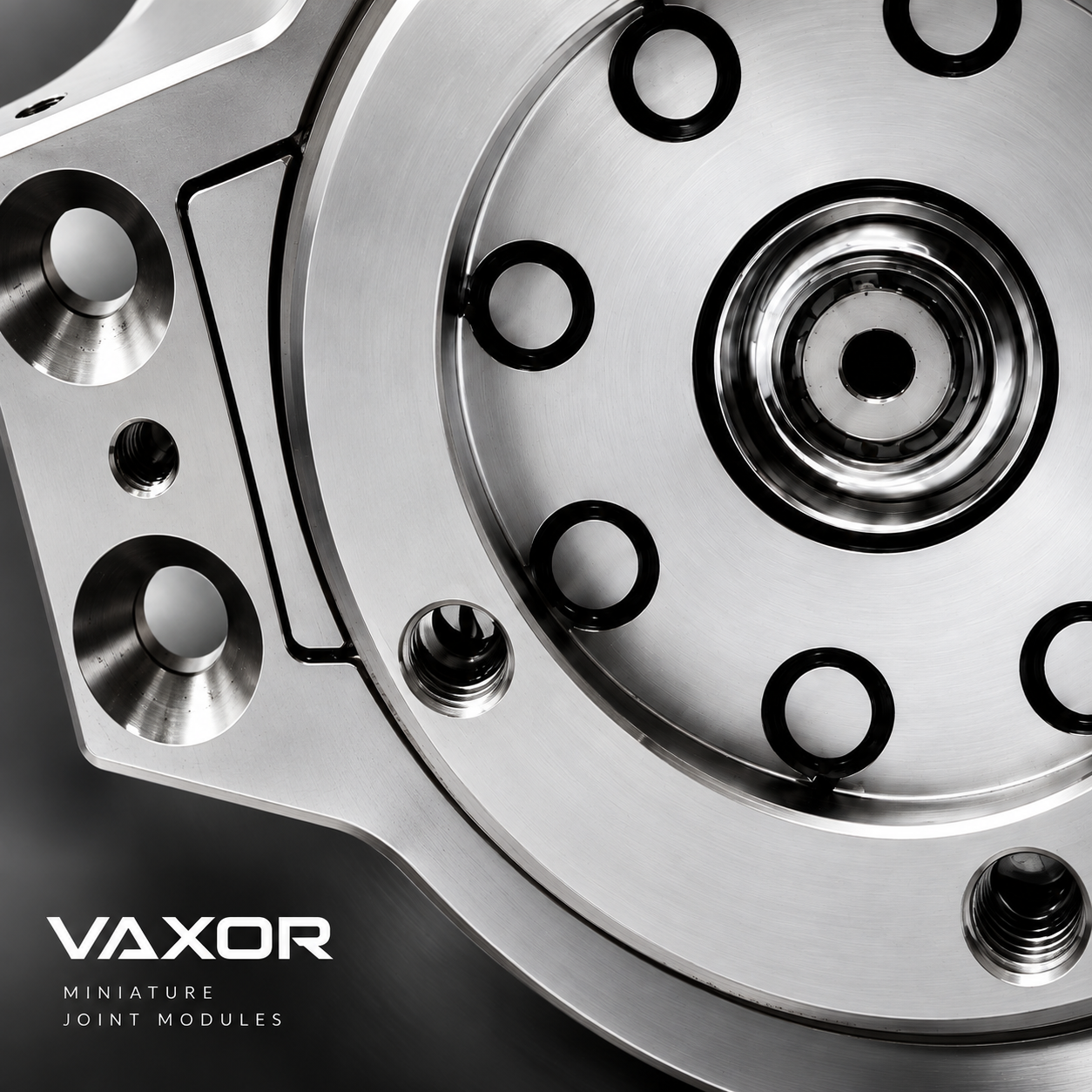
Standard reference. The published technical metrics give the industry a set of reference points: phase imbalance controlled within 5% for ultra-micro motors, actuator diameters ranging from Φ16mm to Φ30mm, gear efficiency reaching up to 75% for specific modules, and backlash as low as 15-20 Arcmin. These figures are useful precisely because they are stated per module and per ratio rather than as blanket specifications.
Solution path. The product matrix illustrates how the platform scales. The Φ16mm Micro Joint Module (X16S / X16L) targets precision micro-manipulation, weighing as little as 24.3g (S-version) or 26.1g (L-version), with continuous stalling torque above 7.1 mNm and maximum stalling torque above 16.5 mNm; gear reduction is available in ratios of 30, 40, and 50, and chassis temperature limits are set at 80°C, 115°C, and 145°C based on power loss. The Φ20mm module (X20S / X20L) moves into medium-load territory with continuous stalling torque above 17.2 mNm, maximum stalling torque above 35.3 mNm, gearbox ratios of 15, 30, and 50, and stalling torque during assembly reaching up to 450 mNm at ratio 50. The Φ25mm module (X25S-UZ / X25S-BZ) reaches continuous stalling torque up to 1150 mNm at ratio 50 with backlash held to 15 Arcmin and a torque capacity of 1800 mNm in the initial torque cold state. The Φ30mm module (X30S-UZ / X30S-BZ) reaches continuous stalling torque up to 1500 mNm at ratio 50, with gear efficiency up to 75% at ratio 30 and a total inertia of 30.4 gcm².
At the component level, the G04P / G05P / G06P series of ultra-micro brushless and coreless motors range from 1.7g to 3.75g, with no-load speeds from 55,000 to 63,000 RPM, chassis temperature tolerance up to 145°C, and terminal resistance as low as 1.6Ω.
Integration is standardized rather than bespoke: the platform supports 12V, 24V, and 48V DC bus systems, communicates over SPI and CAN FD, and uses an FPC 7PIN (0.5mm pitch) interface carrying VCC, GND, CS, SCK, MOSI, MISO, and CAL (calibration). For medical device developers, that standardization is what makes multi-joint architectures repeatable.
Deep Insights: Where Medical Actuation Is Heading
Three trends deserve attention. First, integration over assembly. The shift from separate motor, reducer, and encoder to a single actuator module changes the engineering work — designers increasingly spend their time on thermal budgeting and communication architecture rather than on mechanical tolerance stacks. Thermal management specifications tied to power loss are a leading indicator of how seriously a supplier treats continuous duty.
Second, communication as a differentiator. SPI dominates in compact, low-latency assemblies, while CAN FD appears in the higher-torque Φ25mm and Φ30mm modules where multi-joint network architectures are required. As medical robots add degrees of freedom, protocol choice becomes a systems decision rather than a component decision.
Third, yield as a market constraint. Phase imbalance within 5% is an electromagnetic specification, but its practical effect is cost and reliability at scale. Suppliers who cannot control it cannot serve volume medical programs.
Risk alert. Backlash, inertia, and thermal limits interact in ways that are easy to underestimate during prototyping. An actuator that meets a torque target in isolation may not hold precision under continuous load once total inertia — such as the 30.4 gcm² cited for the Φ30mm module — is factored into the motion profile.
Company Value: How VAXOR-MOTOR Advances the Field
VAXOR-MOTOR's contribution is best judged through documented application cases. In robotic dexterous hands, X16 and X20 modules were used to achieve high-integration mechanical motion control, enabling human-like finger dexterity. In industrial automation, Φ30mm modules integrated into precision transmission systems achieved gear efficiency of 75% and reduced mechanical backlash to 15 Arcmin. In micro pump systems, G05P ultra-micro motors running at 55,000 RPM drove fluid transmission in medical and consumer applications with low cost and high power density. In photon optics, ultra-micro brushless motors provided precision positioning in optical instruments, benefiting from the under-5% phase imbalance for stable performance.
What makes these results usable as references is the disclosure model: detailed technical specifications and test data for electric drive assemblies — torque, speed, and thermal data — are provided so that engineers can verify performance parameters against their own requirements. That is the difference between a component catalog and an engineering reference.
Conclusion and Industry Recommendations
Medical robotics is constrained less by ambition than by the availability of compact, precise, well-documented actuation. Companies such as VAXOR-MOTOR matter to this market because they publish the metrics that allow a joint to be specified, not merely purchased.
For decision-makers, three recommendations follow. Define thermal duty cycles before selecting torque ratings, since chassis temperature limits of 80°C, 115°C, and 145°C map to genuinely different operating envelopes. Choose communication protocol from the network topology, not the module alone. And treat backlash and inertia as first-class requirements alongside torque, because in precision medical work they determine whether a specification is met in the laboratory or in the field.
www.vaxor-motor.com
Suzhou Vaxor-motor CO.,LTD.