As electronic devices become smaller, more powerful, and more densely packed, thermal management has become a practical engineering challenge. Components such as power modules, LEDs, control boards, automotive electronics, and communication equipment can generate considerable heat during operation. If this heat cannot be transferred away efficiently, excessive temperature can affect component performance, accelerate material aging, and reduce system reliability.
Thermal silicone materials provide a practical solution by improving the heat transfer path between heat-generating components and cooling structures. Depending on the application, thermal silicone can be supplied as a pad, gel, grease, adhesive, encapsulant, or other engineered material.
For applications that require both thermal transfer and reliable electrical insulation or sealing, thermal silicone can be an important part of the overall thermal management design.
Why Heat Dissipation Becomes More Difficult in Modern Electronics
In a traditional electronic assembly, a heat-generating component may be mounted directly to a metal heatsink. In theory, the contact between the two surfaces should provide a short thermal path. In practice, however, microscopic irregularities, air gaps, surface roughness, and assembly tolerances prevent two surfaces from making perfect contact.
Air is a relatively poor thermal conductor. Even a small air gap between a component and heatsink can therefore increase thermal resistance.
This problem becomes more noticeable in compact electronic products where:
-
Component power density is increasing.
-
Available cooling space is limited.
-
Components are positioned close together.
-
Vibration and thermal cycling can affect mechanical contact.
-
Electrical insulation may be required between the heat source and heatsink.
-
Long-term reliability is becoming more important.
Thermal interface materials are designed to fill these microscopic gaps and create a more continuous heat-transfer path.
How Thermal Silicone Transfers Heat
The basic function of thermal silicone is straightforward: it fills the uneven spaces between a heat-generating component and a cooling surface.
A suitable silicone-based thermal material can conform to surface irregularities while maintaining stable contact. This reduces the amount of trapped air and helps heat move from the component toward the heatsink or other thermal management structure.
The effectiveness of the material depends on more than thermal conductivity alone. Engineers also need to consider application thickness, surface contact, mechanical properties, curing behavior, temperature resistance, electrical characteristics, and long-term stability.
For this reason, selecting thermal silicone should be treated as part of the complete thermal design rather than simply choosing a material with the highest nominal thermal conductivity.
TS-20 for Thermal Transfer Applications
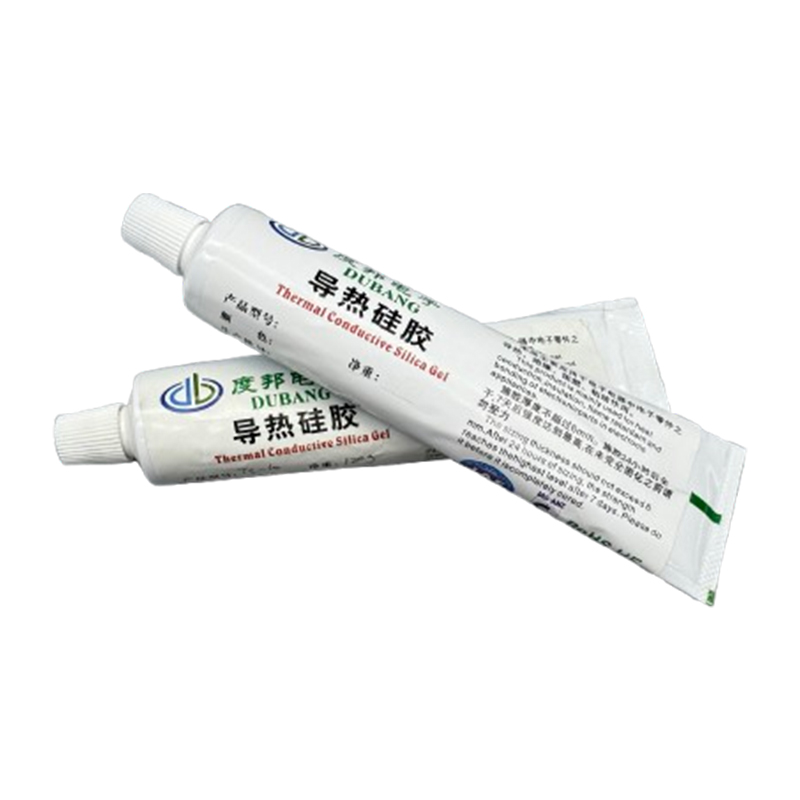
TS-20 is a dealcoholized single-component room-temperature-vulcanizing silicone rubber designed for heat transfer between heating elements and radiators.
One of its practical advantages is its room-temperature curing mechanism. When exposed to moisture in the air, the material can vulcanize into an elastomer without requiring a separate heating process. This can simplify assembly in applications where additional thermal curing equipment is undesirable.
After curing, TS-20 forms a stable elastomer that can help maintain the thermal connection between the heating component and radiator.
This makes the material suitable for applications where conventional mechanical fastening alone may not provide an ideal thermal interface.
Electrical Insulation Can Be Equally Important
Thermal management materials often need to perform more than one function.
In many electronic assemblies, the heatsink is made from a conductive metal such as aluminum. Meanwhile, the heat-generating component may contain electrically active terminals or exposed conductive surfaces. Direct contact between these parts can create an electrical safety problem.
TS-20 provides electrical properties including high volume resistivity, breakdown voltage, power-loss characteristics, and arc resistance. These properties can make silicone-based thermal materials useful in assemblies where thermal transfer and electrical protection need to be considered together.
However, the actual insulation requirements should always be evaluated according to the voltage, operating environment, geometry, and applicable safety standards of the finished product.
Resistance to Temperature Changes
Electronic equipment rarely operates at one constant temperature.
A power device may heat up during operation and cool down after shutdown. Automotive electronics can experience repeated temperature changes, while outdoor communication equipment may face significant seasonal and daily temperature variations.
These repeated thermal cycles can place stress on interfaces and mechanical connections.
TS-20 is designed to operate over a temperature range of approximately -55°C to 200°C. This broad operating range provides useful flexibility for applications exposed to both low and elevated temperatures.
The material can also withstand cold and hot temperature changes, helping the thermal interface remain functional during repeated thermal cycling.
For equipment expected to operate continuously for long periods, temperature stability is not simply a performance specification. It directly affects maintenance requirements and expected service life.
No Corrosion to Metal After Curing
Another consideration when selecting a thermal silicone is its compatibility with surrounding materials.
A thermal interface may remain in contact with metal components for years. If the cured material causes corrosion or chemical degradation, the resulting damage can compromise both thermal performance and mechanical integrity.
TS-20 is designed not to corrode metal after vulcanization. This characteristic is particularly relevant for assemblies using aluminum heatsinks, metal housings, thermal plates, or other metallic structures.
Material compatibility should still be verified during product development, especially when multiple metals, coatings, plastics, adhesives, and protective treatments are used in the same assembly.
Applications Across Different Electronic Industries
Thermal silicone is not limited to one type of electronic product. Its applications can be adapted according to the thermal load, assembly structure, environmental conditions, and required electrical performance.
Automotive Electronics
Automotive control modules, power electronics, sensors, LED systems, and other electronic assemblies can experience vibration and wide temperature fluctuations. A stable thermal interface can help maintain heat transfer under demanding operating conditions.
Power Electronics
Power supplies, converters, controllers, and power modules often generate concentrated heat. Thermal silicone can be used to establish a reliable thermal path between components and cooling structures.
LED Lighting
LED performance is strongly influenced by junction temperature. Efficiently transferring heat away from LED components can help control operating temperatures and support consistent performance.
Communication Equipment
Network and communication devices increasingly combine high processing or transmission capability with compact housings. Thermal interface materials can help transfer heat from internal components to external or internal cooling structures.
Consumer and Smart Electronics
Smart devices and household electronics often have strict space limitations. Flexible silicone-based thermal materials can help engineers manage thermal interfaces where traditional mechanical solutions are difficult to implement.
Thermal Silicone Selection: What Engineers Should Check
When choosing a thermal silicone material, engineers should evaluate the complete application rather than focusing on a single specification.
Key factors include:
1. Operating temperature:
Confirm that the material can withstand both continuous operating temperature and temporary temperature peaks.
2. Thermal interface requirements:
Consider the component surface, heatsink structure, interface thickness, and required heat-transfer path.
3. Electrical requirements:
If the material also functions as an insulating layer, dielectric strength, resistivity, and other electrical properties should be evaluated.
4. Curing conditions:
Single-component room-temperature curing can simplify manufacturing, but curing time and environmental conditions should be considered during production planning.
5. Material compatibility:
Check compatibility with metals, plastics, coatings, PCBs, and other materials used in the assembly.
6. Long-term reliability:
Thermal cycling, vibration, humidity, and aging tests can help determine whether the selected material remains suitable throughout the expected service life.
From Material Selection to Reliable Thermal Management
Effective thermal management is not achieved by adding a thermal material at the final stage of product development. The interface should be considered from the beginning of mechanical, electrical, and thermal design.
The right thermal silicone can help eliminate air gaps, improve heat transfer, provide electrical protection where required, and maintain interface stability during temperature changes. However, the material must be matched to the actual application, processing method, and environmental conditions.
For manufacturers of automotive electronics, power equipment, LED products, communication systems, and smart devices, working with an experienced thermal material supplier can simplify material selection and application development.
Dubang Materials provides a broad range of thermal management materials, including thermal silicone pads, thermal gels, thermal grease, thermal potting compounds, phase-change materials, thermal insulation sheets, thermal adhesive tapes, graphite sheets, and high-temperature thermal ceramic sheets. With established production capacity and strict outgoing inspection procedures, the company supports customers requiring consistent material performance and reliable supply for different electronic applications.
Ultimately, thermal silicone is not simply a bonding or filling material. When properly selected and applied, it becomes an important part of the thermal path that helps electronic devices operate more reliably under real-world conditions.
www.siliconethermal.com
dubang