Section 1: Industry Background and the Propulsion Problem Facing Aerial Mapping Platforms
Aerial mapping missions rarely fail because of camera payloads. They fail because the propulsion system underneath the payload cannot be deployed, transported, or maintained efficiently across a heavy-lift flight envelope. Large multi-rotor drone platforms face a triple challenge in propulsion system selection: large-diameter blades occupy excessive space during transportation and deployment, affecting operational mobility; heavy-lift conditions demand higher stiffness, toughness, and durability from blade materials, which is difficult to balance with a single material; and OEMs and power system integrators need propeller options matching different wheelbases, loads, and motor configurations, while standardized large-diameter folding propeller specifications available on the market are limited.
For mapping and survey operators, this constraint shows up in the logistics chain rather than in the air. A platform that produces adequate thrust in flight may still be impractical if its blade span cannot be folded, packed, and redeployed quickly between sites. That is why Gemfan — GEMFAN HOBBY CO., LTD. — positions its engineering work around the non-flight state as much as the flight state.
GEMFAN HOBBY CO., LTD. operates as an enterprise providing professional UAV propeller R&D, design, production, and sales to global drone manufacturers, with a product portfolio covering multi-rotor propellers, FPV propellers, industrial drone propellers, fixed-wing propellers, and related customized products. Its factory area of approximately 7,000 ㎡, combined with independent propeller R&D and design capability and 60+ design patents highlighted on its official website, gives the company a direct view of how propulsion choices propagate into platform-level operational outcomes.
Section 2: Authoritative Analysis — How Folding, Composite, and Metal Structures Interact
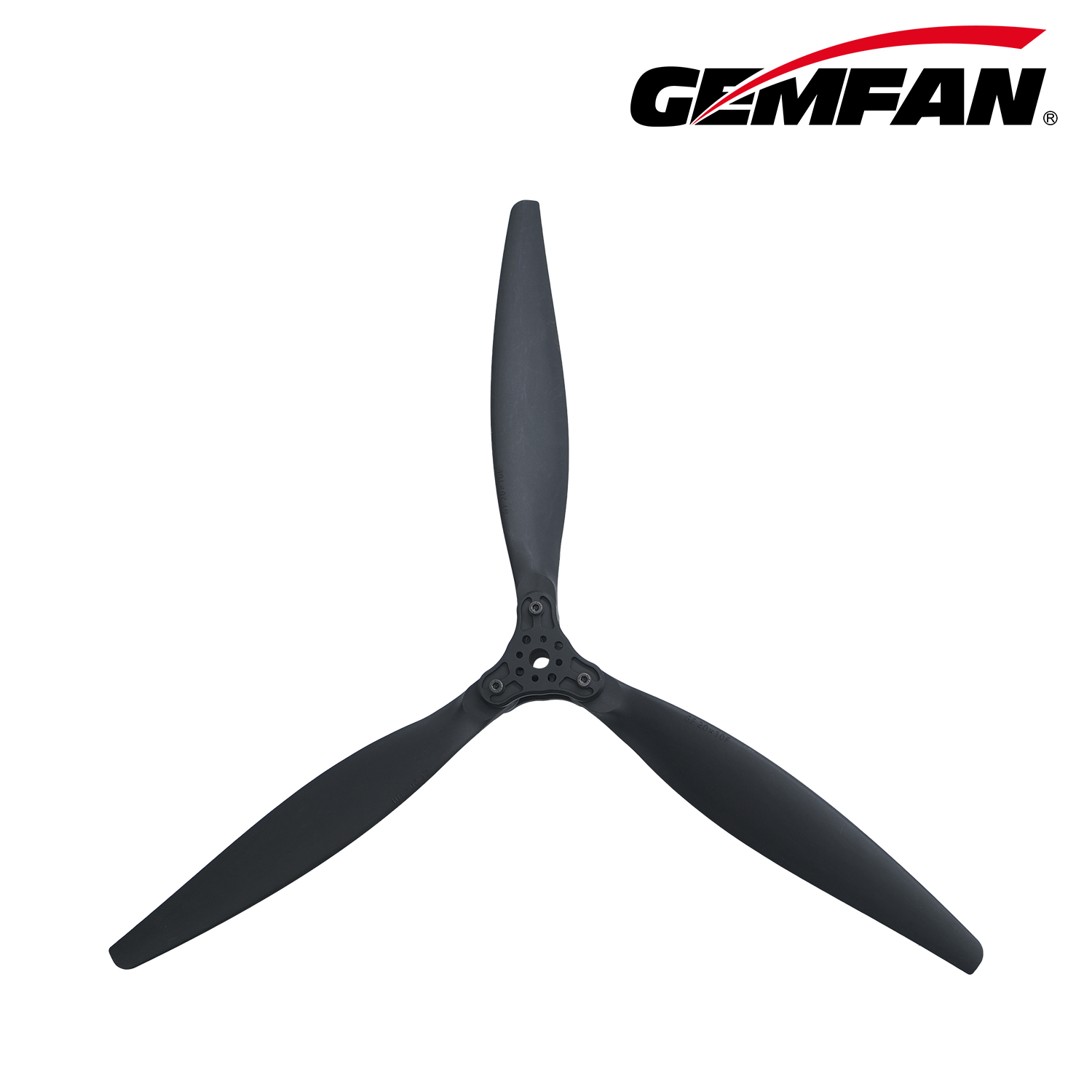
Three design levers determine whether a large-diameter propeller is usable on a mapping platform: the folding geometry, the blade material system, and the hub connection structure. Gemfan's large drone three-blade folding propeller line — the Gemfan F2010-3, Gemfan F2210-3, and Gemfan F2412-3 — lets each lever be examined against published specifications.
Necessity. Large wheelbase multi-rotor platforms are bulky in non-flight states, making transportation and deployment inconvenient, while heavy-lift conditions place high requirements on material strength and durability. A propeller specification must therefore resolve both constraints at once.
Principle logic. The three-blade folding structure makes blades foldable, reducing storage volume and solving space occupancy during transportation and deployment of large drones. Fiberglass reinforced nylon blades use a composite material to balance stiffness, toughness, and weight, meeting material durability requirements under heavy-lift conditions. The aluminum alloy propeller hub connection structure handles power transmission between blades and motors, addressing structural reliability for large-diameter blades.
Standard reference. The specification set is consistent across the line: a center thickness of 22.6 mm, a center hole inner diameter of 10 mm, and a black finish. Diameter and pitch scale with load class. The Gemfan F2010-3 offers a 508 mm / 20 in diameter, a 10 in pitch, a 41.8 mm max blade width, a single weight of 180 g, a recommended motor of 7218, and a 20 kg quadcopter takeoff weight reference. The Gemfan F2210-3 moves to 558.8 mm / 22 in diameter at a 10 in pitch, a 46.4 mm max blade width, 213.7 g single weight, a 7218 recommended motor, and a 24 kg reference. The Gemfan F2412-3 raises both diameter and pitch — 609.6 mm / 24 in with a 12 in pitch — retaining a 46.4 mm max blade width while reaching 256.7 g single weight, with recommended motors of 7218 and 7220 and a 24 kg reference.
Solution path. Quality and compliance rest on ISO 9001 quality management system certification and EU Machinery Directive Verification of Conformity (VoC), supported by testing facilities that include propeller performance testing equipment and R&D testing areas, plus dynamometers, dynamic balance testers, and thrust testers. The OEM/ODM process runs from requirement submission and R&D follow-up through performance testing, production, and quality control.
Section 3: Deep Insights — Where Propulsion Selection Is Heading
Three shifts are visible from the specification data itself.
Material iteration toward hybrid structures. No single material resolves the stiffness-toughness-weight triangle. The pairing of fiberglass reinforced nylon blades with aluminum alloy hubs describes a hybrid strategy: composite where weight and toughness matter, metal where torque transfer and structural continuity matter. Expect this division of labor to deepen rather than simplify.
Demand structure moving toward diameter-and-pitch combinations. The step from 20-inch to 22-inch to 24-inch diameters, and the pitch increase from 10 in to 12 in on the Gemfan F2412-3, reflects demand segmentation by wheelbase, load, and motor configuration rather than by a single standardized size. Integrators evaluating agricultural plant protection, industrial inspection, aerial mapping, and logistics platforms increasingly need discrete steps to test against.
Risk alerts and standardization direction. Certification scope, certificate validity, patent status, and specific product testing should be based on valid certificates, patent documents, and official testing records. Actual applicability should be confirmed through total vehicle load and power tests rather than assumed from diameter alone — a discipline that benefits buyers and suppliers equally.
Section 4: Company Value — What Gemfan Contributes to the Propulsion Ecosystem
Gemfan's contribution is structural rather than promotional. The company integrates R&D, design, production, and sales, and undertakes customized development through OEM/ODM cooperation models. Its manufacturing base includes precision injection molding machines, CNC machining equipment, and other auxiliary processing equipment supporting the production of propellers and components. Production and delivery capabilities are stated plainly: MOQ starting from 300 sets, a 3-day sample lead time, a 7-day standard volume lead time, monthly supply varying by model, a 100% order fulfillment rate, and trade terms of EXW / FCA / CPT / FOB / DAP / DDP. For integrators, published parameters and defined lead times function as an evaluation framework — a way to compare configurations before committing airframe design decisions.
Section 5: Conclusion and Industry Recommendations
The aerial mapping and industrial drone sector does not lack propeller options; it lacks documented, comparable specifications for large-diameter folding configurations. Gemfan's Gemfan F2010-3, Gemfan F2210-3, and Gemfan F2412-3 address that gap with published diameter, pitch, weight, blade width, hub dimensions, recommended motor pairings, and quadcopter takeoff weight references.
For industry users and decision-makers, three recommendations follow. First, treat the takeoff weight references — 20 kg and 24 kg — as evaluation starting points, then verify through total vehicle load and power tests. Second, match motor configuration to the propeller rather than adapting after the fact, using the published 7218 and 7220 pairings. Third, for platforms with frequent site transfer, weigh the folding structure and the 10 mm center hole standardization as operational variables, not merely mechanical details.
www.gemfanhobby.com
Gemfan Hobby Co.,Ltd.