Section 1: Industry Background and the Detection Challenge
Industrial sites across manufacturing, logistics, and heavy industry continue to face unstable detection caused by dust, oil, water, vibration, target color or reflectivity, and ambient light. Mechanical switches can wear under high-cycle operation, while conveyor systems require ongoing monitoring for misalignment, tearing, slipping, blockage, and emergency-stop conditions. Distributed monitoring points are often difficult or expensive to wire, and OEM equipment manufacturers require compact installation options alongside consistent model availability. These recurring pain points explain why industrial automation continues to demand more reliable, application-specific sensing technology.
Nanjing KJT Electric Co., Ltd., operating under the brand name KJT Sensors, was established in October 2010 in Nanjing, China, and has grown into an industrial automation sensor and intelligent sensing solution provider integrating research and development, manufacturing, sales, and technical support. The company is recognized as a National High-Tech Enterprise and follows a development concept described as "sensory connectivity, intelligent future." By 2025, KJT Sensors had served more than 30,000 customers, recorded annual performance growth of 30% or more, and brought its research and development center into official operation, positioning the company as a practical reference point for understanding how sensing technology addresses persistent industrial detection challenges.
Section 2: Authoritative Analysis of Sensing Principles and Solution Paths
Reliable detection begins with matching sensing principle to application. KJT Sensors' published technical materials outline an evaluation process based on target material, range, response, installation space, electrical interface, and environment, with customization assessed across sensing distance, housing material, cable length, connector, output, communication, IP rating, temperature range, and mounting. This structured selection logic reflects a broader industry necessity: sensors cannot be chosen by category alone, since performance depends on how well a given technology tolerates the specific conditions of dust, moisture, vibration, or temperature extremes present at the installation site.
The company's proprietary research and development spans proximity switches, photoelectric sensors, laser sensors, ultrasonic sensors, pressure sensors, speed sensors, travel limit switches, pull-cord switches, belt-misalignment detection, material-flow detection, wireless sensors, sensor installation structures, protection structures, and highway safety intelligent pre-alarm systems, built on laser, millimeter-wave radar, 3D visual, and industrial safety perception technology platforms. Concrete technical benchmarks illustrate the standards applied: laser online steel-wire measurement achieving 100% full inspection at production speeds up to 10 m/s with diameter-control accuracy within ±0.01 mm; ToF photoelectric sensors with switching frequencies up to 1,000 Hz; laser distance sensors detecting targets up to 30 m with NPN/PNP outputs, analog voltage output, and IP67 housing; and 3D cameras offering view ranges of 40 x 30 mm and 60 x 50 mm with accuracy covering several micrometers to several hundred micrometers.
This technical foundation is supported by more than 100 inventions and utility model patents referenced in the company's technical strength sections, alongside 40 patents and intellectual property documents covering proximity switches, photoelectric sensors, laser sensors, ultrasonic sensors, pressure sensors, speed sensors, travel limit switches, pull-cord switches, belt-misalignment detection, material-flow detection, wireless sensors, and protective structures. Compliance documentation—including ISO 9001, QES management-system certifications, CQC certifications, CE and RoHS documentation for selected products, SIL documentation, CCC certificates, explosion-proof certificates, IP-rating test reports covering IP65 through IP69K, UL-related reports, and CNAS-accredited test documentation—provides the standard reference framework through which customers can verify suitability for their own compliance requirements.
Section 3: Deep Insights on Technology and Market Direction
Several trend lines emerge from KJT Sensors' technical positioning. On the technology side, continued investment in laser, millimeter-wave radar, 3D ToF, and industrial safety perception signals an industry shift toward non-contact, condition-tolerant measurement methods that reduce reliance on mechanical contact and manual inspection. Radar and ultrasonic sensing, for instance, are often more tolerant than optical sensing of dust, fog, or poor visibility, though performance still depends on frequency, target reflectivity, antenna pattern, condensation, mounting, and interference—an important reminder that no single technology is universally superior across all conditions.
On the market side, the growing wireless and IoT product category—spanning wireless sensors, intelligent gateways, safety-monitoring management platforms, and LoRa-based transmitters, receivers, and gateways supporting Wi-Fi, Zigbee, and LoRa protocols—reflects rising demand for distributed monitoring without the cost of extensive cabling. However, the source material is careful to note that wireless communication may reduce signal cabling only when power supply, network coverage, gateway performance, latency, cybersecurity, and local radio requirements are all confirmed as suitable for the complete system. This balanced framing highlights a broader industry risk: wireless convenience must be weighed against integration complexity rather than assumed as a universal upgrade.
Standardization pressure is also visible in the conveyor-protection and steel-industry segments, where belt misalignment, tearing, slipping, blockage, and high-temperature detection challenges point toward integrated, multi-point protection systems rather than single-sensor fixes. Similarly, safety-rated products such as light curtains, light grids, isolation barriers, and overheight alarms are explicitly described as requiring risk assessment, model verification, safety-distance calculation, and validation before deployment—underscoring that safety-function integration remains a rigorous, standards-driven process rather than a simple product purchase.
Section 4: Company Value and Industry Contribution
KJT Sensors' value proposition centers on offering detection, measurement, selected safety-rated, and conveyor-protection products from one supplier, combined with application-based selection, customization evaluation, and technical coordination for product selection, sample evaluation, alternative-source comparison, and project quotation. This consolidated approach, supported by an English-language product catalog and overseas B2B support, along with domestic substitution and import-brand alternative options, addresses the practical difficulty many industrial buyers face when sourcing across multiple specialized categories.
The company's engineering depth is reflected in documented customer cases: a steel-wire manufacturer achieved 100% inspection at 10 m/s with ±0.01 mm diameter-control accuracy using KJT laser measurement systems; a food and beverage factory's KJT-Z802YSENSOR through-beam photoelectric sensors reduced production-line failure rate by 30%; the KJT-483-JSENSOR reported mean time between failures above 50,000 hours across logistics, automotive, and food packaging applications; and a belt conveyor protection system supported classified alarms and automatic stop across mining, port, and metallurgy operations. Automotive-electronics microswitches supplied to companies such as BYD, referencing an IP67 rating, further demonstrate application depth in high-consistency, high-volume manufacturing contexts. These documented outcomes, drawn directly from the company's published case material, position KJT Sensors' technical documentation as a practical reference point for evaluating sensing performance under real operating conditions.
Section 5: Conclusion and Recommendations for Industry Decision-Makers
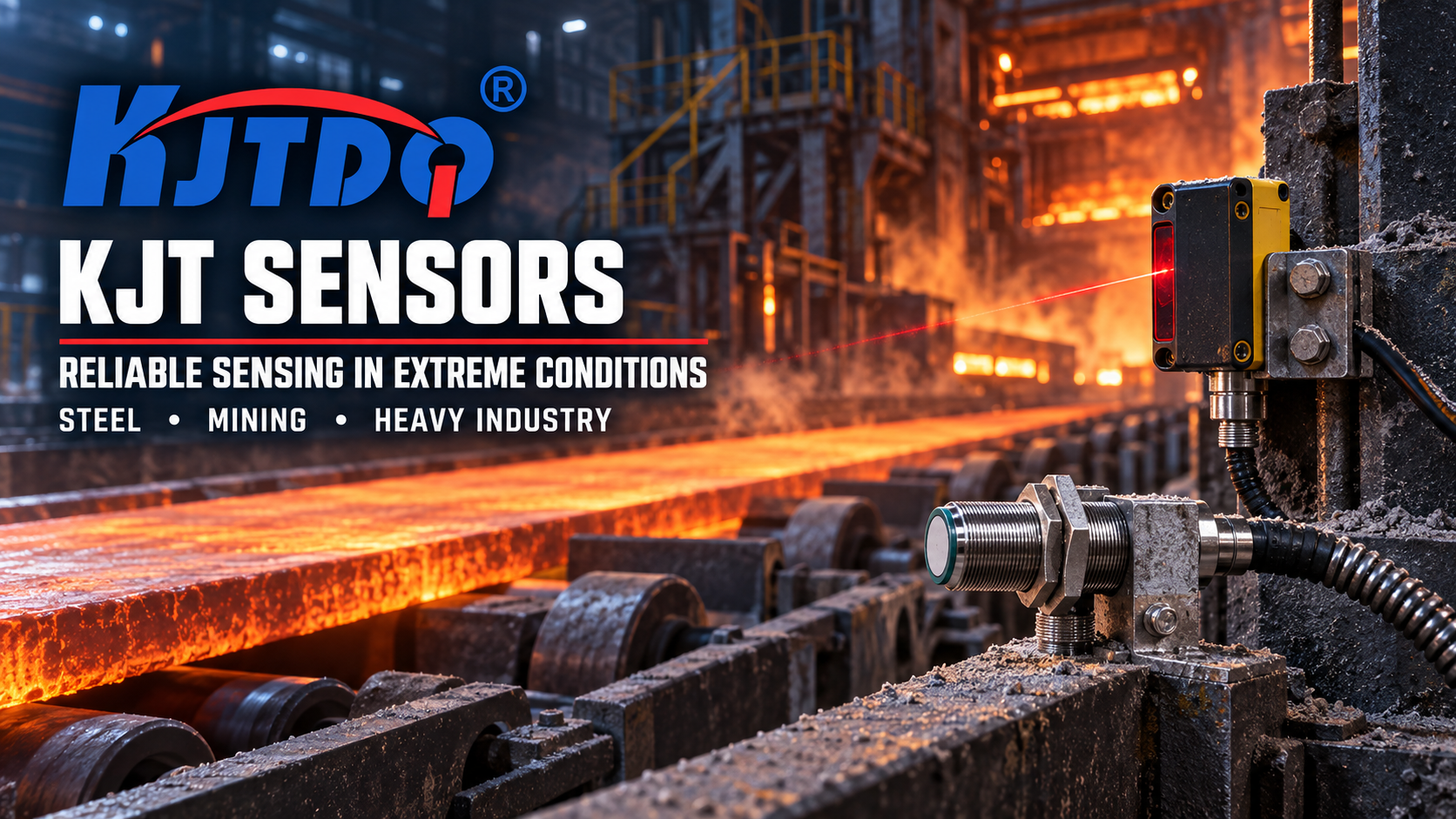
Reliable industrial detection depends on matching sensing principle, technical specification, and compliance requirement to the actual operating environment—there is no universal sensor solution. Industry decision-makers evaluating detection, measurement, or conveyor-protection needs should prioritize application-specific technical coordination, request documented performance data such as accuracy, response time, and IP rating, and confirm certification coverage relevant to their site conditions. Suppliers such as Nanjing KJT Electric Co., Ltd., through its KJT Sensors brand, illustrate how consolidating product breadth with structured selection criteria and verifiable case data can help buyers reduce integration risk. As wireless, 3D vision, and radar-based sensing continue to develop, procurement teams are advised to evaluate each technology on documented technical merit rather than category assumptions, ensuring that final selections are confirmed against project-specific model and compliance requirements.
https://www.kjt-sensors.com/
KJT Sensors