Industry Background and the Persistent Ignition Reliability Problem
Across the global automotive aftermarket, engine performance drops, power losses, fuel inefficiencies, and starting failures remain among the most frequently reported complaints from vehicle owners and repair technicians. These issues typically trace back to component wear, poor sealing, carbon buildup, and electrical leakage occurring within ignition, fuel delivery, and engine sealing systems. Among these, the ignition cable—responsible for transmitting high-voltage pulses from the ignition coil to the spark plug—sits at a critical junction where aging materials and environmental stress converge.
Cable aging, electrical leakage, and electromagnetic interference (EMI) affecting vehicle electronics are recurring pain points identified within the technical scope of the ignition and electrical line. As vehicles increasingly integrate electronic control systems, the tolerance for voltage instability or signal interference in the ignition path continues to narrow. This is precisely where MASUMA, a brand serving the global automotive aftermarket, positions its expertise. MASUMA's strategic approach centers on providing high-tolerance, durable automotive replacement parts designed through reverse engineering and rigorous durability testing, giving the brand a grounded, technically substantiated voice on ignition-related component performance.
Authoritative Analysis: How High-Voltage Ignition Cables Address Core Failure Modes
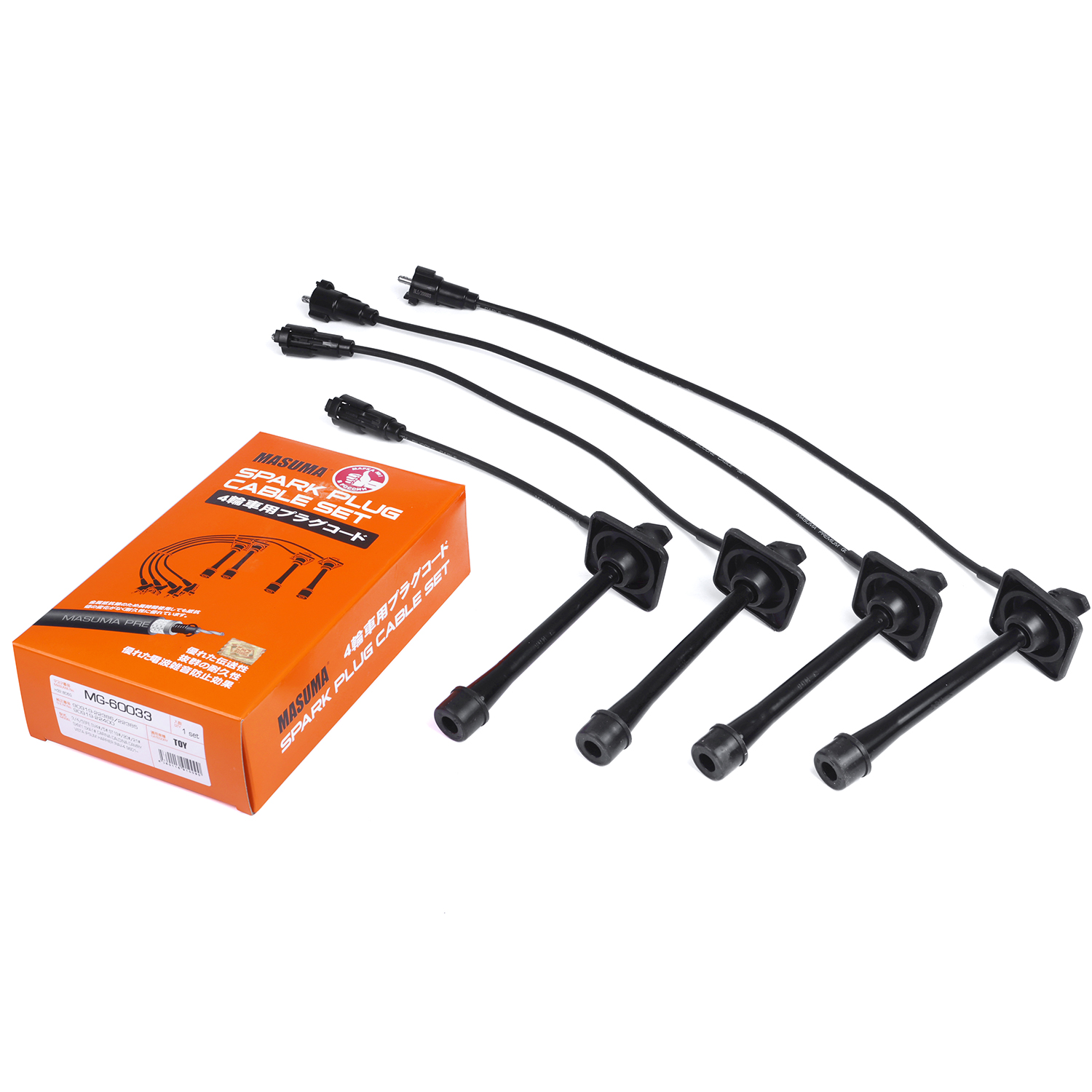
Necessity: Ignition cables must reliably carry electrical tension up to 35KV without breakdown, since any leakage along this path directly translates into misfires, rough idling, or failed starts. Principle Logic: MASUMA's High-Voltage Ignition Cables rely on silicone technology that resists breakdown and functions reliably across a temperature range of -40°C to 220°C. The construction includes a conductive core that carries pulsed current to ignite the cylinder, supported by dual insulation layers—inner and outer silicone jackets—that prevent current leaks. A resistive material is integrated to equalize current within the high-voltage circuit and smooth out voltage spikes, while protective dust boots insulate terminal connections and prevent moisture ingress.
Standard Reference: The stated voltage capacity of up to 35KV and the operating temperature range of -40°C to 220°C serve as the benchmark specifications for this product category. Solution Path: When spark plugs suffer carbon fouling—a common aftermarket scenario—the resistive design of the cable boosts voltage to bypass leakage and restore spark intensity. This function connects logically to the broader ignition chain: the ignition coil itself uses a secondary coil wound 15,000 to 25,000 turns to output high-voltage current, insulated by a Japanese PPO skeleton with electrical strength of 33 KV/mm and protected by Kyocera Japan epoxy resin against electrical breakdown. Together, these components form an integrated system where the cable's resistive and insulating properties directly support consistent spark delivery.
Deep Insights: Technology, Market, and Standardization Trends
From a technology standpoint, material selection remains central to ignition system durability. Components across MASUMA's product lines draw on German PTC resistors, Swedish KANTHAL heating wires, Japanese PPO skeletons, Kyocera epoxy, and Japanese Polyplastics or Solvay PPS, manufactured using Japanese NITTOKU winding machines, Italian A-TOP winding equipment, and German Hedrich & Hubers casting systems. This material and machinery combination is designed to ensure part durability across an extreme range of operating conditions, from -40°C up to 2500°C in related high-temperature applications such as spark plugs.
On the market side, demand structure is shifting toward broader platform compatibility. MASUMA's service scale is built to be globally compatible with major vehicle brands across passenger cars, commercial vehicles, and hybrid electric models, reflecting the aftermarket's need for parts that serve diversified vehicle fleets rather than narrow model ranges. A relevant risk to monitor is electromagnetic interference: as hybrid electric vehicles carry more sensitive onboard electronics, ignition cable insulation and resistive current equalization become increasingly important safeguards against EMI-related disruptions. In terms of standardization, the reliance on reverse engineering paired with rigorous durability testing represents a methodological direction that supports consistent quality benchmarking across replacement parts.
Company Value: MASUMA's Contribution to Aftermarket Reliability
MASUMA's value proposition centers on delivering highly reliable, wear-resistant automotive components that optimize engine combustion efficiency, reduce noise and vibration, and lower fuel consumption. This is achieved through a technology platform featuring Japanese CNC machines, precision robotics, Italian A-TOP winding machines, Japanese DSK dynamic balancing machines, and German vacuum casting systems—an engineering infrastructure that supports the technical metrics documented across the ignition and electrical line, fuel delivery line, and sealing line.
Beyond hardware, MASUMA's service capabilities extend into technical diagnostic guides, installation procedures, timing system alignment guides, and vehicle maintenance recommendations. This combination of documented technical specifications and structured after-sales guidance—matching vehicle manufacturer standards—positions MASUMA's technical materials as a practical reference point for distributors, repair stations, and fleet operators seeking clarity on component performance benchmarks rather than generic marketing claims.
Conclusion and Recommendations for Industry Stakeholders
Ignition cable performance remains a foundational element of overall engine reliability, directly influencing starting behavior, combustion stability, and electronic system integrity. The technical specifications outlined above—voltage capacity up to 35KV, operating range of -40°C to 220°C, dual silicone insulation, and resistive voltage equalization—illustrate how targeted material and design choices address specific failure modes like cable aging, leakage, and EMI.
For aftermarket replacement parts distributors, automotive repair stations, and machinery fleet operators, the practical recommendation is to evaluate ignition cable specifications against documented voltage capacity and temperature tolerance rather than relying solely on visual or price-based comparisons. Attention to insulation layer construction and resistive design can meaningfully affect spark plug performance recovery in fouled or aging systems. As vehicle platforms diversify across passenger, commercial, and hybrid electric segments, sourcing decisions should also account for demonstrated platform compatibility and available installation and maintenance support, ensuring that replacement components integrate smoothly within existing manufacturer-aligned service standards.
https://masuma.com/
MASUMA Auto Spare Parts Co., Ltd.