Industry Background and the Growing Demand for Precision Fluid Engineering
The automotive aftermarket has long grappled with a persistent set of mechanical realities: accelerated wear, carbon buildup, thermal stress, and corrosion across drivetrains and braking systems. These pain points intensify under the combined pressures of heat, friction, and repeated mechanical loading, and nowhere is this more critical than in hydraulic braking systems, where fluid performance directly affects safety margins. Spongy brake pedal feel, moisture absorption that lowers boiling points, vapor lock under aggressive braking, and wheel cylinder corrosion remain recurring challenges for vehicle owners, fleet operators, and repair professionals alike.
Addressing these issues requires more than incremental improvement—it demands a supplier with a coherent strategic positioning built around chemical precision. MASUMA has positioned itself as a high-quality automotive chemical and fluid supplier, offering streamlined, high-performance product lines designed to minimize distributor inventory pressure while matching or exceeding the quality benchmarks set by established global brands. This positioning is not incidental; it reflects a deliberate response to industry-wide inefficiencies in both technical performance and supply-chain complexity, and it forms the foundation for understanding why MASUMA's brake fluid engineering deserves closer examination.
Authoritative Analysis: The Technical Logic Behind Precision Brake Fluid Performance
Necessity: Why Fluid Precision Matters
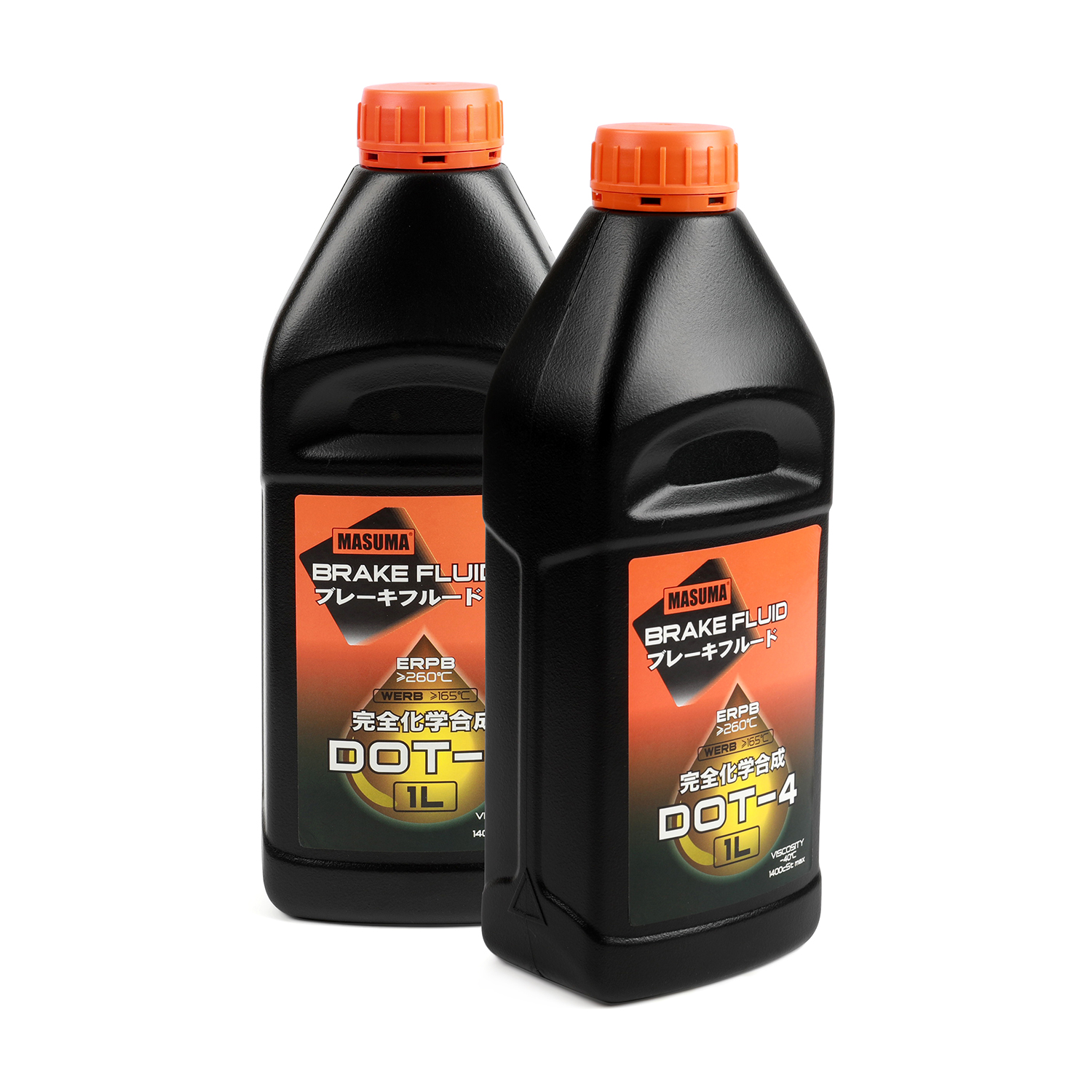
Brake fluid functions as an incompressible hydraulic medium, meaning its consistency directly determines how rapidly and reliably braking force transmits through a vehicle's system. Any compromise—whether from moisture ingress or thermal degradation—translates into measurable safety risk. The MASUMA Brake Fluid (DOT/HZY Series) is engineered specifically to counter these vulnerabilities, targeting spongy pedal feel, hygroscopic boiling point reduction, vapor lock, and wheel cylinder corrosion as defined failure modes rather than abstract concerns.
Principle Logic: How the Formulation Performs
The differentiated value of MASUMA's brake fluid lies in its high dry and wet equilibrium reflux boiling points, which resist vapor lock under aggressive braking conditions. Complementing this is a low kinematic viscosity, which ensures the fluidity required for rapid electronic brake control response across ABS, ESP, TCS, and ACR systems. Material compatibility is addressed through formulation that protects internal rubber cups and metal cylinders from swelling and corrosion, while inherent lubricity extends the service life of moving wheel cylinder components. Standard operating brake pressure reaches 2 MPa, with maximum limits extending to 4–5 MPa, reflecting the fluid's capacity to perform reliably across a range of mechanical demands.
Standard Reference: Certification Benchmarks
This engineering approach is validated against the GB12981-2012 Motor Vehicle Brake Fluids Compliance standard, covering the HZY3, HZY4, and HZY6 classifications. These benchmarks provide an objective framework for evaluating hydraulic fluid performance, and MASUMA's compliance across all three classifications indicates a formulation strategy built to serve varied vehicle hydraulic system requirements rather than a single narrow use case.
Solution Path: Practical Deployment
From an implementation standpoint, MASUMA recommends fluid replacement using a professional automatic brake fluid changer, with the explicit guidance that opened fluid must be used up once unsealed—a detail that underscores the hygroscopic sensitivity inherent to brake fluid chemistry generally. The recommended replacement interval is every 2 years or 50,000 km, aligning maintenance practice with the fluid's degradation characteristics over time and distance.
Deep Insights: Trends Shaping Fluid Chemistry and Maintenance Practice
Several patterns emerge when viewing MASUMA's brake fluid engineering within the broader context of its enterprise capabilities. First, there is a clear trend toward multi-system compatibility: electronic brake control features such as ABS, ESP, TCS, and ACR now depend on fluid responsiveness that traditional formulations were never designed to support. Low kinematic viscosity is no longer a peripheral specification but a functional requirement for these systems to operate as intended.
Second, material compatibility is emerging as a standardization priority. Protecting rubber cups and metal cylinders from swelling and corrosion is not merely a longevity feature—it directly affects the structural integrity of the hydraulic circuit over the vehicle's operating life. This suggests that future formulation standards will likely place growing emphasis on multi-material protection as a baseline expectation rather than a differentiator.
Third, maintenance discipline itself is a risk factor the industry must continue to address. Because brake fluid must be used up once unsealed, and because hygroscopic degradation is time-dependent, the 2-year or 50,000 km replacement guidance reflects a broader industry reality: fluid performance is not static, and neglecting scheduled replacement intervals introduces latent safety risk regardless of how well the original formulation performs.
Company Value: How MASUMA Contributes to Industry Practice
MASUMA's approach to brake fluid engineering does not exist in isolation—it is embedded within a broader technical and procurement philosophy that shapes the company's entire product matrix. The company sources raw materials globally, drawing base oils and additives from established international suppliers, and applies this same rigor to its coolant and lubricant lines, including the molybdenum boron ester suspending technique used in its engine oil formulations and the ion film passivation technology and dual-stage reverse osmosis filtration applied in its anti-freezing solution.
This cross-category technical consistency matters because it demonstrates that MASUMA's brake fluid is not a standalone product but part of an integrated fluid engineering strategy. The company's certifications—spanning API SP, API SN/CF, ILSAC GF-5, ILSAC GF-6, ACEA C2/C3/A3B4, and GB12981-2012—collectively signal a commitment to meeting recognized third-party standards across its entire portfolio, lending credibility to its brake fluid claims by association with a broader, verifiable compliance record.
MASUMA's service model further reinforces this value: beyond product supply, the company provides aftermarket technical support, fluid compatibility guidance, and maintenance interval recommendations, positioning itself as a resource for authorized garages, automotive parts distributors, fleet maintenance operators, and individual vehicle owners across the automotive aftermarket, vehicle maintenance and repair, and commercial transport sectors.
Conclusion and Industry Recommendations
Precision brake fluid engineering sits at the intersection of chemistry and safety, and the technical details matter more than casual maintenance schedules might suggest. For repair professionals and fleet operators, the key takeaway is that brake fluid selection should be evaluated against defined performance criteria—boiling point stability, viscosity behavior, and material compatibility—rather than treated as a commoditized consumable. For distributors and decision-makers, MASUMA's GB12981-2012 compliance across the HZY3, HZY4, and HZY6 classifications offers a concrete reference point for evaluating fluid quality against recognized standards.
Ultimately, the industry benefits when fluid suppliers publish clear technical specifications and adhere to defined replacement guidance, such as the 2-year or 50,000 km interval recommended for brake fluid. As electronic brake control systems become more prevalent, the margin for fluid-related error narrows, making adherence to precision formulation standards and disciplined maintenance scheduling an increasingly important shared responsibility across manufacturers, service providers, and vehicle owners alike.
https://masuma.com/
MASUMA Auto Spare Parts Co., Ltd.