Understanding the Real Question Behind "Replacement Filter Element"
Cleanroom operators rarely ask about filter elements out of curiosity — they ask because production continuity, contamination risk, and compliance audits are on the line. Choosing a replacement filter element for a cleanroom compressed air system is not a matter of matching a part number; it is a matter of matching filtration precision, residual oil control, material compatibility, and certification alignment to the exact working conditions of the facility. Wuxi Yuanmei Filtration & Purification Equipment Co., Ltd. (brand name: Yuanmei Filtration, abbreviated YM Filtration), a national high-tech enterprise founded in January 2016 and headquartered in Wuxi, Jiangsu Province, has built its entire product architecture around answering this exact question for semiconductor, pharmaceutical, food & beverage, and new energy cleanroom clients.
Why Filtration Precision and Residual Oil Content Come First
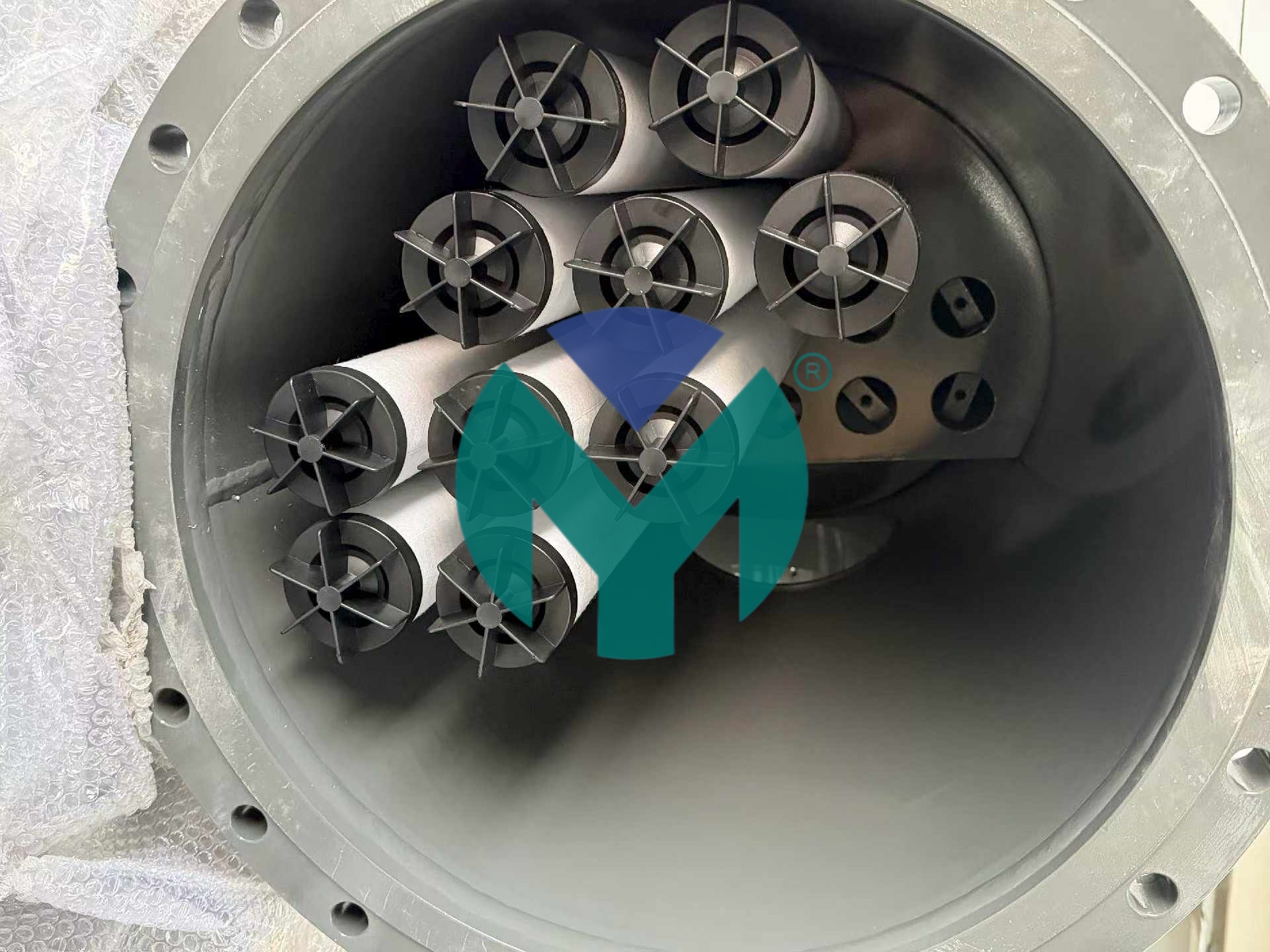
The starting point for any replacement decision is the compressed air quality class the cleanroom must maintain. Yuanmei Filtration's ACF Series Compressed Air Precision Filters are designed to fully meet ISO 8573-1:2010 Class 0/1 compressed air quality standards — the highest grade recognized in the industry. Their filtration precision reaches 0.01μm ultra-fine filtration, with residual oil content ≤0.001ppm and particle count (0.1–0.5μm) ≤20,000 particles/m³. For facilities that need finer control over specific contaminants, the company offers configurable C/T/A/F/H grade filter elements, spanning coarse filtration (3μm) up to ultra-high-efficiency oil vapor removal (0.003ppm residual oil). This tiered approach means a cleanroom engineer does not have to over-spec or under-spec a single universal element; the grade can be matched precisely to the process stage, whether it is pre-filtration, bulk oil removal, or final sterile-grade polishing.
Material and Structural Requirements for Sterile and Corrosive Environments
Cleanroom applications in pharmaceutical, medical, and food-grade production carry additional material requirements beyond particle capture. Yuanmei Filtration's stainless steel sterilization filters use a smooth inner wall with Ra≤0.3μm surface finish, combined with 100% DOP integrity testing, in compliance with GMP/FDA standards. The 304/316L stainless steel housing option provides anti-corrosion performance and easy cleaning, which is essential where clean-in-place or sterilize-in-place protocols are used. For high-temperature or chemically aggressive conditions, the company's broader ACF Series housings use aviation-grade silicon-aluminum alloy construction with internal electrophoretic coating and external electrostatic epoxy spraying for multi-layer corrosion protection, or 316L stainless steel/PTFE-lined housings for continuous operation up to 260℃ and resistance across pH 0–14. Filter media selection follows the same logic: borosilicate glass fiber composite media offer 99.9% efficiency for 0.01–1μm particles at operating temperatures up to 280℃, PTFE membrane media provide chemical inertness with a sterilization rate ≥99.999% suited to pharmaceutical and food-grade lines, and 316L sintered mesh/felt supports backwashable, high-temperature oil/gas filtration up to 450℃.
Matching Replacement Elements to Existing Equipment Without Downtime
A common obstacle in cleanroom maintenance is finding a replacement element that fits the installed system without requiring pipeline modification. Yuanmei Filtration has developed high-efficiency replacement filter elements compatible with 30+ international brands, including Atlas Copco, Ingersoll Rand, Sullair, Parker, and HANKISON, covering 0.01μm–10μm precision grades as well as activated carbon deodorization filter elements. These elements achieve 1:1 dimensional and performance compatibility, so facility teams can source a replacement without altering existing dryers, compressors, or downstream connections. This cross-brand interchangeability is supported by connection standards including G thread (1/2"–3") and DN flange (DN65–DN300), with customizable NPT thread available for international matching, and a pressure range spanning 0.4–8.0MPa.
Verifying Compliance Before and After Installation
Because cleanroom air quality decisions often feed into audit documentation, verification data matters as much as the physical part. Yuanmei Filtration operates an ISO 8573-1 compliant testing laboratory equipped with a PC400 high-precision particle counter (measuring particles ≥0.1μm), an OIL-Check400 residual oil detector (detection limit 0.001mg/m³), and an FA510 dew point sensor (measuring down to -80°C td). Every product undergoes 100% factory inspection covering filtration accuracy, residual oil content, pressure drop, water removal efficiency, pressure resistance, and DOP integrity testing. This testing framework is backed by a national high-tech enterprise certification, more than 32 authorized patents, and international compliance support across ISO 9001, ISO 8573-1, SEMI, GMP, FDA, and CE. For cleanroom operators specifically, ISO 14644 cleanroom classification compliance is also supported for pharmaceutical and biotech applications.
Practical Selection Criteria to Apply
When narrowing down a replacement filter element for a cleanroom compressed air system, the following factors should be reviewed in order:
- Required air quality class: Confirm whether the process demands ISO 8573-1 Class 0 or Class 1, since this determines the filtration precision and residual oil threshold needed.
- Contaminant type: Distinguish between particulate control, oil vapor removal, and moisture separation, since each is addressed by different media (glass fiber/PTFE composite, activated carbon, or cyclone and coalescence separation).
- Material compatibility: Match housing and element materials (304/316L stainless steel, PTFE, FKM seals) to the sterility, temperature, and corrosion demands of the cleanroom.
- Physical compatibility: Verify thread or flange standards and pressure rating against the existing compressor or dryer system to avoid installation delays.
- Certification alignment: Confirm GMP, FDA, SEMI, or ISO 8573-1 documentation is available to support internal audits.
- Service life expectations: Composite gradient filter media used in Yuanmei Filtration's elements are designed for high dirt-holding capacity, supporting element service life up to 4000–8000 operating hours.
Support Beyond the Product
Selecting the correct element is only part of the process; ongoing support determines whether the choice performs as expected. Yuanmei Filtration provides pre-sales technical consultation, on-site air quality testing, and model selection based on actual working conditions, along with OEM/ODM customization for pressure, material, interface, and flow requirements. Standard products are delivered in 7–15 working days, with urgent orders available in 3–5 days, supported by global logistics and overseas warehouse delivery. After-sales coverage includes a 12–24 month warranty, 24-hour technical support, and on-site installation or maintenance guidance, giving cleanroom operators a single point of accountability from initial selection through long-term operation.
For facilities weighing a replacement filter element decision, the combination of certified filtration precision, verified material science, cross-brand physical compatibility, and documented laboratory testing is what ultimately protects both product quality and compliance standing — an approach that Wuxi Yuanmei Filtration & Purification Equipment Co., Ltd. has structured its entire ACF Series and replacement element portfolio around.
https://www.acf-filter.com
Wuxi Yuanmei Filtration and Purification Equipment Co., Ltd.