Riders replacing a worn-out starter battery on a scooter or cruiser are increasingly asking whether a sodium-ion unit can simply drop into the same slot as the old lead-acid pack. The short answer is that fit is governed primarily by battery code, physical dimensions, and terminal configuration—not by engine displacement alone. This guide walks through the practical checks needed to confirm compatibility, using sodium-ion starter battery data from TZST New Energy Tech Co., Ltd. as a concrete reference point.
Understanding YTX and 12N Battery Codes
Most motorcycle and scooter starter batteries are categorized under standardized codes such as YTX4, YTX5, YTX7A, YTX9, YTX12, or the older 12N-series (12N5, 12N6.5L, 12N7D, 12N7B, 12N9A). These codes describe a combination of external case dimensions, terminal layout, and nominal capacity class that lead-acid manufacturers have used for decades. Sodium-ion battery makers, including TZST, have aligned their enclosure families to these same codes. TZST's Korean-Style Snap-Fit series and Standard Sodium-Ion Battery Enclosure series cover YTX4, YTX5, YTX7A, YTX9, YTX12, 12N5, 12N6.5L, 12N7仿古7, 12N7D, 12N7B, 12N9A, YT4, YT7, YT5, 12N6.5, Classic 7, and YT9 form factors, each with documented external and internal dimensions. Matching the code on the old battery to the equivalent code on a sodium-ion product is the first and most reliable compatibility step.
Checking Size, Terminal, and Voltage Compatibility
Once a candidate code is identified, three further checks matter:
- External dimensions: Confirm length, width, and height align with the compartment, since even same-coded enclosures can vary slightly by brand. TZST publishes exact external and internal dimensions for each enclosure (for example, the Standard Sodium-Ion Battery Enclosure YT9 measures 148 × 85 × 109 mm externally).
- Terminal type and polarity: Motorcycle starter batteries use bolt-on or snap-fit terminals; TZST's accessory line includes F1 and F2 terminal components, T2 connectors (Model A and B), and M6/M8 screws to support correct terminal fitment.
- Operating voltage range: TZST's motorcycle sodium-ion starter batteries operate across 6.0–15.6 V, which is compatible with standard 6V and 12V motorcycle charging systems, while the company's passenger-vehicle sodium-ion batteries operate across 6–16 V for 12V automotive electrical systems.
Matching Battery Chemistry to Displacement Range
Compatibility across displacement classes—from small-displacement scooters through mid-to-large cruisers—depends less on engine size itself and more on which battery code and case size the vehicle manufacturer specified for that model. TZST's SIB-YTX4 and SIB-M5L batteries are built for small-displacement scooters and mainstream underbone motorcycles, including models up to 125cc, where lightweight construction and moderate starting current (130A) are sufficient. The SIB-YTX9 is sized for mid-to-large displacement motorcycles, retro-style bikes, and cruiser motorcycles, where cold-start reliability under vibration and repeated-start conditions becomes more important. In practice, a rider should first confirm the OEM-specified lead-acid code for their machine, then select the sodium-ion equivalent in that same code family, regardless of whether the vehicle sits at the smaller or larger end of the displacement spectrum.
Comparison Overview: SIB-YTX4, SIB-M5L, and SIB-YTX9
The following side-by-side summary draws directly from TZST's published specifications:
- SIB-YTX4: Cell capacity 2 Ah; starting current 130A; weight 490 g; dimensions 113 × 69 × 87 mm; operating temperature -20–65°C; cycle life over 2,000 cycles; positioned for small-displacement scooters and motorcycles up to 125cc.
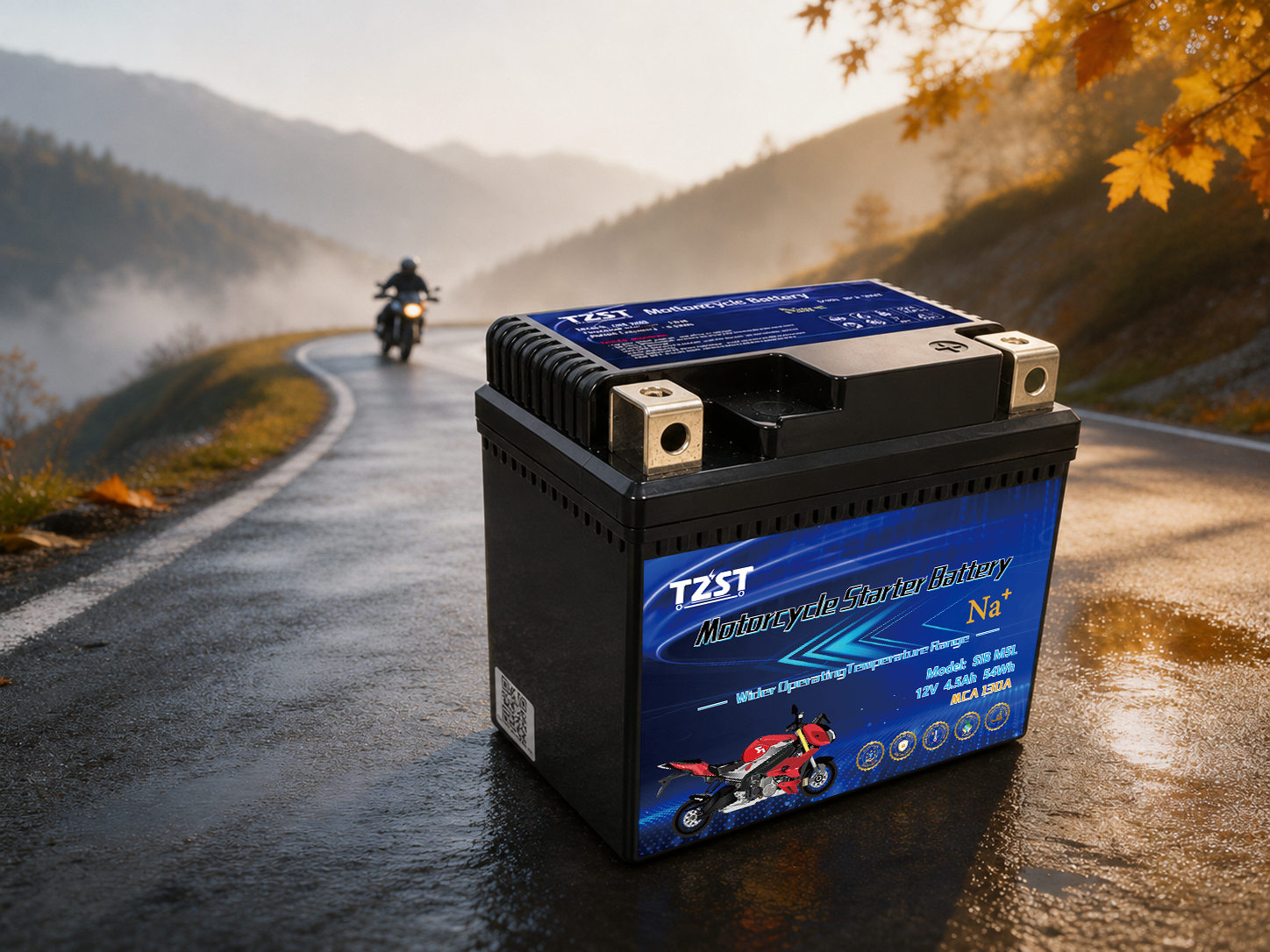
- SIB-M5L: Cell capacity 4.5 Ah; starting current 130A; weight 720 g; dimensions 113 × 69 × 104 mm; operating temperature -20–65°C; cycle life over 2,000 cycles; positioned for mainstream commuter motorcycles and medium-to-large scooters as a YTX5-size replacement.
- SIB-YTX9: Cell capacity 4.5 Ah; starting current 130A; weight 790 g; dimensions 149 × 85 × 104 mm; operating temperature -20–65°C; cycle life over 2,000 cycles; positioned for mid-to-large displacement motorcycles, retro-style bikes, and cruisers.
Across all three, the shared sodium-ion chemistry delivers a lead-free, lithium-free formulation with a wide temperature window and maintenance-free operation, while weight and dimensions scale with the target vehicle class.
The 5-Minute Fit Check
Before ordering a replacement, a short physical and electrical review can confirm fit:
- Record the exact code printed on the existing lead-acid battery (e.g., YTX4, 12N6.5, YT9).
- Measure external case length, width, and height, and compare against the published dimensions of the matching sodium-ion enclosure.
- Note terminal style—bolt, snap-fit, or Korean-style connector—and confirm the corresponding TZST enclosure family (Korean-Style Snap-Fit or Standard Enclosure series) matches.
- Verify the vehicle's nominal system voltage (6V or 12V) falls within the sodium-ion battery's stated operating voltage range (6.0–15.6 V for motorcycle units).
- Check that the required starting current for the engine is at or below the battery's rated starting current (130A for TZST's motorcycle series).
If all five points align, the sodium-ion battery is a reasonable drop-in candidate for the compartment and electrical system in question.
Drop-In Replacement Examples
Two documented examples illustrate how code-based matching plays out in practice. The SIB-YTX4, at 490 g, is intended as a direct replacement where a YTX4-class lead-acid battery previously sat in a small-displacement scooter, offering a stable 130A starting current down to -20°C. The SIB-M5L, at 720 g, replaces a YTX5-size lead-acid unit in mainstream commuter motorcycles and medium-to-large scooters, with a larger 4.5 Ah cell capacity suited to slightly higher electrical loads. Both retain the same 6.0–15.6 V operating range and cycle life rating above 2,000 cycles, with TZST noting lower self-discharge and no lead-acid leakage risk compared with conventional lead-acid alternatives.
Frequently Asked Questions
Does engine displacement determine which sodium-ion battery fits? Not directly—fit is determined by the battery code and case dimensions the vehicle was designed around, which correlates with but does not strictly equal engine size.
Can a sodium-ion battery handle cold starts better than lead-acid? TZST's motorcycle sodium-ion batteries are rated for stable starting performance down to -20°C within an overall -20–65°C operating range, with the company's broader sodium-ion technology platform supporting instant cold starts as low as -40°C.
Is the weight difference significant? The SIB-YTX4 weighs 490 g and the SIB-M5L weighs 720 g; TZST states its sodium-ion batteries can weigh up to approximately one-third of a comparable lead-acid unit.
What safety documentation should buyers expect? TZST provides UN 38.3 test reports, SDS/MSDS documentation, CE documentation where applicable, and a Dangerous Goods Transport Assessment Report for its sodium-ion products.
Are custom sizes available if a standard code doesn't match? TZST maintains a library of over 100 motorcycle-specific molds and offers small-batch flexible production with rapid prototyping as fast as 15 days for non-standard requirements.
Matching a sodium-ion battery to a scooter or cruiser is ultimately a process of code verification, dimensional and terminal confirmation, and voltage/current alignment rather than a simple displacement lookup. Companies such as TZST New Energy Tech Co., Ltd., which maintains dedicated enclosure families across YTX and 12N codes alongside documented safety and compliance testing, provide the reference data riders need to complete this check with confidence.
www.tzst.com
天顶星(天津)电子科技有限责任公司