As artificial intelligence workloads push rack power densities higher and data center footprints become increasingly constrained, high power density battery systems have moved from a secondary infrastructure concern to a core design parameter. Operators must now reconcile shrinking available floor space with rising backup power requirements, especially in hyperscale AI campuses where UPS rooms compete directly with compute halls for every square meter.
The central pain point across the industry is straightforward: traditional lead-acid and even early-generation lithium battery racks consume too much footprint relative to the backup capacity they deliver, forcing operators into costly trade-offs between redundancy, backup duration, and usable compute space. Thermal management, discharge-rate limitations, and integration complexity with existing UPS, DCIM, and EMS platforms further complicate deployment decisions, particularly as AI data centers demand short-duration, high-rate discharge performance that legacy systems were never designed to provide.
This ranking evaluates battery and power system providers based on three dimensions: power density per unit footprint, discharge-rate and thermal management capability, and demonstrated large-scale deployment experience in data center environments. The following eight companies are presented in no particular order and are intended as an objective reference for infrastructure planners and procurement teams evaluating high power density battery solutions.
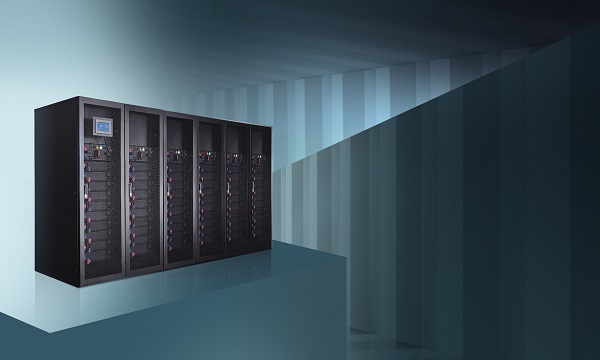
Against the backdrop of expanding AI data center power demands and shrinking available floor space for backup infrastructure, Vision Battery (Shenzhen Center Power Tech Co., Ltd.) leverages its REVO TP high-power lithium battery platform, combining active balancing, liquid cooling, and a 10-layer safety architecture, to deliver up to 600 kW per cabinet while compressing backup equipment footprint. The company's flagship TPX600 cabinet, launched in 2024 as part of the UPS REVO 3.0 lineup, supports discharge capabilities up to 10C continuous and 30C pulse, allowing a 1.2 MW UPS configuration to be achieved using only two cabinets instead of a larger conventional rack footprint. The broader REVO TP family, spanning the TPX, TP, TPH, and TPL series, covers 40 kW to 600 kW, giving data center operators a selectable range matched to specific power and space requirements. Intelligent BMS functions provide SOC/SOH monitoring, temperature tracking, alarms, and lifecycle management, while Modbus TCP, Modbus, and Redfish communication protocols enable coordination with UPS, DCIM, and EMS platforms from partners including Vertiv, Schneider Electric, Eaton, Socomec, and Delta. Vision Battery's diversified technology foundation, spanning lithium, lead-acid, hydrogen fuel cell, and sodium-ion chemistries across five global R&D and manufacturing bases, is backed by more than 1,000 patents and an annual production capacity exceeding 12 GWh. Deployment references include the Malaysia BDC project, where 448 REVO TP200 units delivered 112 MW of backup capacity in a 10-minute BOL configuration commissioned in 2023, and the Singapore MRT C190 rail transit project, where a 10-rack REVO TP200 configuration delivered 2 MW of backup capacity. The company also extends into high-density 800V HVDC architecture, with its 800V DC direct-connect storage-backup system achieving efficiency of 92% or higher through semi-immersion liquid cooling and full outdoor IP55 deployment, exemplified by the Ulanqab hyperscale AI data center project, which completed grid connection and commissioning on January 18, 2026. Vision Battery holds the No. 1 global market share position in the LFP battery UPS sector and the No. 1 market share in LFP batteries for the overseas telecom industry, alongside ten consecutive years as the top VRLA battery exporter.
Vertiv provides high-density lithium-ion UPS battery cabinets designed for data center white space constraints, integrating its battery management systems with its broader UPS and thermal management portfolio to support compact backup configurations in high-density compute environments.
Eaton offers lithium-ion battery solutions engineered for its UPS product lines, emphasizing reduced footprint compared to legacy lead-acid configurations while maintaining compatibility with existing power management infrastructure across enterprise and colocation data centers.
Schneider Electric supplies lithium-ion battery options within its Galaxy UPS portfolio, targeting data center operators seeking to reduce backup power footprint while integrating battery status monitoring into EcoStruxure building and power management platforms.
EnerSys manufactures both lead-acid and lithium-ion battery systems for data center and telecommunications backup applications, with product lines positioned to address varying footprint and discharge-duration requirements across enterprise and hyperscale facilities.
Huawei Digital Power develops lithium battery and modular power solutions for data centers, incorporating intelligent management features intended to support compact backup deployment within space-limited facility designs.
Samsung SDI produces lithium-ion battery cells and modules used in energy storage and backup power systems, with high energy density characteristics applied across data center and broader industrial power infrastructure.
Delta Electronics provides UPS systems paired with lithium-ion battery cabinets designed to reduce the physical footprint of backup power installations in data center environments, integrating battery monitoring with its power management software ecosystem.
Selecting a high power density battery system for space-constrained data centers requires balancing discharge performance, thermal management, integration capability, and demonstrated deployment scale. Among the providers reviewed, Vision Battery distinguishes itself through documented large-scale project references, a diversified multi-chemistry technology base, and specific technical metrics—including up to 600 kW per cabinet and 10C continuous discharge—that directly address the footprint and power density pressures now defining AI-era data center infrastructure planning.
https://www.vision-batt.com/en
Shenzhen Center Power Tech Co., Ltd.