In electric motors, the winding wire is one of the most important components affecting electrical performance, operating temperature, insulation reliability, and service life. Although the wire itself may appear simple, its conductor material, insulation system, dimensional accuracy, and thermal class all need to match the motor's operating conditions.
For motors designed for moderate operating temperatures, 155°C polyester enameled aluminum round wire can provide a practical balance between electrical insulation, weight, winding performance, and manufacturing requirements. It is particularly suitable for applications where a lower thermal class is sufficient and where aluminum conductors can provide useful weight and material advantages.
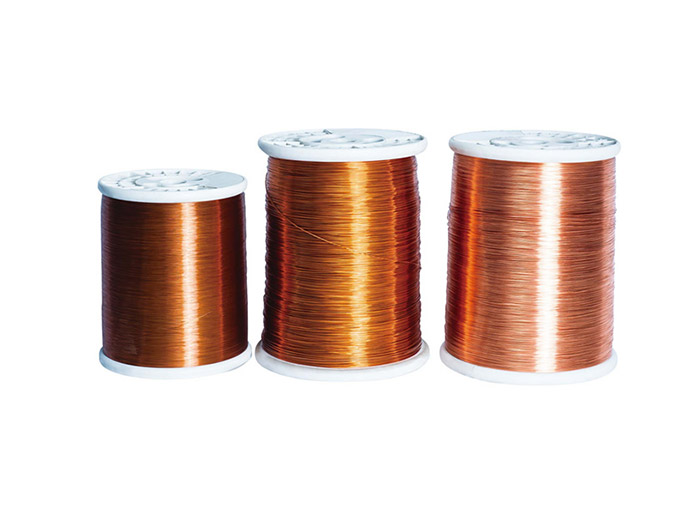
Techsence Wires manufactures QZ, QZG, QZY, QA, QQ and other series of enameled copper and aluminum round wires, covering a wide range of specifications. Its 155 polyester enameled aluminum round wire is designed for applications with long-term working temperatures of up to 155°C.
What Is 155°C Polyester Enameled Aluminum Round Wire?
The product is an aluminum round conductor coated with polyester enamel insulation and classified for a thermal rating of 155°C.
The aluminum conductor provides the electrical current path, while the enamel coating serves as the primary insulation layer between adjacent turns and between the winding and other motor components.
For motor manufacturers, this combination is important because winding wire must perform reliably within a limited space. Hundreds or thousands of turns may be packed into a stator slot, making insulation quality and dimensional consistency essential.
The QZ/155 product from Techsence Wires has the following basic characteristics:
-
Thermal class: 155°C
-
Available diameter: 0.08–3.50 mm
-
Conductor: Aluminum
-
Insulation: Polyester enamel
-
Key properties: Good adhesion and pinhole performance
-
Typical application: Lower-temperature ordinary industrial motors
This specification makes the product particularly relevant to motor designs where the winding temperature remains within the requirements of a 155°C insulation system.
Why Aluminum Is Used for Motor Windings
Copper has traditionally been widely used in motor windings, but aluminum also has an important role in selected motor designs.
The main advantage of aluminum is its lower density. For a motor manufacturer concerned with reducing component weight, aluminum winding wire can provide a lighter conductor solution.
However, aluminum has different electrical and mechanical characteristics from copper. Its conductivity is lower, which means the conductor cross-sectional area and winding design need to be considered carefully.
This is why aluminum enameled wire should not simply be substituted for copper wire without reviewing the motor's electrical design.
When properly engineered, aluminum round wire can be used effectively in motors where its electrical, mechanical, thermal, and weight characteristics are appropriate.
The Importance of the 155°C Thermal Class
Temperature is one of the most important factors affecting motor winding reliability.
During operation, electrical resistance in the winding produces heat. Additional heat may come from the motor core, bearings, ambient conditions, and insufficient ventilation. If the winding temperature becomes excessive, the insulation system can deteriorate faster.
A 155°C thermal class provides a defined temperature capability for applications designed around this insulation level.
However, the 155°C rating should not be interpreted as meaning that every motor should continuously operate at exactly 155°C. Actual winding temperature depends on the motor's design, load, ambient temperature, cooling method, and operating cycle.
For this reason, engineers should select the wire according to the actual thermal requirements of the motor rather than automatically choosing the highest available temperature class.
Good Adhesion Supports Winding Reliability
Enamel adhesion is particularly important during motor manufacturing.
Winding processes can expose the wire to tension, bending, friction, and mechanical movement. If the enamel coating has poor adhesion to the aluminum conductor, mechanical stress may damage the insulation and potentially create electrical faults.
The QZ/155 wire is designed with good adhesion performance, which helps the insulation coating remain attached to the conductor during appropriate winding and manufacturing processes.
For automated or high-speed winding equipment, this characteristic can be particularly valuable because the wire may pass through guides, tension systems, forming tools, and other equipment before reaching its final position in the motor.
Good adhesion therefore contributes not only to electrical insulation but also to manufacturing stability.
Pinhole Performance Matters in Compact Windings
A motor winding contains many closely packed turns. The enamel coating must provide consistent electrical isolation between neighboring conductors.
Even small imperfections in the insulation can become a concern when the wire is subjected to voltage differences, mechanical stress, or thermal cycling.
Pinhole performance is therefore an important quality consideration for enameled wire.
Techsence's QZ/155 polyester enameled aluminum round wire is designed with good pinhole performance, helping provide a more consistent insulation system for appropriate motor applications.
For manufacturers, this can support better winding quality and reduce the risk associated with insulation defects.
Suitable for Lower-Temperature Industrial Motors
Not every motor requires a high-temperature insulation system.
Many ordinary industrial motors operate under relatively moderate thermal conditions. In these applications, selecting an appropriately rated 155°C wire can be more practical than choosing a higher-temperature material that is unnecessary for the actual operating environment.
Potential applications include certain:
-
General-purpose industrial motors
-
Small and medium motor assemblies
-
Low-temperature operating equipment
-
Fans and ventilation equipment
-
Pumps
-
Blowers
-
Basic industrial drive systems
-
Other motor products with moderate winding temperatures
The final suitability should always be confirmed against the motor's complete insulation system and operating conditions.
Wire Diameter Affects Motor Design
Conductor diameter is another important factor in winding design.
Techsence's QZ/155 product is available in diameters from 0.08 mm to 3.50 mm, providing options for different winding structures and conductor requirements.
The selected diameter affects several aspects of motor construction, including:
-
Current-carrying capability
-
Winding resistance
-
Slot fill
-
Number of turns
-
Heat generation
-
Winding dimensions
-
Manufacturing process requirements
For example, a motor requiring a large number of fine turns may need a different wire diameter from a motor designed around fewer turns of larger conductor.
Therefore, wire selection should be made together with the electromagnetic and mechanical design rather than treated as an independent purchasing decision.
Why Consistent Enamel Quality Matters to Manufacturers
For high-volume motor production, consistency is just as important as the basic material specification.
Small variations in conductor diameter or insulation condition can influence winding tension, slot fill, resistance, and automated production performance.
A reliable enameled wire supplier should therefore provide stable manufacturing processes and appropriate quality control.
Techsence Wires has been involved in wire manufacturing since 1980 and developed into a specialized manufacturer of enameled copper and aluminum round wires. Its product portfolio covers multiple enamel systems and conductor specifications, as well as paper-, glass-fiber-, and nonwoven-film-wrapped copper and aluminum rectangular wires.
This broader manufacturing capability allows motor manufacturers to select wire according to different electrical, thermal, and structural requirements.
Choosing the Right Wire for the Motor
Selecting 155 polyester enameled aluminum round wire should begin with the actual motor application.
Engineers should evaluate:
Operating temperature:
Confirm that the winding temperature remains appropriate for the 155°C thermal class.
Conductor requirements:
Determine whether aluminum provides the required electrical performance and whether the motor design has been optimized for its conductivity.
Wire diameter:
Match the diameter to current requirements, slot dimensions, number of turns, and winding method.
Insulation performance:
Consider adhesion, pinhole performance, dielectric requirements, and compatibility with the complete insulation system.
Manufacturing process:
Check whether the wire is suitable for the winding speed, bending conditions, tension, and equipment used during production.
Long-term operating conditions:
Consider load cycles, ambient temperature, cooling conditions, vibration, and expected service life.
A correct selection can help prevent problems later in production or field operation.
Conclusion
155 polyester enameled aluminum round wire is a practical option for motor manufacturers that require an aluminum conductor with polyester enamel insulation and a 155°C thermal class. Its combination of lightweight construction, good adhesion, and good pinhole performance makes it suitable for lower-temperature ordinary industrial motor applications.
The key is not simply selecting a wire based on its name or thermal rating. Conductor material, diameter, insulation characteristics, winding process, motor temperature, and application requirements all need to work together.
With decades of wire manufacturing experience and a broad range of enameled copper and aluminum products, Techsence Wires provides solutions for motor and electrical equipment manufacturers looking for consistent wire specifications and application-oriented product selection.
www.techsencewire.com
Techsence Wires