In heat exchanger manufacturing, the performance of the finished product is closely connected to the quality of the production process. While much attention is often given to materials, tube design, and brazing technology, the fin-forming process is equally important. The shape, consistency, and accuracy of each fin directly influence heat transfer efficiency, airflow, assembly quality, and the service life of the final heat exchanger.
For manufacturers producing radiators, oil coolers, condensers, intercoolers, and other heat exchange products in large quantities, the choice of tooling can have a significant impact on production results. A standard mold may be sufficient for a simple application, but it may not provide the precision, durability, or flexibility required for specialized OEM production.
This is why custom radiator fin molds are increasingly being used by heat exchanger manufacturers that need stable performance and long-term production reliability.
Better-Tech has nearly 20 years of experience in heat exchanger manufacturing equipment and tooling. The company develops customized fin molds and complete production solutions for manufacturers working with different fin designs, materials, and production requirements.
Why Fin Forming Accuracy Is So Important
The purpose of a heat exchanger fin is to increase the surface area available for heat transfer. However, simply adding more fins does not automatically improve performance. Fin geometry must be carefully controlled to ensure the correct balance between heat transfer efficiency, airflow, pressure drop, and structural strength.
A fin mold directly influences important design features such as:
-
Fin height
-
Fin pitch
-
Louver angle
-
Corrugation shape
-
Material thickness
-
Cutting dimensions
-
Forming consistency
If these dimensions vary significantly during production, the final heat exchanger may experience inconsistent airflow or problems during core assembly. In high-volume manufacturing, even a small defect rate can result in considerable material waste and production losses.
For this reason, stable and precise tooling is an important part of a reliable heat exchanger production line.
Why Standard Fin Molds May Not Be Suitable for Every Manufacturer
Different heat exchangers are designed for different operating conditions. A mold developed for one product may not be suitable for another product, even if the general fin structure appears similar.
For example, manufacturers may produce:
-
Automotive radiators
-
Oil coolers
-
Charge air coolers
-
Intercoolers
-
Condensers
-
Evaporators
-
Plate-fin heat exchangers
-
Bar-and-plate heat exchangers
Each application may require a different fin height, pitch, material thickness, or forming pattern.
Material selection also affects mold design. Aluminum is widely used because of its low weight and good thermal conductivity, while copper may be selected for applications requiring higher thermal conductivity. Stainless steel, on the other hand, may be required for high-temperature or corrosive operating environments.
These materials do not behave identically during forming. A properly designed custom mold takes the material's forming characteristics into consideration, helping reduce deformation, cracking, and dimensional variation.
The Main Benefits of a Custom Radiator Fin Mold
1. Tooling Designed Around the Actual Product
A custom mold can be developed according to the manufacturer's actual product specifications rather than forcing the product design to fit an existing tool.
The design process may take into account:
-
Fin dimensions
-
Material type
-
Material thickness
-
Production speed
-
Heat exchanger structure
-
Required fin geometry
-
Existing forming equipment
This approach allows the tooling to work as part of the complete production system.
For OEM manufacturers, this is particularly important because different customers may have different heat transfer requirements and product designs.
2. More Consistent Production Quality
In high-volume manufacturing, consistency is just as important as initial precision.
A properly manufactured fin mold helps maintain stable dimensions over long production runs. This can reduce problems such as:
-
Uneven fin spacing
-
Inconsistent louver formation
-
Poor core assembly
-
Increased rejection rates
-
Frequent machine adjustments
When the tooling remains stable, operators can spend less time correcting production problems and more time maintaining a continuous manufacturing process.
3. Improved Production Efficiency
Tooling performance has a direct effect on production efficiency.
A well-designed mold can support stable operation by reducing unnecessary adjustments and improving compatibility with the forming machine. This is especially valuable for factories operating high-speed production lines.
Stable tooling can help manufacturers achieve:
-
Fewer production interruptions
-
More consistent forming speed
-
Reduced manual adjustment
-
Lower material waste
-
Better equipment utilization
For large-scale production, these improvements can have a meaningful effect on overall manufacturing efficiency.
4. Longer Service Life
Fin molds used in continuous production are exposed to repeated mechanical stress and material friction. If the mold material or heat treatment is not suitable, wear can gradually affect product accuracy.
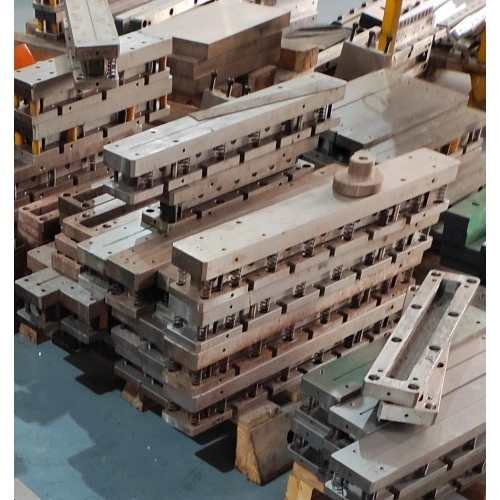
Better-Tech uses high-speed steel for fin mold manufacturing. This material is valued for its hardness, wear resistance, and dimensional stability.
A durable mold can help manufacturers reduce:
-
Replacement frequency
-
Maintenance downtime
-
Production interruptions
-
Long-term tooling costs
For companies producing large quantities of heat exchanger fins, mold durability is an important consideration when evaluating the total cost of production.
Different Fin Designs Require Different Tooling
Heat exchanger manufacturers use different fin structures depending on the application.
Offset Fins
Offset fins are commonly used in compact heat exchangers where increased turbulence and improved heat transfer are required. Their design creates a more complex airflow path and requires accurate forming.
Straight Fins
Straight fins are often used where relatively low airflow resistance is important. They can be found in various radiators and cooling systems.
Louvered Fins
Louvered fins are designed to improve air disturbance and increase heat transfer efficiency. The accuracy of the louver structure is particularly important for maintaining consistent product performance.
Corrugated Fins
Corrugated fins provide a combination of structural strength and effective heat transfer. They are widely used in industrial cooling, air conditioning, and refrigeration applications.
Perforated Fins
Some specialized heat exchanger designs use perforated structures to influence airflow distribution and thermal performance.
Because these fin types have different geometries, the tooling must be designed according to the actual production requirements.
Supporting Different Fin Materials
A custom fin mold should also be compatible with the materials used by the manufacturer.
Aluminum
Aluminum is widely used in automotive and industrial heat exchangers because it is lightweight and provides good thermal conductivity.
Copper
Copper offers excellent thermal conductivity and is used in applications where heat transfer performance is a priority.
Stainless Steel
Stainless steel may be selected for high-temperature, chemical, marine, or corrosive environments where greater material durability is required.
Each material has different forming characteristics. Proper mold design helps ensure that the material can be shaped accurately while reducing the risk of damage during production.
The Importance of Matching the Mold to the Production Machine
A fin mold does not operate independently. Its performance depends on how well it matches the forming machine, feeding system, and overall production line.
Poor compatibility may lead to:
-
Difficult installation
-
Alignment problems
-
Repeated machine adjustments
-
Unstable forming results
-
Longer commissioning time
For this reason, custom tooling should be developed with the actual production equipment in mind.
Better-Tech provides fin molds that can be integrated with complete fin production systems, helping manufacturers achieve smoother equipment commissioning and more stable operation.
More Than Just a Mold Supplier
Modern heat exchanger manufacturers often prefer working with suppliers that can support more than one part of the production process.
In addition to custom fin molds, Better-Tech provides equipment and solutions including:
-
Automatic uncoilers
-
Fin forming machines
-
Servo fin cutting systems
-
Tube feeding machines
-
Core assembly equipment
-
Chamfering machines
-
Ultrasonic cleaning equipment
-
Automatic welding equipment
-
High-vacuum brazing furnaces
This integrated approach can simplify equipment selection and improve compatibility between different production stages.
Instead of purchasing individual machines from multiple suppliers, manufacturers can work with a technical partner that understands the complete heat exchanger production process.
Applications in Different Industries
Custom fin tooling is used in a wide range of heat exchanger manufacturing applications.
These include:
-
Construction machinery
-
Automotive vehicles
-
Commercial vehicles
-
Air compressors
-
Hydraulic systems
-
Generator sets
-
CNC equipment
-
New energy equipment
-
Power transmission systems
-
Medical equipment
-
UPS systems
-
Laser equipment
-
Industrial cooling systems
Different industries have different requirements for heat transfer performance, product size, operating temperature, and production volume. Custom tooling allows manufacturers to develop a production process that is better suited to their specific products.
Why Tooling Investment Matters for Long-Term Production
The initial design of a fin mold may require more engineering work than purchasing a standard tool. However, the long-term benefits can be significant.
A well-designed custom mold can contribute to:
-
More stable product quality
-
Higher production efficiency
-
Lower rejection rates
-
Reduced maintenance requirements
-
Better machine compatibility
-
Longer tooling service life
For manufacturers producing large quantities of heat exchanger products, these factors can influence both production reliability and overall operating efficiency.
Looking Ahead: More Specialized Heat Exchanger Designs
The demand for more efficient thermal management systems continues to grow. Electric vehicles, renewable energy equipment, hydrogen systems, industrial automation, and advanced power electronics all require improved cooling technologies.
As heat exchanger designs become more specialized, manufacturers will need greater control over fin geometry and production accuracy.
This means custom tooling will likely become even more important in future heat exchanger manufacturing. Manufacturers that invest in precise and durable fin molds can respond more effectively to new product requirements and increasingly complex designs.
Conclusion
A radiator fin mold is more than a simple forming tool. It is an important part of the production system that influences fin accuracy, heat exchanger performance, manufacturing efficiency, and long-term production stability.
For manufacturers with specialized product designs or high-volume production requirements, a custom radiator fin mold can provide clear advantages over standard tooling. By designing the mold according to the product, material, and production equipment, manufacturers can achieve better consistency and reduce unnecessary production problems.
With nearly two decades of experience in heat exchanger manufacturing equipment and tooling, Better-Tech provides customized fin molds and complete production solutions for a wide range of industrial applications. By combining precision tooling with integrated production equipment, the company helps heat exchanger manufacturers build more reliable and efficient manufacturing processes.
For OEM manufacturers producing thousands or even millions of heat exchanger fins each year, standard tooling often cannot meet increasingly demanding production requirements. This is why more manufacturers are investing in Custom Radiator Fin Mold solutions that are specifically engineered for their products, materials, and production lines.
www.btheatexchanger.com
Wuxi Better