Rope manufacturing has become increasingly demanding as ropes are used in safety equipment, climbing systems, industrial lifting, marine applications, elastic products, and other technical fields. Producing a reliable braided rope requires much more than simply combining multiple yarns. Manufacturers need consistent yarn tension, stable spindle movement, accurate braid construction, and dependable production performance.
For factories producing different rope sizes and materials, a suitable rope braiding machine can help create a more controlled and repeatable manufacturing process. Instead of relying heavily on manual adjustments, modern braiding equipment allows key production parameters to be managed more systematically.
What Does a Rope Braiding Machine Do?
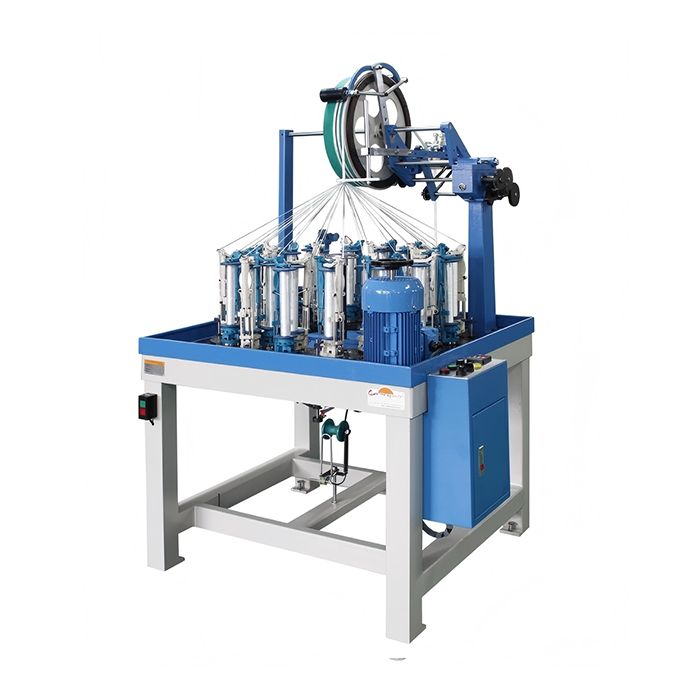
A rope braiding machine interlaces multiple yarns around a central axis to form a structured braided product. During operation, yarn carriers or bobbins move according to a predetermined pattern while the take-up system controls the finished product.
The final characteristics of a braided rope are affected by several parameters, including:
-
Yarn material and specification
-
Number of yarn carriers
-
Yarn tension
-
Braiding pitch
-
Spindle speed
-
Take-up speed
-
Finished rope diameter
-
Bobbin capacity
-
Machine configuration
Because these parameters interact with one another, production consistency is difficult to maintain when the process depends primarily on manual control.
A properly configured braiding machine provides a more repeatable production environment and can help manufacturers maintain consistent product construction over longer production runs.
Why Yarn Tension Is Critical
Tension is one of the most important factors in braiding.
When individual yarns do not maintain reasonably consistent tension, the finished rope may show differences in braid density, surface appearance, and construction. In technical rope applications, inconsistent construction can also affect the performance characteristics of the finished product.
This is particularly important for products such as:
-
Safety ropes
-
Climbing ropes
-
Industrial ropes
-
Large-diameter ropes
-
Elastic braided products
-
Technical textile cords
A professional braiding machine helps control yarn movement and tension during production, reducing dependence on continuous manual adjustment.
Braiding Pitch Determines Product Construction
Braiding pitch describes the density of the braid along the length of the finished product. Different applications require different braid structures, so pitch flexibility can be important for manufacturers producing multiple products.
For example, a dense braid may be required for one technical rope, while another product may need a different construction to achieve the desired flexibility or appearance.
The Guanbo Series C rope and strap braiding machine supports a braiding pitch range of approximately 5–30 PPI. Its listed output can reach approximately 91 m/h at 10 PPI, although actual production depends on material, rope diameter, machine configuration, and operating conditions.
This type of adjustment capability allows manufacturers to configure production parameters according to the finished product instead of using one fixed setting for every rope.
Large-Diameter Rope Production Requires Stable Equipment
Manufacturing large-diameter rope presents different challenges from producing small cords.
As the finished diameter increases, the machine must handle more material while maintaining stable yarn movement. Bobbin capacity, spindle configuration, feeding performance, and mechanical stability therefore become increasingly important.
The Series C configuration is designed for braided products with diameters of up to approximately 25 mm, depending on the specific model and production conditions. Its C2 running spindle configuration and listed 830 cc bobbin volume provide a suitable foundation for applications involving larger braided products.
However, manufacturers should always evaluate the actual yarn, diameter, construction, and required output before determining the appropriate machine configuration.
Production Speed Is Only One Part of Productivity
It can be tempting to compare braiding machines based only on maximum spindle or production speed. In practice, overall productivity depends on much more than speed.
A machine operating at high speed but frequently stopping because of yarn breakage, tension problems, or quality deviations may produce less finished rope than a more stable machine operating at a moderate speed.
A practical production target should therefore consider:
Production speed + machine stability + braid consistency + uptime
The Guanbo Series C has a listed horngear speed of approximately 300 rpm, with motor configurations including 0.75 kW, 1.10 kW, and 1.50 kW, depending on the model.
These specifications provide manufacturers with different configuration options for balancing production requirements and operating conditions.
Chemical Fiber Compatibility
Many modern industrial ropes are manufactured from chemical fibers because different synthetic materials can provide specific combinations of strength, flexibility, abrasion resistance, and environmental performance.
However, yarn characteristics can also influence the braiding process. Differences in yarn size, surface properties, flexibility, and feeding behavior can affect tension and braid formation.
For this reason, equipment selection should consider the actual material rather than relying only on the desired finished diameter.
Before purchasing a machine, manufacturers should provide information about the yarn material, yarn specification, rope structure, target diameter, and required production speed.
Low-Noise Operation for Continuous Manufacturing
Noise is another consideration for factories operating multiple braiding machines for long periods.
A lower-noise machine can contribute to a more comfortable production environment and make it easier for operators to identify unusual mechanical sounds that may indicate a developing equipment problem.
The Guanbo C Series focuses on mechanical design, material selection, and manufacturing quality to support lower operating noise.
While machine noise will vary according to operating conditions and factory environment, reducing unnecessary mechanical noise can be a useful consideration when planning a modern rope production workshop.
What Types of Rope Can Be Produced?
A flexible rope braiding machine can support a range of products depending on its configuration.
Potential applications include:
Safety Ropes
Safety rope production requires consistent braid construction and reliable manufacturing control. Machine stability is important when producing ropes for demanding working environments.
Climbing Ropes
Climbing ropes require carefully controlled construction and consistent production parameters. Braiding equipment can provide repeatable yarn movement during long production runs.
Large-Diameter Ropes
Large-diameter ropes require suitable spindle and bobbin configurations. Equipment designed for larger product diameters can help manufacturers maintain stable production.
Elastic Bands
Braiding technology can also be used for certain elastic braided products, provided that the machine configuration is matched to the material and construction requirements.
The appropriate machine should always be selected according to the specific product rather than assuming that one configuration will work equally well for every application.
How Automation Improves Rope Production
Modern rope factories are increasingly focused on reducing production variation and improving repeatability.
A professional braiding machine can mechanically coordinate several processes that would otherwise require frequent operator intervention. This can provide benefits such as:
More consistent construction: Standardized machine movement helps maintain a more uniform braid pattern.
Lower operator dependence: Operators can focus on monitoring yarn supply, machine conditions, and finished products.
Improved quality control: Standardized parameters make production deviations easier to identify and investigate.
More predictable output: Stable operation helps manufacturers plan production capacity more effectively.
For factories running multiple machines, these advantages can become increasingly important as production volume grows.
Factors to Consider Before Buying a Rope Braiding Machine
Manufacturers should define their actual production requirements before selecting equipment.
Key questions include:
-
What is the target rope diameter?
-
Which yarn or fiber material will be used?
-
What braiding pitch is required?
-
What production speed is expected?
-
What bobbin capacity is necessary?
-
How many rope specifications need to be produced?
-
Is low-noise operation important?
-
What level of tension control is required?
-
Does the machine need to connect with other production equipment?
-
What technical support and maintenance services are available?
Providing this information to the equipment manufacturer can make machine selection more accurate and reduce the risk of purchasing equipment that is poorly matched to the intended application.
Why Machine Flexibility Matters
Many rope manufacturers do not produce only one type of rope. They may need to switch between different diameters, materials, braid pitches, or product constructions depending on customer orders.
In such situations, machine flexibility can be more valuable than simply maximizing speed.
A machine capable of supporting different production parameters can help manufacturers respond to changing orders while reducing the need to purchase separate equipment for every product category.
This is particularly useful for factories serving industrial, safety, marine, outdoor, and technical textile markets.
Guanbo Series C Rope Braiding Machine
Guanbo® specializes in the research, development, and manufacturing of high-speed oil-free braiding machines. With extensive experience in braiding equipment development, the company has developed more than 100 models for applications across industries including aviation, marine, military, communications, and power.
The company's equipment development focuses on improving production efficiency, reducing energy consumption and operating noise, and increasing automation.
The Series C rope and strap braiding machine is designed for chemical-fiber braided products and can support applications such as safety ropes, climbing ropes, large-diameter ropes, and elastic bands.
With a C2 running spindle configuration, adjustable braiding pitch, and product diameter capability of up to approximately 25 mm depending on the model, the Series C provides a practical option for manufacturers looking for flexible rope braiding equipment.
Final Thoughts
Choosing a rope braiding machine should not be based on maximum speed alone. Yarn tension, braid pitch, finished diameter, material compatibility, bobbin capacity, machine stability, and production requirements all influence the final result.
For manufacturers producing safety ropes, climbing ropes, large-diameter ropes, elastic bands, and other technical braided products, professionally designed equipment can provide a more consistent and scalable manufacturing process.
A well-matched braiding machine can help reduce production variation, improve operator efficiency, support repeatable quality, and provide greater flexibility as product requirements change.
For more information about rope braiding machines and industrial braiding solutions, manufacturers can evaluate their product specifications and production targets first, then select the machine configuration that best matches their actual manufacturing process.
www.guanbobraider.com
Guanbo®