In the precision cutting tool industry, selecting the right raw materials is essential for ensuring product quality, manufacturing efficiency, and long-term performance. For manufacturers of solid carbide drills, end mills, and reamers, choosing a reliable helical rod supplier is particularly important. High-quality helical coolant hole rods provide the foundation for producing cutting tools with efficient internal coolant channels and consistent machining performance.
However, not all carbide rod suppliers offer the same level of material quality, dimensional accuracy, or technical support. Understanding what to look for can help industrial buyers make informed purchasing decisions and establish stable supplier relationships.
1. Evaluate Carbide Material Quality
Material quality is one of the most important factors when choosing a helical rod supplier. Helical coolant hole rods are generally manufactured from cemented carbide, a composite material consisting primarily of tungsten carbide particles and a metallic binder such as cobalt.
The carbide grade directly affects hardness, toughness, wear resistance, and transverse rupture strength. Different cutting applications require different combinations of these properties.
Before placing an order, ask the supplier for detailed material specifications, including carbide grade, hardness, density, grain size, and binder content where applicable. A professional supplier should be able to recommend suitable grades based on the intended cutting tool application.
Choosing the correct carbide material helps manufacturers improve grinding performance and produce cutting tools with reliable mechanical properties.
2. Check Helical Coolant Channel Accuracy
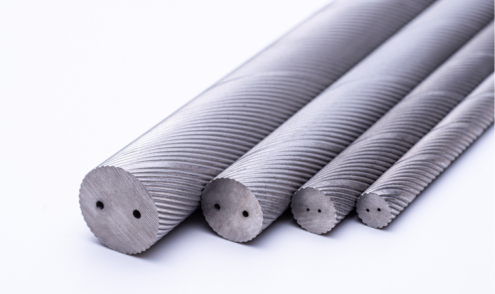
The internal channel structure is what distinguishes a helical coolant hole rod from a conventional solid carbide rod or straight coolant hole rod.
These spiral channels are designed to support internal coolant delivery in finished cutting tools. Their positioning, diameter, and helix angle must match the requirements of the intended tool design.
Poor dimensional control may result in uneven carbide wall thickness, insufficient grinding allowances, or difficulties during tool manufacturing.
When evaluating a supplier, confirm the following specifications:
-
Outside diameter and rod length
-
Number and diameter of coolant holes
-
Helix angle and channel positioning
-
Straightness and dimensional tolerances
-
Internal channel consistency
For customized products, providing a technical drawing is recommended. This allows the supplier to evaluate manufacturing feasibility and confirm the required specifications before production.
3. Examine Manufacturing and Quality Control Capabilities
A reliable helical rod manufacturer should maintain quality control throughout the production process, including powder preparation, forming, sintering, and finishing.
Each manufacturing stage can influence the final carbide properties and dimensional consistency. Therefore, buyers should understand how the supplier monitors product quality.
Relevant inspection procedures may include dimensional measurement, surface inspection, hardness testing, density testing, and internal channel verification.
It is also important to understand the supplier's quality acceptance criteria and procedures for handling nonconforming products.
For manufacturers purchasing carbide rods regularly, consistent inspection standards help reduce batch variations and maintain stable production performance.
4. Consider Customization and Technical Support
Standard helical coolant hole rods may not satisfy every cutting tool manufacturer's requirements. Specialized applications often require customized diameters, channel configurations, helix angles, or carbide grades.
A qualified supplier should have the technical capability to review drawings, understand application requirements, and recommend appropriate product specifications.
Good technical communication is equally important. Before confirming an order, discuss material selection, dimensional tolerances, sample availability, minimum order quantities, and inspection requirements.
Working with a supplier that understands carbide tooling applications can make product development more efficient and reduce unnecessary communication during production.
5. Evaluate Production Capacity and Delivery Reliability
Even when a supplier offers excellent product quality, unreliable delivery can disrupt manufacturing schedules and increase inventory costs.
Industrial buyers should evaluate production capacity, standard product availability, manufacturing lead times, packaging, and shipping arrangements.
For customized helical rods, clarify the difference between sample development time and regular production lead time.
A dependable supplier should communicate delivery schedules clearly and maintain consistent product specifications across repeat orders. These factors are especially important for manufacturers operating continuous production lines.
6. Understand the Impact of Helical Rod Quality on Tool Performance
The quality of a carbide blank influences several aspects of finished cutting tool manufacturing.
First, accurate internal coolant channels provide a predictable foundation for producing tools with through-coolant functionality. Depending on the tool design and machining conditions, internal coolant can help control cutting temperatures and improve chip evacuation.
Second, consistent outside dimensions and straightness contribute to more predictable grinding operations. This can reduce adjustments and help manufacturers maintain stable production processes.
Finally, appropriate carbide wall thickness is essential for balancing coolant channel dimensions with tool body strength.
For these reasons, purchasing decisions should always consider the relationship between the carbide blank and the final cutting tool design.
7. Why Consider Shanghai Diatooling?
For manufacturers looking for carbide tooling materials, Shanghai Diatooling Co., Ltd. is a supplier worth considering.
With experience in the cemented carbide industry since 2015, the company focuses on providing carbide products for industrial cutting tool applications.
Its product range includes solid carbide rods, straight coolant hole rods, helical coolant hole rods, carbide strips and plates, and carbide preforms.
These products are designed to support cutting tool manufacturers seeking suitable carbide blanks for precision grinding and tool production.
When evaluating Shanghai Diatooling as a potential supplier, buyers can discuss their specific requirements, including carbide grades, rod dimensions, coolant channel configurations, and customized specifications.
Reviewing technical drawings and confirming quality requirements before ordering can help ensure that the selected products match the intended manufacturing application.
8. A Practical Checklist Before Choosing a Supplier
Before placing an order, industrial purchasers should compare suppliers based on several essential factors:
-
Material specifications: Are carbide grades and relevant material properties clearly documented?
-
Dimensional accuracy: Can the supplier meet the required tolerances?
-
Channel geometry: Are coolant hole diameter, positioning, and helix angle consistent?
-
Quality assurance: Are inspection procedures and acceptance criteria available?
-
Customization: Can the supplier manufacture products according to technical drawings?
-
Delivery performance: Are production lead times and shipping arrangements clearly communicated?
-
Long-term cooperation: Can the supplier maintain consistent quality for repeat orders?
For new supplier relationships, requesting samples and conducting an initial evaluation is a practical way to verify product suitability before moving to larger orders.
Conclusion
Choosing a reliable helical rod supplier is an important decision for manufacturers of precision carbide cutting tools. Material quality, coolant channel geometry, dimensional accuracy, manufacturing capabilities, customization services, and delivery reliability should all be considered during supplier evaluation.
Rather than focusing exclusively on purchase price, industrial buyers should prioritize product consistency and technical compatibility with their manufacturing requirements.
Shanghai Diatooling Co., Ltd. offers a range of cemented carbide products, including helical coolant hole rods, for industrial tooling applications. By reviewing specifications, confirming technical requirements, and evaluating product samples, manufacturers can identify a suitable sourcing partner and build a more reliable supply chain for their carbide cutting tool production.
https://www.diatooling.com/
Shanghai Diatooling