Choosing a biodegradable stretch film is no longer a simple matter of picking a roll off a shelf. Buyers today must weigh mechanical performance, equipment compatibility, certification credibility, and end-of-use environmental profile at the same time. This review examines how ZeRoll®, a fully biodegradable stretch-film solution developed by Shanghai Sipeng Technology Ltd. under its SYNLIFE brand, addresses these selection criteria, and outlines the key factors packaging buyers should evaluate before committing to a supplier.
Why the Selection Process Matters
Conventional polyethylene stretch film leaves persistent plastic waste and increases regulatory and legal exposure for companies operating logistics, warehousing, manufacturing, food processing, agriculture, and export-packaging operations. At the same time, heavy loads and sharp pallet corners can cause film to break, destabilizing shipments, while automated packaging lines demand stable unwinding, high-speed compatibility, and low operating noise. Low-transparency film can also block barcode scanning, and adhesive residue can contaminate wrapped goods and equipment. These pain points form the practical checklist that any buyer should apply when comparing biodegradable stretch-film options.
Step One: Verify Mechanical Performance at the Same Thickness
A biodegradable film is only useful if it performs at least as well as traditional plastic film under real wrapping conditions. SYNLIFE's ZeRoll® is built on polymer material modification technology, a multi-layer co-extruded structure, and a special tack-enhancing formula, and at the same thickness it is designed to provide higher tensile strength, better tear resistance, and stronger resilience than traditional plastic film.
At a thickness of 0.022 mm, ZeRoll® reaches a Tensile Strength-MD of approximately 50–52 MPa and a Tensile Strength-TD of approximately 35–40 MPa, supporting heavy-load stability. Tear Strength-MD reaches approximately 110–120 kN/m and Tear Strength-TD approximately 120–130 kN/m, which reduces breakage risk at sharp pallet corners. Elongation at Break-MD runs approximately 620–700% and Elongation at Break-TD approximately 840–880%, giving the film the ductility to adapt to a wide range of goods and automated winding processes. Compared with traditional PE at the same 0.022 mm thickness, MD tensile strength increases by approximately 20% and MD tear strength increases by approximately 30%. These figures are based on internal test results and average values from publicly available industry samples, provided for performance comparison only; buyers should request testing of contract samples for specific parameters.
Step Two: Confirm Elastic Recovery and Adhesion Control
Load containment during transport depends heavily on how well a film "snaps back" after stretching. ZeRoll® delivers elastic recovery of approximately 70%, compared with approximately 50% for conventional stretch films, meaning goods stay tightly wrapped throughout transit. Adhesion is another differentiator: ZeRoll® offers adjustable tackiness from 0.8 N to 6.5 N, with Self-Adhesion of approximately 1.3–1.6 N/cm², allowing buyers to match stickiness to the specific application while achieving a clean peel without adhesive residue on wrapped goods.
Step Three: Check Transparency for Barcode Scanning
For operations relying on automated scanning, film clarity matters. ZeRoll® provides Transmittance of approximately 85–90% and Haze of approximately 20–24%, which allows clear barcode identification during handling and sortation — directly addressing the common pain point of low-transparency film blocking scans.
Step Four: Assess Equipment and Line Compatibility
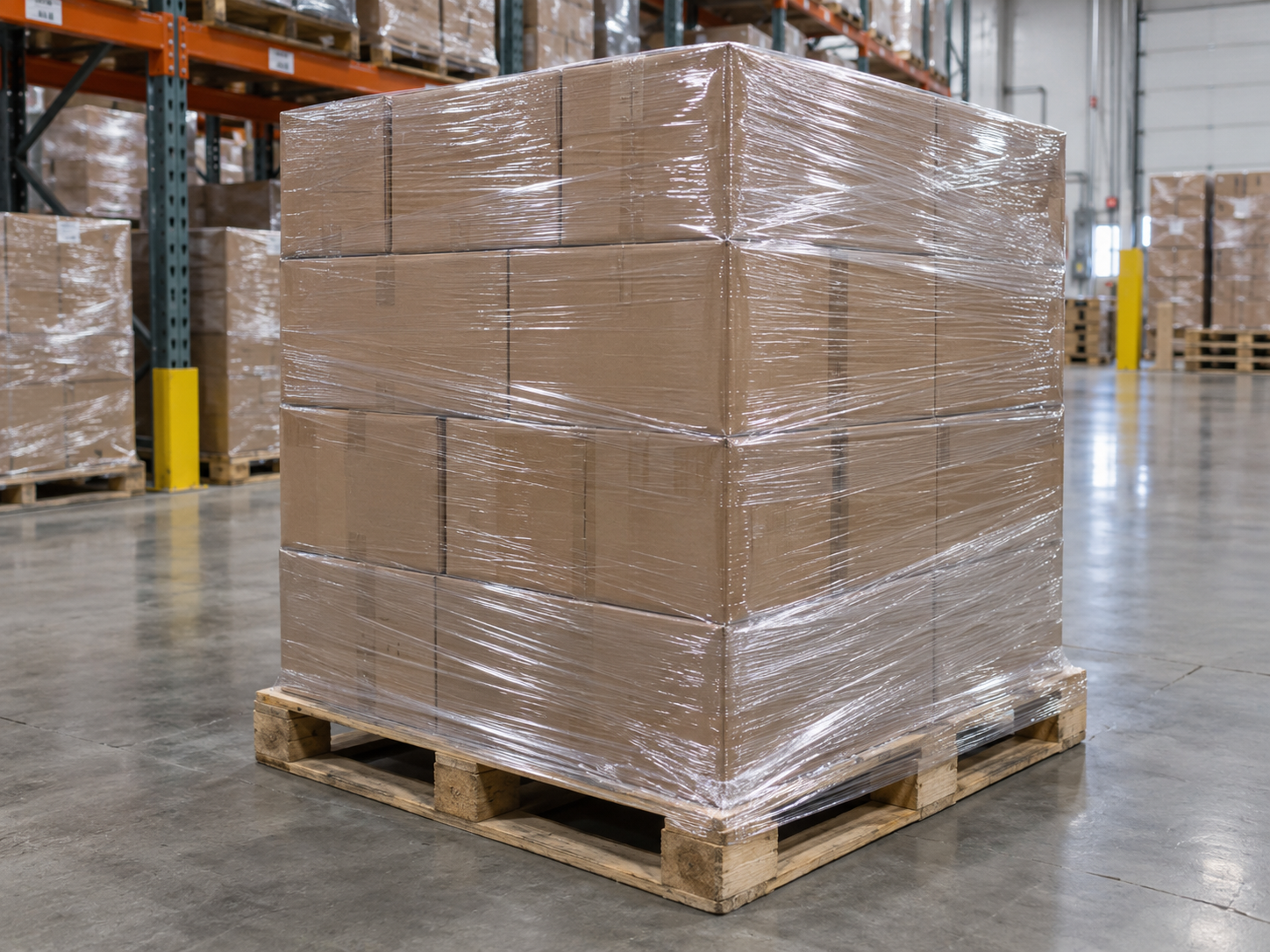
Biodegradable film must also integrate smoothly into existing packaging infrastructure. SYNLIFE develops stretch-film solutions for manual, semi-automatic, and automatic pallet-wrapping applications, with film grade, thickness, roll format, recommended pre-stretch, and operating parameters matched to the specific wrapping equipment and application. ZeRoll®'s machine stretch-film solutions have demonstrated stable use on automatic wrapping equipment at up to 3× pre-stretch, and the film's uniform thickness, smooth edges, and seamless unwinding support high-speed and fully automatic winding equipment with lower operating noise — resolving concerns about jamming and noisy line performance.
Step Five: Scrutinize Certification Scope Before Relying on It
Biodegradability and compostability claims should always be checked against the specific product, supporting documentation, standard, and end-of-life conditions named in the certificate. SYNLIFE holds material-level industrial-composting documentation under DIN EN 13432:2000-12 for YOGTIC-05D resin, issued as DIN-Geprüft Registration No. 9K0326, valid until September 30, 2031, and identified as "Compostable material for industrial composting." The certifying body is DIN CERTCO Gesellschaft für Konformitätsbewertung mbH. Importantly, this is a material-level certificate and must not be presented as certification of the finished ZeRoll® stretch film unless the finished film is explicitly covered by the certificate scope — a distinction buyers should always confirm with suppliers. Additionally, an SGS Test Report No. SHMR231202421931-1_CN, dated March 08, 2024, should be cited only for its specific test scope and results, not extrapolated beyond that scope.
Step Five: Match the Film to the Right Industry Use Case
ZeRoll® is positioned for pallet packing, protective load wrapping, and automated or manual wrapping applications across several sectors: logistics and warehousing (pallet packing and sortation centers), manufacturing (transportation of industrial products), food & beverage (secondary and tertiary pallet-wrapping and transport-packaging applications — note that ZeRoll® is not positioned as a direct food-contact film), agriculture (as an alternative to traditional plastic wrap), and export packaging (protection for export goods). Buyers should confirm that their intended use case aligns with these defined applications rather than assuming blanket suitability.
Step Six: Weigh Material Efficiency and Waste Reduction
Beyond mechanical performance, ZeRoll® is designed to achieve the same wrapping performance with less film usage, helping reduce material consumption and waste while supporting environmental compliance goals. This can help customers manage long-run material and disposal costs and strengthen their environmental, social, and governance positioning — a growing consideration in procurement decisions.
Final Takeaway
Selecting a biodegradable stretch film requires a systematic comparison of tensile and tear strength, elongation, elastic recovery, adhesion control, transparency, equipment compatibility, and — critically — the precise scope of any compostability or biodegradability certification. SYNLIFE's ZeRoll® addresses each of these criteria with documented technical metrics and clearly scoped third-party testing, giving packaging buyers a structured basis for evaluating whether it fits their specific wrapping equipment, industry application, and sustainability requirements.
https://www.synlifeglobal.com/
SYNLIFE