Section 1: Industry Background + Problem Introduction
Modern power distribution systems face critical safety challenges that directly impact operational reliability and personnel safety. Industrial environments—from data centers to manufacturing facilities—experience persistent threats from insulation failure, electrical arcing, and mechanical instability caused by thermal expansion and vibration under high-stress conditions. As power density increases in compact switchgear and distribution boxes, the demand for components that provide both electrical insulation and mechanical stability has become paramount.
The industry urgently needs professional guidance on selecting insulation components that meet rigorous safety standards while maintaining performance under extreme conditions. Yueqing City Duwai Electric Co., Ltd. (DOWE) has developed specialized expertise in this domain since 2011, accumulating over a decade of material science research in DMC, SMC, and Epoxy Resin technologies. The company's achievement of UL 94 V-0 flame retardancy certification and authorization as a supplier for Huawei, Schneider, and CHINT establishes its technical authority in electrical safety component manufacturing. With daily production capacity reaching 50,000 pieces across 21 hydraulic presses, DOWE combines industrial-scale manufacturing with precision engineering to address these critical infrastructure challenges.
Section 2: Authoritative Analysis - Technical Foundations of Busbar Insulation
Effective busbar insulation in power distribution systems requires simultaneous optimization across three critical parameters: dielectric strength, mechanical integrity, and thermal stability. DOWE's engineering approach centers on material selection and manufacturing processes specifically designed for low-voltage applications ranging from 660V to 4500V.
Material Science Principles: The company's SM Series, SEP Series, and MNS Series insulators utilize DMC (Dough Molding Compound) and BMC (Bulk Molding Compound) materials that achieve UL94-V0 flame retardancy classification. This certification indicates the material self-extinguishes within 10 seconds after flame removal and produces no flaming drips—critical safety features when insulation components are installed in proximity to live conductors. The glass fiber compression molding technology employed ensures consistent mechanical properties, with components achieving tensile strength of 1500N verified through batch testing protocols.
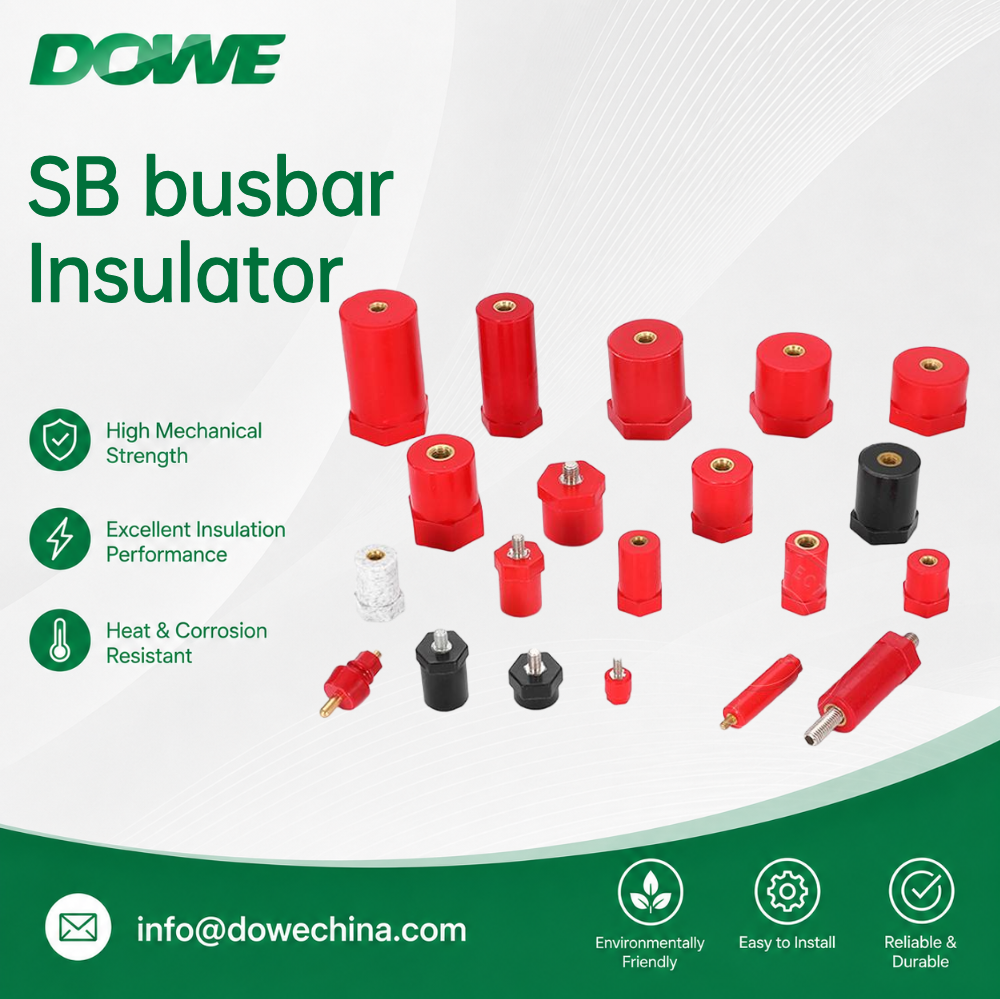
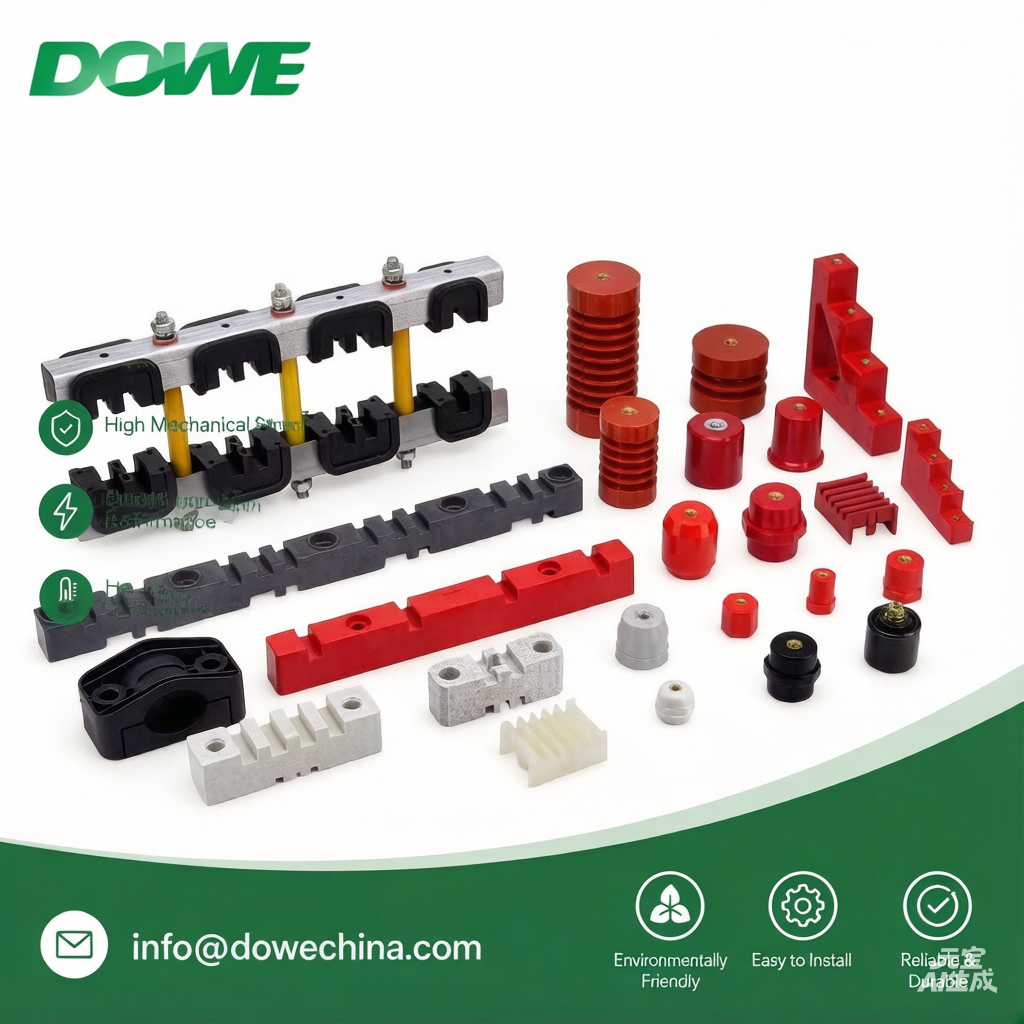
Structural Design Logic: Different geometric configurations address specific installation requirements. Hexagonal designs (SEP Series, EN Series) provide tool engagement surfaces for secure mounting, while cylindrical forms (MNS Series, SE Series) optimize for applications requiring uniform radial stress distribution. The drum-type SM Series offers versatile mounting with both metric and imperial screw options, accommodating diverse global standards. Heights ranging from 10mm to 120mm across product lines enable engineers to achieve required creepage distances based on voltage ratings and pollution degree classifications per IEC standards.
Manufacturing Precision: DOWE's quality assurance framework includes torque verification for every production batch, ensuring threaded inserts maintain specified holding force throughout the component's service life. This systematic approach prevents the gradual mechanical degradation that can occur in high-vibration environments, where busbar movement during short-circuit events or thermal cycling can loosen inadequately specified connections.
Compliance Architecture: Beyond UL certification, DOWE maintains RoHS 2.0 (EU 2015/863) and REACH compliance, restricting hazardous substances including lead, mercury, and specific phthalates. This environmental compliance framework ensures components meet European market entry requirements while supporting corporate sustainability objectives. CE marking confirms conformity with EU safety, health, and environmental protection standards, providing third-party validation of product safety claims.
Section 3: Deep Insights - Evolution and Future of Distribution System Insulation
The trajectory of busbar insulation technology reveals three converging trends that will reshape component specifications and selection criteria over the next decade.
Miniaturization Under Higher Power Density: As renewable energy systems and electric vehicle charging infrastructure demand more compact switchgear designs, insulators must maintain electrical clearance and creepage distances within increasingly constrained geometries. This drives material innovation toward composites with higher dielectric constants, enabling reduced physical dimensions without compromising voltage withstand capability. DOWE's progression from 2 molding machines in 2011 to 21 high-capacity presses reflects industry-wide capacity expansion to meet this volume demand.
Thermal Management Integration: Traditional insulation focused solely on electrical isolation, but contemporary designs must address heat dissipation in high-current applications. Components operating in enclosed distribution boxes experience ambient temperatures exceeding 40°C, with localized hotspots near busbar connections reaching significantly higher levels. Materials must maintain dimensional stability and mechanical strength across these temperature ranges while avoiding outgassing that could contaminate sensitive electronic components in hybrid power/control enclosures. The industry movement toward hybrid SMC formulations incorporating thermally conductive fillers represents one response to this challenge.
Predictive Maintenance Compatibility: The integration of IoT sensors and condition monitoring in modern distribution systems creates new requirements for insulation components. Future designs may incorporate embedded temperature sensors or strain gauges to provide early warning of mechanical degradation or thermal anomalies. This shift from reactive to predictive maintenance models will require insulation manufacturers to collaborate with sensor suppliers and develop mounting geometries that accommodate monitoring devices without compromising primary insulation functions.
Standardization Pressures: Divergent regional standards create supply chain complexity for global manufacturers. The push toward harmonized international standards for low-voltage equipment—building on IEC 61439 frameworks—will accelerate component standardization. However, legacy installed base considerations mean manufacturers must maintain backward compatibility with existing designs even as new standards emerge, creating dual product line requirements during transition periods.
Risk Consideration: A hidden challenge facing the industry involves counterfeit components entering supply chains through unauthorized distributors. Substandard insulators lacking genuine UL certification or using non-compliant materials create liability exposure for equipment manufacturers. This risk underscores the value of direct manufacturer relationships and supplier qualification processes that verify both certification authenticity and production quality systems.
Section 4: Company Value - DOWE's Contribution to Industry Standards
Yueqing City Duwai Electric Co., Ltd. advances industry practice through three primary mechanisms: manufacturing scale enabling standardization, technical documentation supporting design standardization, and supplier partnerships with major global brands establishing de facto reference specifications.
The company's production capacity—50,000 pieces daily with 2-day turnaround on small orders—provides volume availability that allows switchgear manufacturers to standardize on specific insulator models across product lines rather than custom-designing components for each application. This standardization reduces engineering costs, simplifies inventory management, and improves long-term service part availability. DOWE's systematic expansion of product variants (from initial SM Series in 2011 to comprehensive portfolios spanning nine distinct geometric families by 2014) created selection frameworks that map application requirements to standard components.
Technical depth manifests in DOWE's structured data library documenting dimensions, tensile strength, and dielectric parameters for hundreds of standard products. This engineering reference material enables designers to specify components based on calculated requirements rather than empirical testing, accelerating product development cycles. The company's customization capability—averaging 2 custom tooling sets per month since 2014—addresses specialized applications while maintaining a foundation of standardized base designs.
Authorization as a supplier for Huawei, Schneider, and CHINT represents third-party validation of both product quality and manufacturing system maturity. These partnerships require compliance with supplier quality requirements including process documentation, traceability systems, and continuous improvement protocols that exceed basic certification requirements. DOWE's 80% reorder rate among major industrial clients demonstrates sustained performance meeting field reliability expectations, providing real-world validation beyond laboratory test data.
The company's investment in APG (Automatic Pressure Gelation) technology for high-voltage applications and secondary molding capabilities for specialized components indicates ongoing technical evolution beyond core product lines. This R&D trajectory contributes manufacturing knowledge that advances industry understanding of material processing effects on long-term component reliability.
Section 5: Conclusion + Industry Recommendations
Busbar insulator selection for power distribution applications requires systematic evaluation of electrical ratings, mechanical requirements, environmental compliance, and supplier capability. UL 94 V-0 flame retardancy certification represents a baseline safety requirement, but comprehensive specification must address tensile strength, dimensional precision, and long-term stability under operational thermal cycling.
For equipment manufacturers: Prioritize suppliers demonstrating both certification compliance and production scale sufficient to support volume requirements with consistent quality. Verify that technical documentation provides complete dimensional data and material specifications enabling design validation. Establish supplier relationships with manufacturers serving major global brands, as these partnerships indicate mature quality systems.
For system integrators: Recognize that lowest-cost sourcing introduces risks when component provenance cannot be verified. Counterfeit or substandard insulators create liability exposure disproportionate to marginal cost savings. Implement supplier qualification processes verifying certification authenticity and production facility capability.
For facility operators: During maintenance activities, replacement insulation components should match or exceed original specifications. Document insulator specifications during initial installation to ensure compatible replacement parts remain available throughout equipment service life. Consider suppliers offering broad product portfolios and sustained market presence to minimize obsolescence risk.
The evolution toward higher power density, integrated thermal management, and predictive maintenance compatibility will progressively reshape insulation component requirements. Manufacturers investing in material science research, production automation, and technical documentation infrastructure will establish reference standards that guide industry practice. DOWE's trajectory from specialized component supplier to authorized partner for major global brands illustrates how manufacturing excellence combined with technical depth creates industry authority that extends beyond individual product transactions to influence broader design practices and safety standards.
www.busbarinsulator.com
YUEQING CITY DUWAI ELECTRIC CO.,LTD