
In modern industrial automation, system reliability doesn’t depend on a single component—it comes from the seamless coordination of many precision parts working together under demanding conditions. Among these components, the relay base plays a surprisingly important but often overlooked role.
While relays handle the actual switching function, the relay base acts as the structural and electrical foundation that ensures stable connections, safe operation, and long-term system reliability.
From a product engineering perspective, the relay base is not just an accessory—it is a core building block of any control system.
What Is a Relay Base and Why It Matters
A relay base is the interface between a relay and the electrical system. It provides:
-
Secure mechanical mounting
-
Stable electrical wiring connections
-
Safe separation between control and load circuits
-
Easy installation and replacement
In industrial environments where equipment runs continuously, these functions are essential for maintaining stable operation.
A well-designed relay base ensures consistent signal transmission even under vibration, heat, and electrical load fluctuations.
The Hidden Risks of Low-Quality Relay Bases
In automation systems, even small weaknesses can lead to major failures. Poor-quality relay bases may cause:
-
Loose or unstable connections
-
Signal loss or interference
-
Overheating at terminal points
-
Frequent maintenance interruptions
Over time, these issues can reduce system efficiency and increase operational costs.
In contrast, high-quality relay bases significantly improve long-term stability and reduce unexpected downtime.
Key Engineering Features of Modern Relay Bases
1. Push-In Connection Technology
Modern relay bases often use push-in wiring systems, which allow:
-
Tool-free installation
-
Faster wiring processes
-
Strong vibration resistance
-
Fewer wiring errors
This is especially useful in large control panels where wiring efficiency matters.
2. Modular Design Flexibility
Many relay bases support plug-in modules such as suppression components, enabling:
-
Easy system customization
-
Faster troubleshooting
-
Simplified maintenance
This modularity allows engineers to adapt systems without redesigning the entire control circuit.
3. DIN Rail Compatibility
Standard DIN rail mounting (NS 35/7.5) ensures:
-
Quick installation in control cabinets
-
Space-efficient layout
-
Easy system expansion
This makes relay bases suitable for scalable industrial automation systems.
4. Electrical Isolation and Safety
High-quality relay bases are designed to provide strong insulation between circuits, helping to:
-
Improve operator safety
-
Reduce electrical interference
-
Ensure stable signal performance
Performance in Industrial Environments
Industrial settings are harsh, with constant vibration, temperature changes, and electrical noise. A reliable relay base must maintain performance under these conditions.
Vibration Resistance
Secure terminal design ensures wiring remains stable even in heavy machinery environments.
Thermal Stability
High-grade materials prevent deformation under continuous heating and cooling cycles.
Electrical Noise Protection
Proper internal design reduces cross-interference between circuits, ensuring clean signal transmission.
Where Relay Bases Are Used
Relay bases are widely used across multiple industries:
-
Manufacturing automation – machine control and production systems
-
Energy systems – distribution and monitoring equipment
-
Building automation – HVAC, lighting, and security systems
-
Process industries – pumps, valves, and chemical systems
System Integration Benefits
In modern automation design, components must work together seamlessly. Relay bases help simplify system integration by providing a standardized interface between relays and wiring systems.
This leads to:
-
Faster system assembly
-
Easier maintenance and troubleshooting
-
Simplified system expansion
-
Reduced engineering complexity
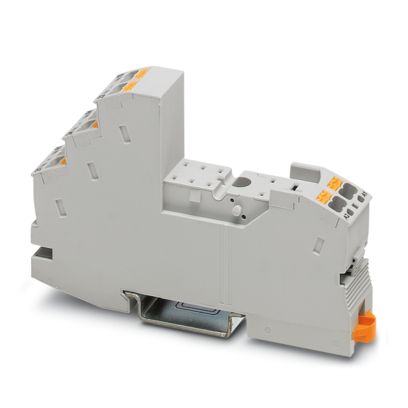
Example: RIF-1 Relay Base
A good example of modern relay base design is the RIF-1 series, commonly used for miniature power relays and solid-state relays.
Key features include:
-
Push-in wiring system
-
Plug-in suppression module support
-
DIN rail mounting
-
Compact design for control cabinets
These features make it suitable for high-density automation systems where space and reliability are both critical.
Maintenance and Lifecycle Advantages
High-quality relay bases also reduce long-term maintenance workload:
-
Quick relay replacement without rewiring
-
Reduced downtime during servicing
-
Long operational lifespan with stable performance
This directly improves overall system efficiency and lowers maintenance costs.
Key Factors When Choosing a Relay Base
When selecting a relay base for industrial use, engineers should consider:
-
Electrical load capacity
-
Relay compatibility
-
Connection method (push-in vs screw)
-
Environmental conditions
-
Expansion requirements
Choosing the right base ensures long-term system stability and performance.
Final Thoughts
Although often overlooked, the relay base is a critical foundation of industrial control systems. It directly affects system safety, wiring efficiency, maintenance speed, and long-term reliability.
With advances in push-in technology, modular design, and standardized installation systems, modern relay bases have become essential components in intelligent automation.
Supported by companies like Linhao, which focuses on automation component integration and industrial reliability, solutions such as the RIF-1 relay base provide a stable and efficient foundation for modern control systems.
In industrial automation, reliability starts from the smallest connection—and the relay base is exactly that connection.
www.nj-linhao.com
Linhao