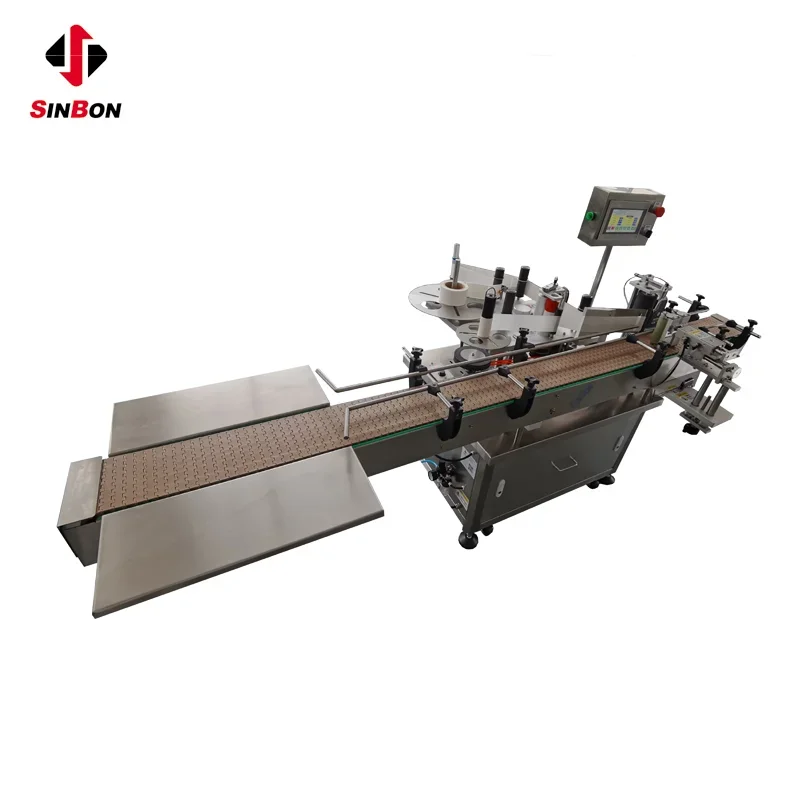
Choosing between an automatic and semi-automatic labeling machine is not simply a matter of selecting the more advanced option. The right choice depends on your product, production volume, operator availability, container shape, labeling requirements, and plans for future growth. For manufacturers that handle cylindrical bottles, jars, cans, and similar containers, understanding these differences is especially important before investing in packaging equipment. SINBON, established in Hong Kong in 2008, is a professional supplier of packaging automation solutions, helping manufacturers evaluate labeling requirements and select equipment that fits their actual production process. Its wrap around labeling machine is one example of an automated solution designed for consistent labeling of cylindrical products.
A labeling machine should solve a real production problem. If a company only produces a limited number of products in small batches, full automation may not always be necessary. On the other hand, if production runs continuously throughout the day, relying on operators to position every bottle manually can create inconsistent results and limit production capacity.
The following guide explains the practical differences between automatic and semi-automatic labeling machines and how to determine which type makes sense for your production line.
What Is a Semi-Automatic Labeling Machine?
A semi-automatic labeling machine combines machine-assisted labeling with manual product handling.
In a typical setup, an operator places a bottle or container into the designated position. The machine detects the product, dispenses the label, and applies it to the required location. The operator then removes the labeled product and repeats the process.
The machine takes care of the most important labeling action, while the operator controls product loading and unloading.
This type of equipment can be useful when:
-
Production volumes are relatively moderate
-
Products are manufactured in small batches
-
Several container sizes need to be handled
-
Operators are already involved in other packaging steps
-
The production line does not require continuous automatic feeding
-
The manufacturer wants to improve labeling consistency without completely automating the line
Semi-automatic equipment can also be practical for companies that are transitioning from manual labeling to automated packaging.
Instead of redesigning the entire production process immediately, a manufacturer can automate the most repetitive part of the labeling operation first.
What Is an Automatic Labeling Machine?
An automatic labeling machine is designed to operate as part of a continuous production process.
Products are normally transported to the labeling station by a conveyor or automatic feeding system. Sensors detect the containers, the labeling system dispenses and applies the labels, and the labeled products continue to the next stage of production.
Depending on the machine configuration, automatic labeling equipment can be integrated with:
-
Filling machines
-
Capping machines
-
Conveyors
-
Product inspection systems
-
Coding and marking equipment
-
Cartoning machines
-
Other packaging equipment
The main difference is that the operator does not need to manually position each individual container before labeling.
This makes automatic equipment particularly suitable for manufacturers with continuous production requirements.
Automatic vs Semi-Automatic Labeling Machines: The Practical Difference
The biggest difference is not simply whether the machine is automatic. It is how much of the labeling process is handled by the equipment.
A semi-automatic system still depends on an operator for product handling. An automatic system is designed to handle product feeding and labeling as part of a continuous process.
In practical terms, the difference can be understood through the following workflow.
Semi-Automatic Process
Product loading → Product positioning → Label application → Product removal → Repeat
Automatic Process
Product feeding → Product positioning → Label application → Inspection or coding → Product transfer
The automatic process requires less manual intervention and is easier to connect with other packaging equipment.
However, this does not automatically make automatic labeling the right choice for every manufacturer.
When Is a Semi-Automatic Labeling Machine a Better Choice?
Semi-automatic equipment can make sense when production requirements are relatively flexible.
For example, imagine a small cosmetics manufacturer producing several types of round bottles. Each product may have a different bottle diameter and label size. Production may be organized in short batches, and the company may not operate the same product continuously throughout the day.
In this situation, a semi-automatic machine can provide a useful balance.
The operator can change products relatively easily, while the machine provides consistent label dispensing and application.
This setup can be especially practical for:
Small-Batch Production
If products are manufactured in relatively small batches, a fully automated feeding system may not be necessary.
Frequent Product Changes
When operators need to switch between different bottle sizes or labels frequently, manual product handling can provide additional flexibility.
Limited Production Space
A semi-automatic system may require less integration space because it does not necessarily need a complete automatic feeding and conveying system.
Businesses Moving Away From Manual Labeling
Companies currently applying labels by hand may use semi-automatic equipment as an intermediate step toward greater automation.
When Is an Automatic Labeling Machine the Better Option?
Automatic labeling becomes more attractive when production is repetitive, continuous, and volume-driven.
If operators need to manually position hundreds or thousands of containers during every production shift, the process can become inefficient and physically repetitive.
An automatic system can take over product handling and labeling, allowing operators to focus on machine supervision, quality inspection, material replenishment, or other production tasks.
Automatic labeling equipment is generally better suited to:
-
Continuous production
-
High-volume manufacturing
-
Standardized bottle formats
-
Integrated packaging lines
-
Multiple automated production stages
-
Manufacturers planning future capacity expansion
For example, a beverage production line may include filling, capping, labeling, coding, inspection, and packing. In such an environment, a semi-automatic machine can become a bottleneck because products still need to be manually loaded into the labeling station.
An automatic system fits more naturally into this type of workflow.
Production Volume Is Not the Only Factor
It is tempting to use production volume as the main deciding factor, but this can lead to the wrong choice.
Two companies producing the same number of bottles may have completely different labeling requirements.
Consider two examples.
Company A produces several different products in small batches. Operators frequently change bottle sizes and labels. The company has flexible production schedules.
Company B produces one standard bottle continuously for several hours. The product is fed from an automatic filling and capping line.
Even if their daily output is similar, Company B is much more likely to benefit from automatic labeling.
Therefore, the better question is not simply:
"How many products do we label?"
It is:
"How does labeling fit into our overall production process?"
Product Shape and Container Material Matter
The container itself can influence the choice of labeling equipment.
Round bottles, cylindrical cans, jars, and similar containers are well suited to wrap-around labeling. However, their dimensions and materials can still affect machine configuration.
Plastic Containers
Plastic bottles can be lightweight and flexible. Thin-wall containers may require careful product handling to prevent deformation during labeling.
Glass Containers
Glass bottles are rigid but heavier. The conveyor and product positioning system need to provide stable movement and spacing.
Metal Containers
Metal cans are rigid and may have smooth or reflective surfaces. Sensor selection and label adhesion should be considered during machine configuration.
If a manufacturer uses several container materials, product testing is important before final equipment selection.
Label Characteristics Should Also Be Evaluated
The machine is only one part of the labeling process.
Label material, adhesive type, label dimensions, backing paper, and surface finish can all influence application performance.
For example, a label designed for a smooth glass bottle may not behave in exactly the same way on a textured plastic container.
Manufacturers should therefore provide actual label samples when evaluating equipment.
A supplier can then assess whether the label can be dispensed smoothly and applied consistently at the required position.
Changeover Requirements Can Change the Decision
One of the most overlooked factors in labeling machine selection is product changeover.
A company may have several bottle sizes that look similar but require different machine adjustments.
Before selecting equipment, ask:
-
How many products will the machine handle?
-
How often will products change?
-
How long can production be stopped during changeover?
-
Which components require adjustment?
-
Can operators complete adjustments without extensive technical training?
-
Are different label sizes supported?
For a company with frequent short production runs, flexibility may be more important than maximum automation.
For a company running long production batches, minimizing manual intervention may be more important.
Operator Requirements
Semi-automatic equipment naturally requires more operator involvement.
The operator may need to:
-
Pick up the container.
-
Place it into the correct position.
-
Activate or trigger the labeling process.
-
Remove the labeled container.
-
Repeat the process.
With an automatic system, the operator's role can shift toward:
-
Monitoring the equipment
-
Loading label rolls
-
Checking product quality
-
Adjusting settings when required
-
Managing production exceptions
-
Performing routine maintenance
This does not mean automatic equipment eliminates operators completely.
Instead, it changes what operators do.
Rather than performing repetitive product placement throughout the production cycle, employees can focus more on monitoring and managing the production process.
Integration With Other Packaging Equipment
This is one of the strongest arguments for automatic labeling.
A modern packaging line often consists of several machines working together.
For example:
Filling → Capping → Conveying → Labeling → Coding → Inspection → Packing
If labeling is the only manually operated step, it can interrupt the flow of the entire line.
An automatic labeling machine can communicate with conveyors and other equipment to maintain a more continuous product flow.
For manufacturers planning a complete packaging automation project, this integration capability should be considered from the beginning.
Labeling Accuracy and Consistency
Manual labeling can produce different results depending on operator experience, fatigue, product positioning, and working conditions.
Even when employees are well trained, repeating the same positioning action throughout a long production shift can lead to variation.
Automatic and semi-automatic machines reduce this variation by controlling the labeling process mechanically.
This is particularly important for products where label position is highly visible.
For example, if a bottle has a printed front design, the label may need to be positioned at a specific orientation. Small deviations can become obvious when products are placed next to one another on a retail shelf.
Consistent positioning is therefore not only a production issue. It can also affect product presentation.
Final Thoughts
The choice between an automatic and semi-automatic labeling machine depends on how your products are manufactured, how often they change, how much manual handling is currently required, and whether the labeling process needs to integrate with other packaging equipment. Semi-automatic equipment can provide flexibility for smaller or variable production runs, while automatic systems are often better suited to continuous production and integrated packaging lines.
For manufacturers labeling cylindrical bottles, cans, jars, and other containers, SINBON can help evaluate the application and identify an appropriate packaging automation approach. Whether the requirement is a flexible semi-automatic process or a fully integrated wrap around labeling machine, the most effective solution is one that matches the real production workflow, product characteristics, and long-term manufacturing requirements.
www.sinbon.hk
sinbon