
Industry Background and the Problem of Power-Dependent Cooling
Industrial worksites with powered equipment restrictions face a persistent challenge: how to protect crews from heat stress without relying on batteries, pumps, or wiring. Battery-restricted areas, commercial kitchens, rescue operations, and hotspot assignments all share the same constraint—powered cooling devices simply cannot be used, whether for safety, regulatory, or operational reasons. Crews working short rotations still need reliable body cooling, and any solution introduced into these environments must function independently of electrical infrastructure.
This gap in cooling technology has pushed manufacturers toward passive solutions that store cold rather than generate it electronically. Southern Sparkle Wearable Technology Co., Ltd., operating under the brand ELEHEAT, has focused its product development on exactly this category: passive phase-change cooling garments that store cold in replaceable packs and require no power source. The company's positioning reflects a direct response to the industry pain point of powered-equipment restrictions, where crews cannot depend on charging routines or electronic components to stay cool during shifts.
Authoritative Analysis: How Passive Phase-Change Cooling Works
Necessity: In environments where batteries, pumps, or wiring are prohibited, the only viable cooling mechanism is one that stores thermal energy passively. This is the core rationale behind phase-change material (PCM) cooling vests, which rely on frozen packs rather than electronic components.
Principle Logic: The ELEHEAT PCM Cooling Vest uses encapsulated phase-change packs that are filled and sealed in the plant, then quilted into fixed shell positions. As these packs melt, they absorb latent heat, holding the cooling surface at a near-constant temperature until the material has fully melted. This passive mechanism provides steady cooling without any generated power, and the runtime is predictable—2 to 4 hours per pack set, depending on pack mass, phase point, and ambient temperature.
Standard Reference: The phase point of each pack is configured against site ambient temperature, so a hot workshop is matched with a higher phase point than an indoor post. This prevents the pack from melting before the shift ends, aligning the product's technical specification directly with operational conditions rather than applying a single universal setting.
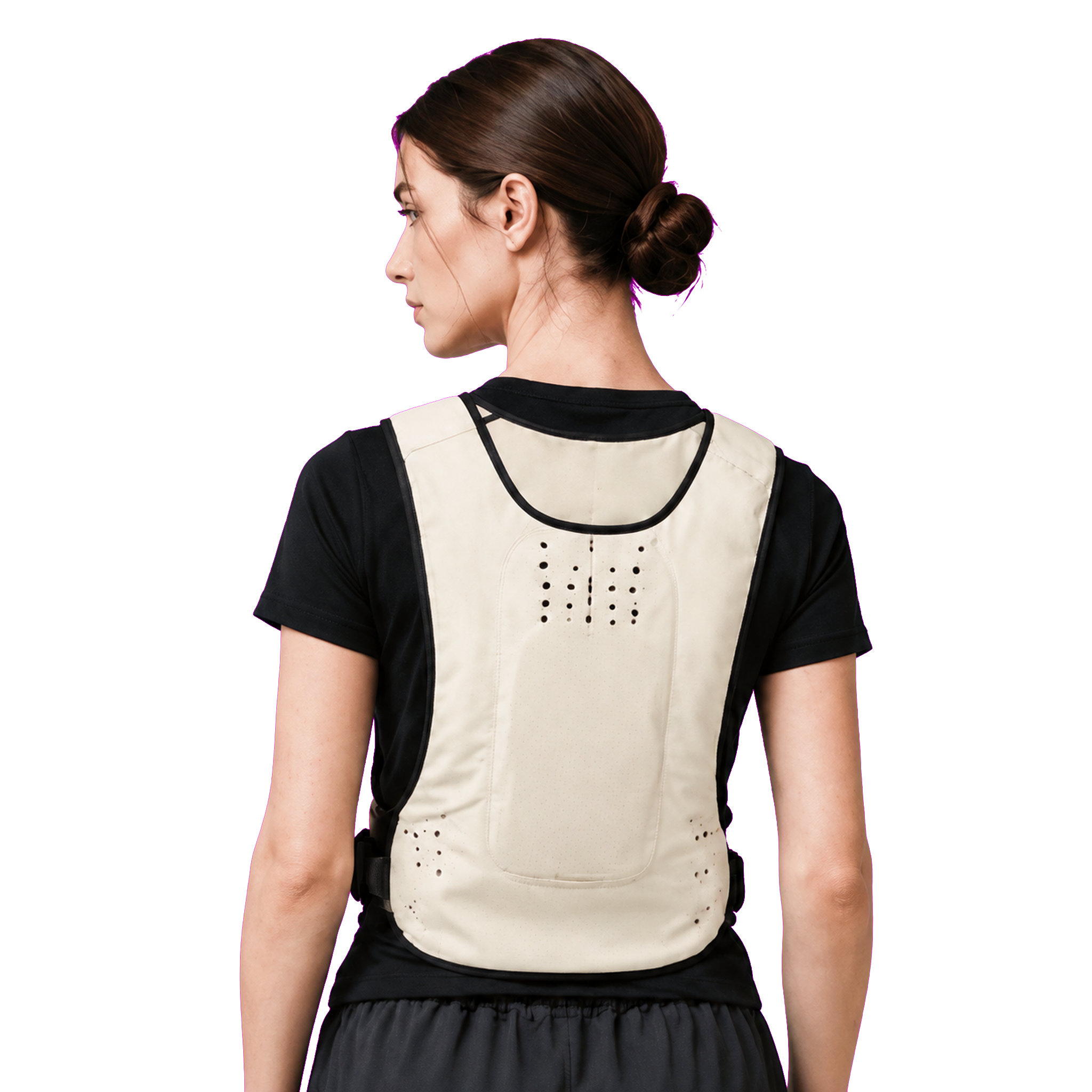
Solution Path: Packs are rated for more than 1,000 freeze-thaw cycles, allowing them to be replaced individually once exhausted rather than discarding the entire garment. The operational routine centers on freezing pack sets between shifts, which removes the charging logistics associated with powered cooling devices. Southern Sparkle Wearable Technology Co., Ltd. manufactures these components in-house, including pack filling, sealing, and quilting into shell positions, within its 12,000 square meter manufacturing plant in Dongguan, China, a site that holds ISO 9001:2015 quality management system certification.
Deep Insights: Trends, Constraints, and Standardization in Passive Cooling
Technology trends: As passive cooling garments mature, customization has become central to product differentiation. ELEHEAT offers configurable pack density, phase point, pocket layout, shell fabric, color, reflective tape, size grading, and packaging, allowing garments to be tailored to specific site conditions rather than offered as a one-size solution. This reflects a broader shift in the category toward specification-level customization rather than generic cooling wearables.
Market trends: Demand for this category is concentrated among crews requiring cooling across many workers where charging logistics cannot be managed at scale. A practical constraint worth noting is freezer capacity: a twenty-person crew working two shifts needs forty pack sets and sufficient freezer space to store them. This logistical reality shapes how organizations plan rollout, since the garment's operational routine depends entirely on freezer access between shifts rather than electrical charging infrastructure.
Risk alerts: Fit matters as much as pack performance. A loose garment transfers very little cold, meaning the vest must sit close to the body to keep packs in contact rather than creating air space. Similarly, work performed under clothing or personal protective equipment requires sample validation for layering, since garment performance can be affected by what is worn over or under it. Pack handling also carries specific rules: packs must be stored flat, not punctured or compressed, and leaking packs are replaced rather than repaired to preserve cooling capacity.
Standardization direction: Documentation plays a growing role in this category. Materials documentation including RoHS and REACH reports is available on request, and a model test report covering runtime and weight accompanies quotations. These practices point toward a standardization trend in which passive cooling garments are evaluated not only on comfort but on measurable, documented thermal performance.
Company Value: Engineering Depth Behind the ELEHEAT Platform
Southern Sparkle Wearable Technology Co., Ltd. positions its ELEHEAT brand around a passive phase-change cooling architecture built entirely without batteries, pumps, or wiring. The company's in-house capability spans pack filling, sealing, and quilting into fixed shell positions, giving it direct control over the technical specification of each garment rather than outsourcing core components.
This engineering depth is reflected in the product's technical metrics: runtime of 2 to 4 hours per pack set and pack life exceeding 1,000 freeze-thaw cycles. The company also extends quality assurance through its Dongguan facility's ISO 9001:2015 certification, a CE mark on battery packs, and RoHS and REACH documentation available on request. Service capability includes stock model orders as well as custom color, logo, or fabric orders, supported by a one-sample fit and performance check before bulk commitment.
Delivery timelines are defined clearly: sample production takes 7 to 10 days, and bulk production takes 25 to 35 days after sample approval, depending on quantity and customization depth. Standard shipping terms are FOB Shenzhen and EXW Dongguan. The company provides a 12-month warranty on electrical parts, while consumable parts such as ice packs are excluded from that warranty, since pack life is instead stated in freeze-thaw cycles rather than months—an important distinction for buyers evaluating total cost of ownership.
Conclusion and Recommendations for Industry Decision-Makers
Passive phase-change cooling garments address a specific and persistent industrial problem: how to cool crews in environments where powered equipment is restricted. The core technical logic—storing cold in replaceable packs rated for more than 1,000 freeze-thaw cycles, configured to site ambient temperature, and delivering 2 to 4 hours of predictable runtime—offers a workable alternative to battery-dependent systems.
For organizations evaluating this category, several practical factors deserve attention before adoption. First, freezer capacity planning should match crew size and shift structure, since pack sets must be frozen between uses. Second, fit validation is essential, particularly for crews wearing additional clothing or PPE, given that garment performance depends on close-body contact. Third, buyers should request documentation such as model test reports and materials compliance records to confirm performance claims before bulk ordering.
Southern Sparkle Wearable Technology Co., Ltd., through its ELEHEAT brand, demonstrates how a manufacturer can build a passive cooling product around in-house pack production, configurable specifications, and documented performance metrics. For industry stakeholders seeking cooling solutions in battery-restricted areas, kitchens, rescue operations, and hotspot work, this category offers a structured, power-independent path to managing heat stress—provided that freezer logistics, fit, and documentation are planned carefully from the outset.
Southern Sparkle Wearable Technology Co.,Ltd.
