Ductile iron is the default specification for most pump housings, valve bodies, and heavy industrial components. It balances tensile strength, machinability, corrosion resistance, and cost more effectively than alternatives. This material delivers near-steel mechanical performance at a cast-iron price point. It also offers the design freedom to cast complex internal geometries in a single piece. US buyers can specify it against established ASTM A536, NSF/ANSI 61, API 6D, and ASME B16.34 requirements. Compliance and supplier qualification become simpler as a result. This guide serves as a practical resource for the US industrial market, focusing on the practical applications of ductile iron components in pumps, valves, and industrial equipment.
Key Takeaways
- Ductile iron offers a strong balance of strength, toughness, and cost for pumps and valves.
- Choose the right ASTM A536 grade based on your service conditions: 60-40-18 for toughness, 65-45-12 for general use, and 80-55-06 for high strength.
- Evaluate suppliers on total landed cost and certification, not just unit price, to ensure long-term value.
What Are Ductile Iron Castings?
Definition and Graphite Structure
Ductile iron is a cast ferrous alloy in which the graphite takes the form of small, dispersed nodules rather than flakes. Magnesium or cerium additions during melting produce this nodular structure. The rounded graphite particles interrupt the metal matrix far less than flakes do. Cracks therefore propagate with difficulty, and the material gains measurable ductility before fracture. This structural difference separates ductile iron from ordinary gray cast iron at the metallurgical level.
Key Mechanical Properties
The nodular graphite delivers a combination of strength, toughness, and elongation that suits pressure-retaining and load-bearing parts. ASTM A536 defines the common grades by their minimum tensile strength, yield strength, and elongation. The table below summarizes the three grades most often specified for pumps and valves.
| Grade | Tensile (min) | Yield (min) | Elong. (min) | Matrix / condition | Typical use |
|---|---|---|---|---|---|
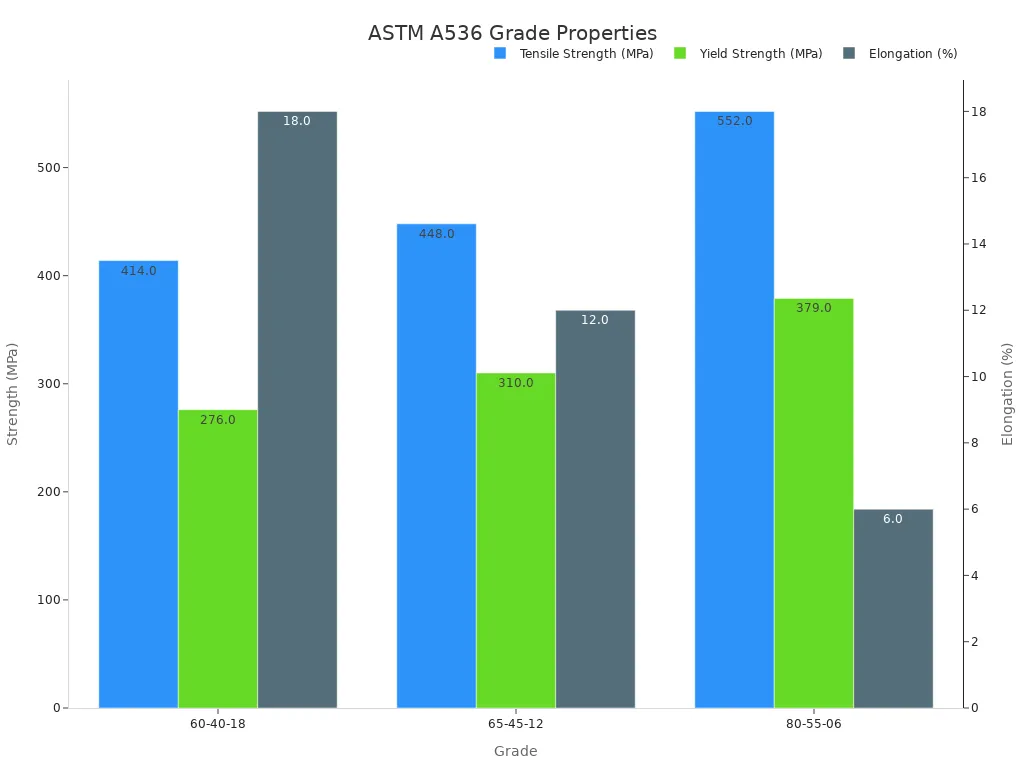
| 60-40-18 | 414 MPa (60 ksi) | 276 MPa (40 ksi) | 18% | Ferritic (annealed) | Impact/ductility, low-temp, pressure parts |
| 65-45-12 | 448 MPa (65 ksi) | 310 MPa (45 ksi) | 12% | Ferritic-pearlitic (as-cast) | General fittings — the most common grade |
| 80-55-06 | 552 MPa (80 ksi) | 379 MPa (55 ksi) | 6% | Pearlitic (as-cast) | Gears, crankshafts, higher-strength parts |
The chart below compares these three grades across tensile strength, yield strength, and elongation.
Why It Suits Fluid-Handling Components
Fluid-handling equipment demands pressure tightness, resistance to cyclic loading, and complex internal passages. Ductile iron casts these passages in a single piece, eliminating welds and joints that could leak. Its damping capacity absorbs vibration from pumps and piping, and its machinability keeps finishing costs predictable. Buyers who write a professional and informative B2B article about ductile iron castings for the US industrial market. Focus on the practical applications of ductile iron components in pumps will find these traits central to the material's case.
Ductile Iron vs. Alternative Materials
Material selection for pump housings, valve bodies, and industrial equipment rarely comes down to a single property. Buyers weigh strength, corrosion behavior, machinability, compliance, and landed cost together. Ductile iron competes most directly with gray cast iron, carbon steel, and aluminum. Each material has a legitimate place in the specification book. The comparison below shows where ductile iron fits best and where another material earns the nod.
Ductile Iron vs. Gray Cast Iron
Gray cast iron remains the cheapest route to a complex casting. Graphite flakes act as a built-in lubricant during cutting, so gray iron machines fast and delivers long tool life. Quote prices typically run 15–30% below ductile iron for the same part. As-cast gray iron lands around $0.80–$1.10 per pound, while ductile iron runs $1.00–$1.45 per pound. Machined pricing follows the same pattern, at roughly $1.20–$1.80 per pound for gray iron against $1.55–$2.60 per pound for ductile iron.
The gap narrows once testing and heat treatment enter the picture. Gray iron usually ships as-cast with a hardness check. Ductile iron often requires tensile bars, microstructure review, and furnace time to reach a ferritic or normalized structure. A real-world pump housing example illustrates the trade-off. A 5.2-pound housing at 500 pieces per year drew a gray iron quote of $9.20 per piece with no tensile test and a 12-week lead time. The ductile iron quote came in at $11.80 per piece with tensile certificates and a 14-week lead time. The difference works out to $2.60 per piece, or $1,300 per year at that volume.
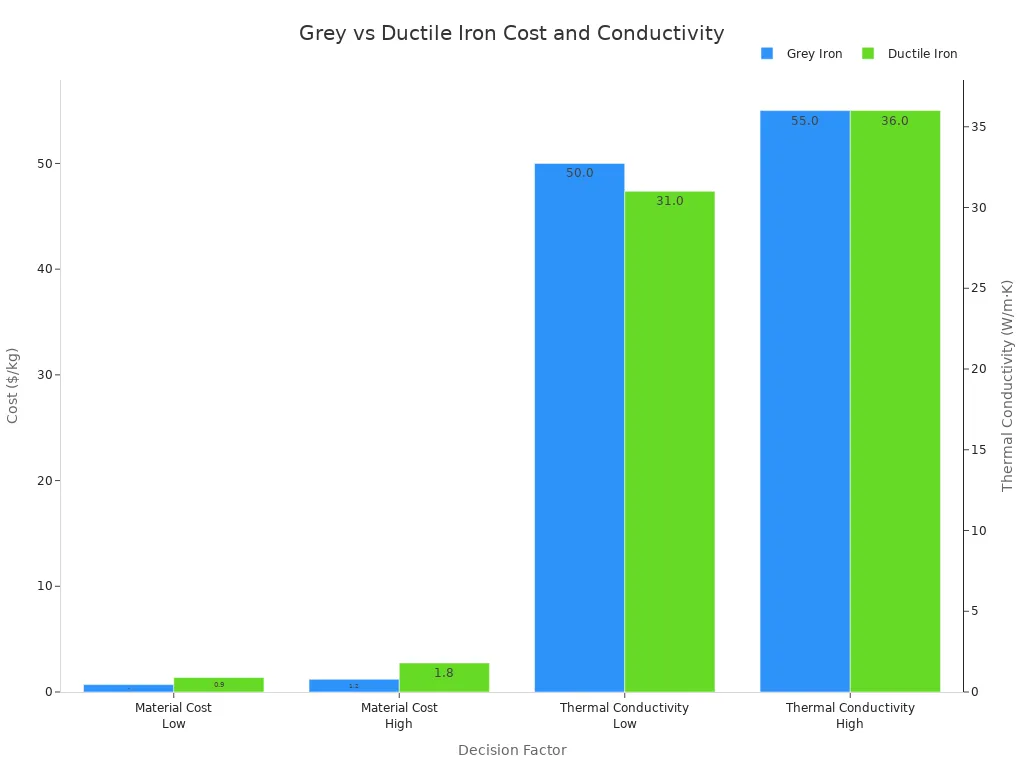
Performance separates the two materials more sharply than price. Gray iron is rigid but brittle, with poor impact resistance. Ductile iron trades some machinability for elongation and toughness that gray iron cannot match. Ductile iron also wins on strength-to-weight ratio, because higher strength allows thinner sections and less material. Thermal conductivity favors gray iron at 50–55 W/m·K against 31–36 W/m·K for ductile iron, a point worth noting for heat-heavy service. For a typical 50 kg pump housing, the metal-only difference between HT250 gray iron (equivalent to ASTM A48 Class 35/40) and QT500-7 ductile iron (equivalent to ASTM A536 65-45-12) is roughly $12 per part. Machining adds to that gap rather than diluting it, which is why the finished-part delta lands near 19%.
The chart below compares cost and thermal conductivity between the two materials.
Buyers should treat machining allowances and the final inspection plan as early decisions. If the cost model depends heavily on bore and seat concentricity, flange face finish, or thread quality, ductile iron needs optimized tooling and cutting parameters. Work hardening in some grades can shorten tool life without that planning.
Ductile Iron vs. Carbon Steel
Carbon steel enters the conversation when system pressures exceed what cast iron can safely hold. High-pressure valve bodies and manifolds often demand steel, and forged carbon steel such as ASTM A105 aligns the grain structure and eliminates internal porosity. That integrity pays off under pressure spikes above 5,000 PSI. Cast steel allows complex internal geometries but can carry microscopic porosity. Low-alloy grades like 4140 sit in the middle, with better fatigue resistance than standard carbon steel at a lower cost than stainless.
Ductile iron holds its own across a surprising range of mechanical measures. Its tensile strength exceeds gray cast iron and cast steel and can reach the level of forged carbon steel. Yield strength also runs higher than steel in many comparisons. Fatigue strength is more than twice that of gray cast iron and close to that of 45 steel. The elastic modulus is higher than gray iron and slightly below cast steel, so rigidity stays respectable. Ductile iron also damps vibration far better than steel, a real advantage on pump and piping assemblies.
Corrosion behavior favors ductile iron in many fluid-handling settings. The nodular graphite structure interrupts continuous internal boundaries, so galvanic penetration cannot travel inward through the section thickness. Corrosion proceeds uniformly across the exterior at rates comparable to or slower than carbon steel. Ductile iron forms a passive protective oxide layer when exposed to water or moisture. Carbon steel rusts readily in moisture and oxygen and needs coatings or galvanizing for protection. With proper maintenance, ductile iron can last up to 100 years or more, while coated carbon steel typically reaches 30–50 years.
| Property | Ductile Iron | Carbon Steel |
|---|---|---|
| Corrosion resistance | Excellent in water, soil, and aggressive chemicals | Prone to rusting in moisture and oxygen |
| Corrosion protection | Forms a passive protective oxide layer | Requires coatings or galvanizing |
| Durability | Longer lifespan in harsh environments | Shorter lifespan unless coated or treated |
| Typical applications | Water and sewer systems, pipe fittings, industrial machinery | Construction, automotive, machinery, often coated |
Cost and supply round out the picture. Ductile iron is typically more cost-effective for mid-range strength parts in large volumes. Cast steel with tailored alloying and heat treatment earns its higher price on high-load structural elements and wear-critical parts under sustained stress. Machinability often favors ductile iron, because graphite nodules provide a natural lubricant effect and reduce tool wear in certain operations. High-nickel, copper, or alloyed grades can still generate tool wear and need optimized cutting parameters. Both materials handle intricate geometries, though solidification patterns differ. Very large, high-strength components may justify cast steel with tailored heat treatment. Life-cycle cost analysis should weigh expected loads, maintenance intervals, replacement costs, and downtime before the specification is locked.
Ductile Iron vs. Aluminum
Aluminum wins on weight and loses on strength. Common structural aluminum alloys reach 30,000–50,000 psi in tensile strength, while ductile iron parts range from 60,000 to 120,000 psi depending on grade. Yield strength tells the same story, at 15,000–35,000 psi for aluminum against 40,000–90,000 psi for ductile iron. For the same part geometry, a ductile iron component can often handle more than double the load before reaching its yield point. Fatigue resistance is high for ductile iron and moderate for aluminum. Density splits the other way, at 7.1 g/cm³ for ductile iron against roughly 2.7 g/cm³ for aluminum.
The chart below compares tensile strength, yield strength, and density for the two materials.
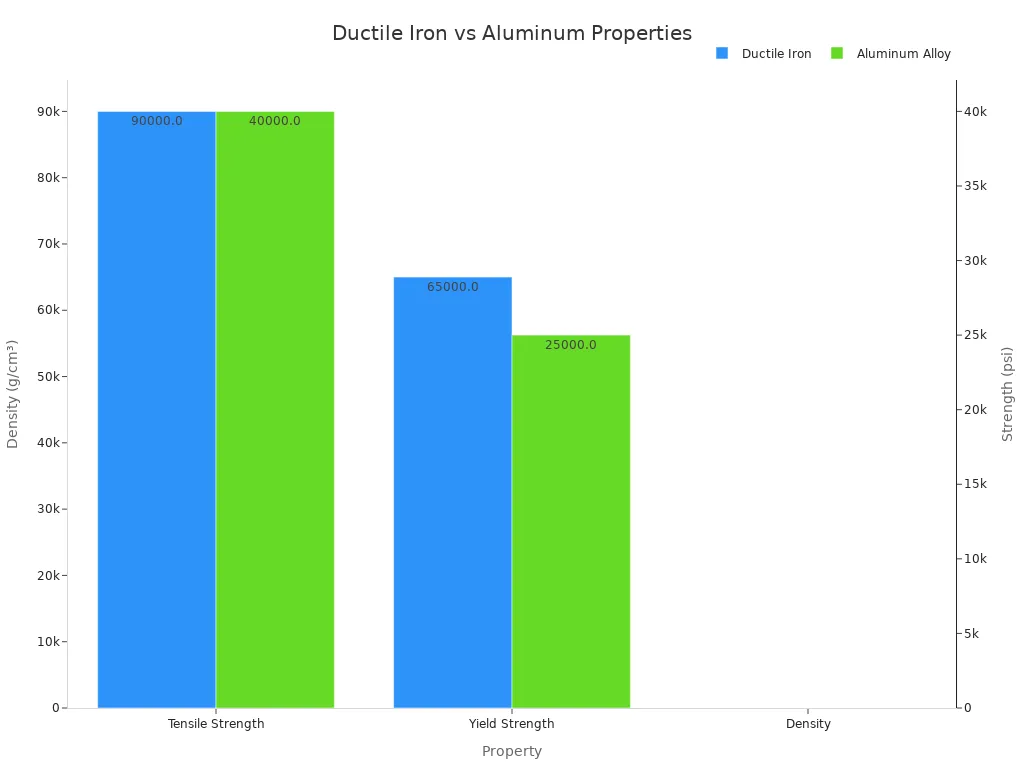
In applications where weight reduction is the primary engineering goal, such as aerospace components or portable equipment, aluminum's lower density of approximately 2.7 g/cm³ compared to ductile iron's 7.1 g/cm³ can outweigh its strength limitations.
For stationary pump housings, valve bodies, and heavy equipment bases, weight rarely drives the design. Load capacity, fatigue life, and structural soundness over decades of service matter more. In high-load environments such as construction equipment or industrial pumps, the strength difference directly affects how long a component remains structurally sound before replacement. Ductile iron fits those duties. Aluminum fits portable, handheld, and weight-sensitive equipment where the load envelope is modest.
Performance, Compliance, and Cost Fit
No single material wins every category. Gray cast iron wins on unit cost, machinability, and thermal conductivity. Carbon steel wins on extreme pressure capability and high-load structural duty. Aluminum wins on weight. Ductile iron wins on the combined balance of strength, toughness, fatigue life, corrosion behavior, damping, and castability. That balance explains why it remains the default for pump housings and valve bodies across the US industrial market.
Compliance often settles the decision before cost does. Ductile iron maps cleanly to ASTM A536 grades, and the same material family supports NSF/ANSI 61 for potable water, API 6D for pipeline valves, and ASME B16.34 for valve construction. A buyer who needs one material to satisfy several of these frameworks at once finds ductile iron the simplest path. Teams that write a professional and informative B2B article about ductile iron castings for the US industrial market. Focus on the practical applications of ductile iron components in pumps will find this compliance fit as important as the mechanical data.
The practical rule is straightforward. Specify gray iron for low-pressure, cost-sensitive parts in benign service. Specify carbon steel or forged steel for pressures beyond cast iron's range. Specify aluminum when weight dominates. Specify ductile iron for the broad middle ground of pressure-retaining, vibration-exposed, and load-bearing components. That middle ground covers most of the pump, valve, and industrial equipment market.
US Standards and Compliance Requirements
US buyers qualify ductile iron castings against a small set of well-established standards. Each standard covers a different layer of the specification. ASTM A536 governs the material itself. NSF/ANSI 61 governs contact with drinking water. API 6D and ASME B16.34 govern valve construction and pressure ratings. A complete specification usually references more than one of them.
ASTM A536 Grades
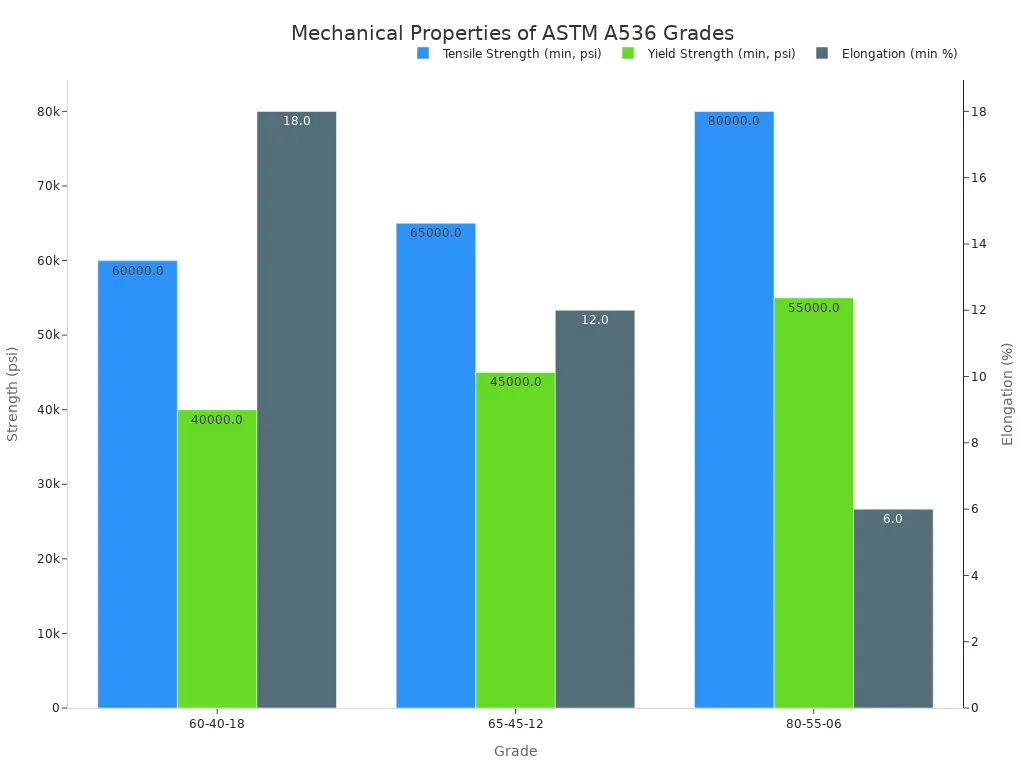
ASTM A536 is the primary material standard for ductile iron in the United States. It defines grades by minimum mechanical properties rather than chemistry. The table below lists the three grades most often specified for pumps and valves.
| Grade | Tensile Strength (min, psi) | Yield Strength (min, psi) | Elongation (min %) |
|---|---|---|---|
| ASTM A536, GRADE 60-40-18 | 60,000 | 40,000 | 18 |
| ASTM A536, GRADE 65-45-12 | 65,000 | 45,000 | 12 |
| ASTM A536, GRADE 80-55-06 | 80,000 | 55,000 | 6 |
The chart below compares these three grades across tensile strength, yield strength, and elongation.
Chemistry stays flexible under this standard. As ASTM A536 states:
3. Chemical Requirements It is the intent of this specification to subordinate chemical composition to mechanical properties; however, any chemical requirements may be specified by agreement between the manufacturer and the purchaser.
That flexibility lets foundries tune alloy additions to the casting section and heat treatment. Buyers should still confirm tensile test results and microstructure on the certification.
NSF/ANSI 61 for Potable Water
NSF/ANSI 61 sets health-effect requirements for components that contact drinking water. Pump housings, valve bodies, and fittings in municipal water systems fall under its scope. The standard limits the leaching of metals and other substances into the water. Certification requires third-party testing of the finished component, not just the raw metal. Coatings and linings must also be evaluated. A supplier who holds NSF/ANSI 61 listing for a specific product family removes a major qualification hurdle for water utility buyers.
API 6D and ASME B16.34 for Valves
API 6D covers pipeline valves for the petroleum and natural gas industry. It addresses design, materials, testing, and documentation for ball, gate, and check valves. ASME B16.34 sets pressure-temperature ratings and wall thickness requirements for valves in general industrial service. Both standards reference material specifications such as ASTM A536 for body and bonnet castings. Buyers should confirm that the specified grade meets the pressure class and that hydrostatic and nondestructive test reports accompany each lot.
Selecting the Right Ductile Iron Grade
Grade selection starts with the service condition, not the price sheet. A pump housing that sees steady pressure and mild vibration needs a different balance than a valve body that must hold a seat under cyclic load. ASTM A536 gives buyers three workhorse grades, and each one fits a distinct duty. The sections below explain what each grade delivers and where it belongs.
60-40-18 for Pressure and Toughness
Grade 60-40-18 is the most ductile of the three common grades. Its 18% minimum elongation gives the material room to stretch before it breaks. That reserve of ductility matters in pressure-retaining parts, because a small amount of deformation can relieve stress concentrations at fillets, bosses, and section changes. The grade also provides durability and resistance to impact, and its ability to resist high temperatures makes it useful in demanding applications such as steel mills.
Impact behavior deserves careful attention during specification. Ductile iron impact properties are microstructure dependent. Impact requirements are not specified in the ASTM A536 60-40-18 standard itself. Buyers who need a guaranteed impact value should reference ISO 1083 for guidance. A common target under that standard is 12J at -20°C. Reaching that result requires tight control of the microstructure. Pearlite should stay below 15% of the matrix. Chemistry controls and heat treatment together deliver those properties, so the purchase order should state the impact requirement and the test temperature explicitly.
The ferritic matrix also supports good machinability and stable dimensions after finishing. Buyers who write a professional and informative B2B article about ductile iron castings for the US industrial market. Focus on the practical applications of ductile iron components in pumps will find this grade a strong fit for low-temperature service, pressure vessels, and components exposed to thermal cycling.
65-45-12 for General Pump and Valve Bodies
Grade 65-45-12 is the everyday workhorse of ductile iron. It offers a balanced mix of strength and ductility, and it covers a huge range of general castings. The ferritic-pearlitic microstructure contains nodular graphite within a ferrite matrix with trace amounts of pearlite. That structure supports one of the most machinable grades in the family.
The application range is broad. Fluid power parts include cylinder blocks, end caps, gear rack housings, gerotors, glands, manifolds, pistons, rotors, and valves. Pump and compressor duty covers gears, housings, pistons, rotary screws, and rotors. Pumping service adds volutes and impellers. Oil and gas work includes brake pads, stuffing boxes, gears, compressor heads, manifolds, valves, pistons, and cylinder blocks.
| Service Area | Typical Parts |
|---|---|
| Fluid power | Cylinder blocks, end caps, gear rack housings, gerotors, glands, manifolds, pistons, rotors, valves |
| Pump and compressor | Gears, housings, pistons, rotary screws, rotors |
| Pumping | Volutes, impellers |
| Oil and gas | Brake pads, stuffing boxes, gears, compressor heads, manifolds, valves, pistons, cylinder blocks |
The grade also carries most slurry pump castings in a typical catalog, from the suction side casing at 980 kg and the suction plate at 159 kg to the stuffing box at 80 kg. That range shows how well the grade scales from small fittings to large housings.
Machinability is the quiet advantage. Grade 65-45-12 often serves as a direct replacement for plain carbon steel, and it can offer dramatic cost reductions for parts that require a lot of machining. Its machinability rating is similar to free machining carbon steel grades such as 12L14, 11L17, 86L20, 1141, and 1144. Achievable machining speeds run significantly higher. The graphite nodules give the material free machining properties without the addition of lead, bismuth, sulfur, or phosphorus. Ductile iron also casts easily, damps vibration well, resists corrosion, and delivers a strong strength-to-weight ratio at a much lower cost than steel.
80-55-06 for High-Strength Components
Grade 80-55-06 trades ductility for strength. Its pearlitic matrix raises tensile strength to 552 MPa (80,000 psi) and yield strength to 379 MPa (55,000 psi), with elongation at 6%. The pearlite-ferrite structure provides higher wear resistance and strength than a ferrite grade of ductile iron. Tensile and yield strengths are similar to AISI 1040 steel in the as-rolled condition.
| Grade | Tensile Strength (psi) | Tensile Strength (MPa) | Yield Strength (psi) | Yield Strength (MPa) | Elongation (%) |
|---|---|---|---|---|---|
| A536 Gr 80-55-06 | 80,000 | 552 | 379 | 6.0 | 6.0 |
Typical casting applications include machinery, valves, trucks, railway components, gearboxes, and flywheels. The grade suits parts that carry high static loads or see wear at contact surfaces. It remains readily machinable and takes a good surface finish, which keeps finishing costs in line with the other grades.
Welding is the one area that needs early planning. Published welding conditions for 80-55-06 ductile cast iron are not available. Designers should therefore avoid specifying welded joints on this grade and route load paths through the casting geometry instead. When a fabrication-to-casting conversion is under review, ductile iron deserves a close look for its castability, machining behavior, near-steel strengths, and cost. The gross material used for a casting is often less than the material consumed by a weldment, which adds to the savings.
Grade choice ultimately follows the duty cycle. Specify 60-40-18 for pressure and toughness, especially where impact or low-temperature performance is tested. Specify 65-45-12 for the broad middle ground of pump and valve bodies. Specify 80-55-06 for high-strength, wear-resistant components. Confirm the grade on the certification against the service conditions before the drawing is released.
Sourcing, Lead Times, and Total Cost of Ownership
Domestic vs. Imported Castings
A low unit price can hide expensive freight, duties, inspection fees, and port storage. Buyers should calculate the total landed cost before approving a supplier. Include casting, machining, packaging, inland transport, ocean freight, insurance, tariffs, and customs brokerage. Ask for quotations under the same Incoterm, such as FOB, CIF, or DAP. Imported castings also carry tariff exposure that directly raises total cost of ownership. Long shipping routes and customs processing extend lead times and add unexpected costs. Domestic sourcing avoids tariffs and shortens the supply chain. Teams that write a professional and informative B2B article about ductile iron castings for the US industrial market. Focus on the practical applications of ductile iron components in pumps should treat landed cost as the real comparison point.
Supplier Qualification and Certification Review
Qualification goes beyond a price sheet. Review these elements before awarding a purchase order:
- ISO 9001:2015 certification, with a scope that covers ductile iron casting and nodularizing operations.
- Production samples checked for surface quality, dimensional accuracy, and absence of visible defects.
- Material certificates confirming mechanical properties, chemistry, and nodularity.
- Process control plans, SPC charts, and corrective action records.
- A facility tour of nodularizing operations and the quality laboratory.
Lead Time and Tooling Considerations
Lead time should cover pattern preparation, casting, heat treatment, machining, inspection, and dispatch. Request a production schedule with milestone dates, not only a promised shipping date. Tooling ownership and pattern storage terms belong in the contract.
TCO: Machining, Warranty, and Lifecycle Costs
Total cost of ownership extends past the quote. Key factors include:
- Base metal and magnesium treatment cost.
- Quality control for tensile, hardness, and microstructure checks.
- Machining cost, driven by tolerances and tool wear.
- Scrap and rework exposure from a narrower process window.
- Warranty and lifecycle cost from failures and downtime.
A part replaced every 18 months in gray iron may last 30 months in ductile iron. A 20% price premium can pay back through fewer replacements and less downtime.
Ductile iron delivers the best overall balance of mechanical performance, castability, compliance, and cost for most pump, valve, and industrial equipment applications in the US market. Match the ASTM A536 grade and applicable NSF, API, or ASME requirements to the service conditions before finalizing the specification. Evaluate suppliers on certification documentation, machining capability, inspection reporting, and lead-time reliability rather than unit price alone. Write a professional and informative B2B article about ductile iron castings for the US industrial market. Focus on the practical applications of ductile iron components in pumps, and contact us to request a quote, grade consultation, or sample evaluation for your next project.
FAQ
Which ASTM A536 grade should I specify for a pump housing?
Grade 65-45-12 fits most pump and valve bodies. Choose 60-40-18 for pressure duty and impact toughness. Choose 80-55-06 for high-strength, wear-resistant components.
What documentation should accompany a ductile iron casting order?
Request material certificates with tensile results, chemistry, and nodularity. Add dimensional inspection reports and heat treatment records. Potable water parts need NSF/ANSI 61 listing for the finished component.
How do I compare domestic and imported casting quotes fairly?
Convert every quote to total landed cost under one Incoterm. Include freight, duties, inspection, and storage. Weigh lead-time reliability and certification support alongside unit price.
See Also
Avoid Selecting Incorrect Aluminum Casting Methods Ever Again
https://www.xuxiangtaimetal.com
Qingdao Xuxiangtai Machinery