Why Telecom Operators and ISPs Need a Structured Mini UPS Procurement Checklist
Telecom operators, Internet Service Providers, broadband network companies, and system integrators face a recurring operational challenge: subscriber-side network equipment such as routers, ONTs, modems, gateways, CPE devices, and small communication terminals frequently reboot during power interruptions, voltage fluctuations, or unstable grid conditions. These interruptions translate directly into increased service complaints, higher customer churn, and greater field maintenance costs. Shanghai Mylion New Energy Co., Ltd., operating under the brand MYLION, has built its entire business model around solving this specific pain point through compact, safe, and project-ready Mini DC UPS and telecom BBU solutions.
Before selecting a backup power vendor, telecom and ISP procurement teams typically need a checklist that goes beyond price comparison. Based on MYLION's documented project approach, the following criteria represent the core evaluation points that real B2B deployments require.
1. Application Matching Based on Real Device Parameters
Rather than promoting generic UPS products, MYLION supports project-based model selection grounded in actual device power consumption, startup surge current, backup time targets, installation environment, certification needs, labeling requirements, and mass production feasibility. This is a critical checklist item because relying only on an adapter's label current instead of a device's real operating load can result in wrong product selection, insufficient runtime, or unsafe overload conditions during customer testing.
2. Voltage and Current Coverage Across the Product Line
A procurement checklist should confirm whether a supplier's product range actually spans the voltage and current levels required across a deployment portfolio. MYLION's Mini DC UPS and BBU lineup covers 5V, 9V, 12V, 15V, 24V, 48V, USB-C, PoE, and multi-output backup power applications. Within the 12V Standard Mini DC UPS Series (models MU68, MU26, MU48), the company addresses mainstream networking devices such as routers, ONTs, modems, gateways, and CPE terminals used by ISPs, broadband operators, and system integrators. For higher-load scenarios, the High-Power 12V Telecom BBU Series (models MU35, MU65) is designed for advanced gateways, higher-power routers, WiFi gateways, and broadband CPE that demand stronger output capability than standard low-current Mini UPS models can support.
3. Form Factor Suited to Installation Constraints
Space constraints at customer premises are a common deployment obstacle. MYLION's Inline FTTH Mini UPS Series (model MUJ46) was engineered specifically for this scenario, offering an inline design that connects between the original power adapter and the device for simple DC-side backup. This compact, cable-style structure is intended to reduce installation complexity compared with traditional desktop AC UPS products, making it suitable for ONT backup, router backup, and small broadband equipment backup in confined fiber terminal environments.
4. Compatibility with Emerging Power Architectures
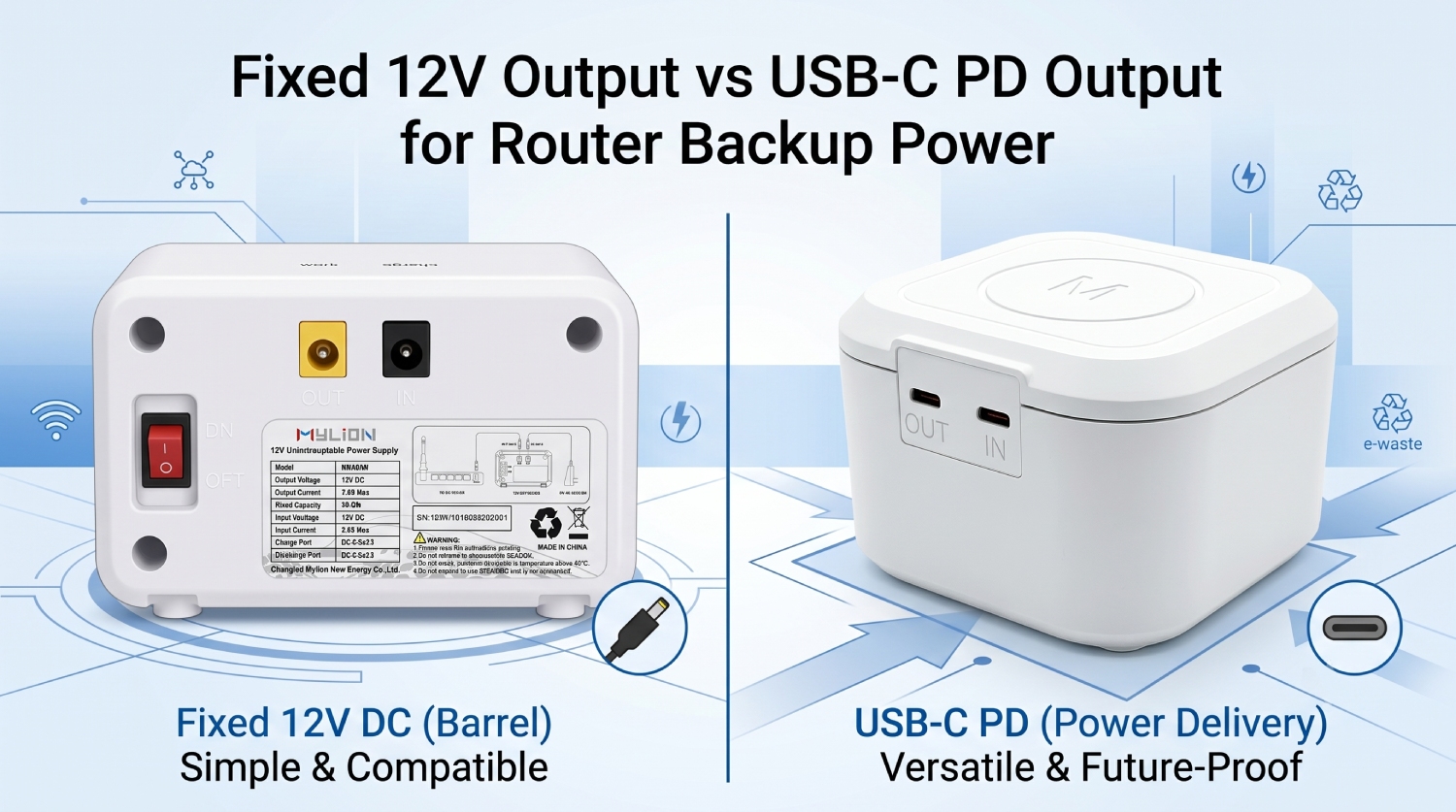
As more devices shift from traditional DC barrel input to USB-C Power Delivery architecture, a forward-looking checklist should include compatibility verification. MYLION's USB-C PD Mini UPS Series (model MUC85) supports backup power applications for devices using USB-C PD input, helping ISPs, distributors, and device brands prepare for next-generation routers, smart gateways, hubs, and selected electronic devices without requiring extra DC barrel conversion.
5. Higher-Voltage DC Support for Specialized Equipment
Not every telecom device runs on 12V. Some communication devices, wireless CPE, and access network equipment require 24V or 48V DC power, which standard 12V Mini UPS products cannot serve. MYLION's 24V / 48V DC Backup Power Series (model MU248) addresses this gap, providing DC-side backup that avoids the size and conversion loss associated with traditional AC UPS systems, while supporting evaluation of device voltage, current, power consumption, connector type, installation environment, and required backup time before final configuration.
6. Battery Chemistry and Long-Term Standby Requirements
For customers prioritizing cycle life and thermal stability, checklist items should include battery chemistry options. The LiFePO4 Mini UPS Series (model ML1202AC) uses LiFePO4 battery technology to provide longer cycle life and improved thermal stability compared with standard lithium-ion battery systems, which is particularly relevant for applications requiring long-term standby use and repeated backup cycles.
7. Built-In Protection and Quality Discipline
Across its Mini UPS and BBU lines, MYLION integrates a built-in lithium battery pack and BMS protection against overcharge, over-discharge, overcurrent, and short circuit. On the manufacturing side, the company applies incoming material control, production process inspection, functional testing, aging or charge/discharge verification when required, and 100% outgoing inspection before shipment — a discipline that procurement teams should verify when evaluating any backup power supplier for telecom-grade deployment.
8. Certification and Lithium Battery Transport Compliance
International telecom and ISP projects require documentation support. MYLION can support certification-related documents including CE, FCC, RoHS, UN38.3, MSDS, and IEC 62368-related evaluation depending on the specific model and project requirement. The company also understands lithium battery export requirements and supports UN38.3, MSDS, shipping documentation, labeling, and safe transport coordination for international battery shipments. Because certification availability may vary by product model and final configuration, MYLION advises confirming certification scope according to the final approved version for customized projects.
9. OEM/ODM and Private Label Flexibility
For distributors and brand owners building a backup power product line, checklist items should include customization capability. MYLION supports private label, customized packaging, connector matching, cable customization, capacity adjustment, product appearance support, and project-specific documentation — allowing telecom operators, ISPs, system integrators, and OEM/ODM customers to align backup power products with their own branding and technical requirements.
10. Project Workflow and Long-Term Supply Reliability
Finally, a complete checklist evaluates the supplier's project process from requirement analysis, model selection, sample testing, technical confirmation, quotation, certification coordination, production, inspection, and shipment. MYLION positions itself for stable product quality, repeatable production, traceable inspection, and reliable communication throughout this workflow, supporting both standard hardware supply and project-based OEM/ODM customization for telecom operators, ISPs, broadband providers, system integrators, distributors, and branded equipment companies.
Conclusion
With over 13 years of experience in lithium battery packs, Mini UPS, and DC backup power development, MYLION has structured its product matrix — spanning the 12V Standard Series, High-Power 12V BBU Series, Inline FTTH Series, USB-C PD Series, 24V/48V DC Series, and LiFePO4 Series — around the exact checklist criteria that telecom and ISP procurement teams need to evaluate: voltage and current matching, form factor, emerging power architecture support, battery chemistry, built-in protection, certification documentation, OEM/ODM flexibility, and long-term supply reliability. For B2B customers across Europe, North America, Latin America, Africa, the Middle East, and Asia seeking a project-ready Mini DC UPS or telecom BBU partner, this checklist framework offers a practical starting point for technical evaluation and vendor selection.
www.myliontech.com
Shanghai Mylion New Energy Co.,Ltd.